




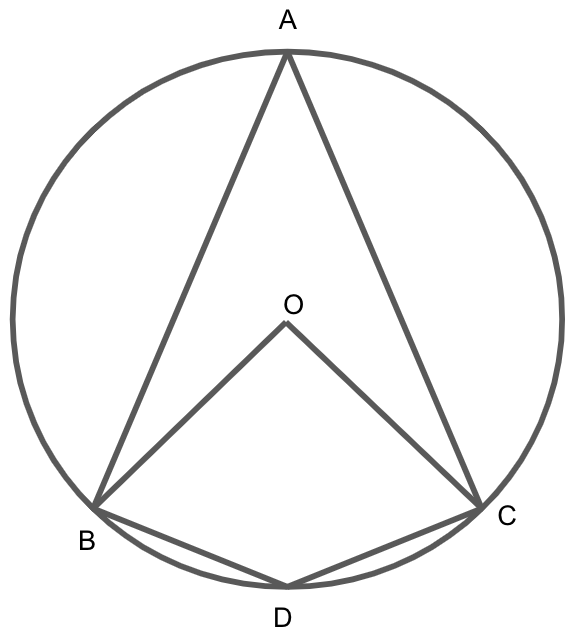
In the figure, O is the center of the circle and \[{\text{BA}} = {\text{AC}}\]. If \[\angle {\text{ABC}} = 50^\circ \], find \[\angle {\text{BOC}}\] and \[\angle {\text{BDC}}\].
Answer
 Verified
646.2k+ views
Hint: First we will join BC in the given diagram. Then we will consider triangle \[\Delta {\text{ABC}}\] and use that \[{\text{BA}} = {\text{AC}}\] to prove it is an isosceles triangle and the two angles inclined on equal and non-equal lines are same. Then we will use the angle sum property of triangle in the triangle ABC, where the sum of the interior angles is \[180^\circ \] and then use the central angle theorem to find the required values.
Complete step by step answer:
We are given that the O is the center of the circle, \[{\text{BA}} = {\text{AC}}\] and \[\angle {\text{ABC}} = 50^\circ \].
Joining BC in the given diagram, we get
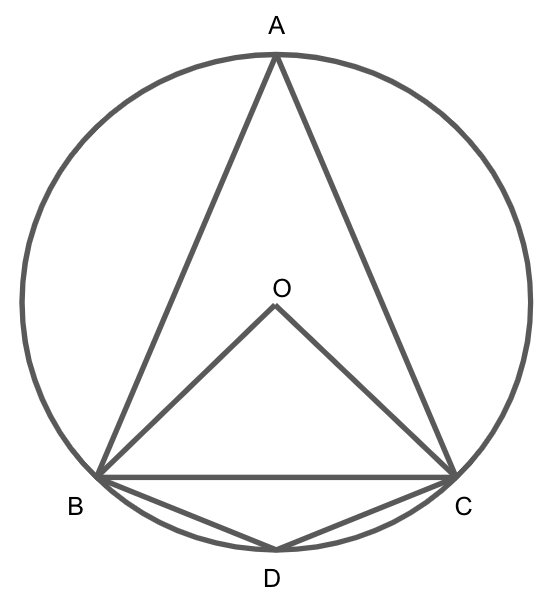
First, we will consider triangle \[\Delta {\text{ABC}}\].
We are given that \[{\text{BA}} = {\text{AC}}\], it means that triangle ABC is an isosceles triangle.
We know that in an isosceles triangle, the two angles inclined on equal and non-equal lines are the same.
\[
\Rightarrow \angle {\text{ABC}} = \angle {\text{ACB}} \\
\Rightarrow \angle {\text{ABC}} = 50^\circ \\
\]
Then we will use the angle sum property of triangle in the triangle ABC, where the sum of the interior angles is \[180^\circ \], we get
\[ \Rightarrow \angle {\text{ABC}} + \angle {\text{ACB}} + \angle {\text{BAC}} = 180^\circ \]
Substituting the value of \[\angle {\text{ABC}}\] and \[\angle {\text{ACB}}\] in the above equation, we get
\[
\Rightarrow 50^\circ + 50^\circ + \angle {\text{BAC}} = 180^\circ \\
\Rightarrow 100^\circ + \angle {\text{BAC}} = 180^\circ \\
\]
Subtracting the above equation by \[100^\circ \] on both sides, we get
\[
\Rightarrow 100^\circ + \angle {\text{BAC}} - 100^\circ = 180^\circ - 100^\circ \\
\Rightarrow \angle {\text{BAC}} = 80^\circ \\
\]
Now according to the central angle theorem, the central angle from any two points on the circle is always twice the inscribed angles from those two points, so we have
\[
\Rightarrow \angle {\text{BOC}} = 2 \times \angle {\text{BAC}} \\
\Rightarrow \angle {\text{BOC}} = 2 \times 80^\circ \\
\Rightarrow \angle {\text{BOC}} = 160^\circ \\
\]
Using the central angle theorem again, we get
\[
\Rightarrow \angle {\text{BOC}} = 2 \times \angle {\text{BDC}} \\
\Rightarrow 160^\circ = 2 \times \angle {\text{BDC}} \\
\]
Dividing the above equation by 2 on both sides, we get
\[
\Rightarrow \dfrac{{160^\circ }}{2} = \dfrac{{2 \times \angle {\text{BDC}}}}{2} \\
\Rightarrow 80^\circ = \angle {\text{BDC}} \\
\Rightarrow \angle {\text{BDC}} = 80^\circ \\
\]
Therefore, the measure of \[\angle {\text{BOC}}\] is \[160^\circ \] and \[\angle {\text{BDC}}\] is \[80^\circ \].
Note: In solving these types of questions, you should be familiar with the concept of angle of elevation and the tangential properties. Students should not use any other trigonometric functions like sine or cosine of the given angle because the given condition of the problem, which is provided to us, is of the height of the triangle and a base. So, do not take the sum equal to \[90^\circ \] instead \[180^\circ \], which is wrong.
Complete step by step answer:
We are given that the O is the center of the circle, \[{\text{BA}} = {\text{AC}}\] and \[\angle {\text{ABC}} = 50^\circ \].
Joining BC in the given diagram, we get
First, we will consider triangle \[\Delta {\text{ABC}}\].
We are given that \[{\text{BA}} = {\text{AC}}\], it means that triangle ABC is an isosceles triangle.
We know that in an isosceles triangle, the two angles inclined on equal and non-equal lines are the same.
\[
\Rightarrow \angle {\text{ABC}} = \angle {\text{ACB}} \\
\Rightarrow \angle {\text{ABC}} = 50^\circ \\
\]
Then we will use the angle sum property of triangle in the triangle ABC, where the sum of the interior angles is \[180^\circ \], we get
\[ \Rightarrow \angle {\text{ABC}} + \angle {\text{ACB}} + \angle {\text{BAC}} = 180^\circ \]
Substituting the value of \[\angle {\text{ABC}}\] and \[\angle {\text{ACB}}\] in the above equation, we get
\[
\Rightarrow 50^\circ + 50^\circ + \angle {\text{BAC}} = 180^\circ \\
\Rightarrow 100^\circ + \angle {\text{BAC}} = 180^\circ \\
\]
Subtracting the above equation by \[100^\circ \] on both sides, we get
\[
\Rightarrow 100^\circ + \angle {\text{BAC}} - 100^\circ = 180^\circ - 100^\circ \\
\Rightarrow \angle {\text{BAC}} = 80^\circ \\
\]
Now according to the central angle theorem, the central angle from any two points on the circle is always twice the inscribed angles from those two points, so we have
\[
\Rightarrow \angle {\text{BOC}} = 2 \times \angle {\text{BAC}} \\
\Rightarrow \angle {\text{BOC}} = 2 \times 80^\circ \\
\Rightarrow \angle {\text{BOC}} = 160^\circ \\
\]
Using the central angle theorem again, we get
\[
\Rightarrow \angle {\text{BOC}} = 2 \times \angle {\text{BDC}} \\
\Rightarrow 160^\circ = 2 \times \angle {\text{BDC}} \\
\]
Dividing the above equation by 2 on both sides, we get
\[
\Rightarrow \dfrac{{160^\circ }}{2} = \dfrac{{2 \times \angle {\text{BDC}}}}{2} \\
\Rightarrow 80^\circ = \angle {\text{BDC}} \\
\Rightarrow \angle {\text{BDC}} = 80^\circ \\
\]
Therefore, the measure of \[\angle {\text{BOC}}\] is \[160^\circ \] and \[\angle {\text{BDC}}\] is \[80^\circ \].
Note: In solving these types of questions, you should be familiar with the concept of angle of elevation and the tangential properties. Students should not use any other trigonometric functions like sine or cosine of the given angle because the given condition of the problem, which is provided to us, is of the height of the triangle and a base. So, do not take the sum equal to \[90^\circ \] instead \[180^\circ \], which is wrong.
Recently Updated Pages
Master Class 11 Social Science: Engaging Questions & Answers for Success

Master Class 11 English: Engaging Questions & Answers for Success
Master Class 11 Accountancy: Engaging Questions & Answers for Success
Master Class 11 Physics: Engaging Questions & Answers for Success
Master Class 11 Computer Science: Engaging Questions & Answers for Success
Master Class 11 Business Studies: Engaging Questions & Answers for Success
Trending doubts
Find the value of the expression given below sin 30circ class 11 maths CBSE
One Metric ton is equal to kg A 10000 B 1000 C 100 class 11 physics CBSE
Draw a diagram of nephron and explain its structur class 11 biology CBSE
10 examples of friction in our daily life
Proton was discovered by A Thomson B Rutherford C Chadwick class 11 chemistry CBSE
The teeth used for biting and cutting food are called class 11 biology CBSE