




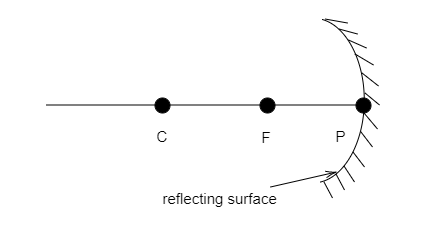
In the figure given below, what does P represent?
A) Principal focus
B) Principal axis
C) Pole
D) None of the above
Answer
 Verified
624.9k+ views
Hint: The given figure represents a concave mirror. Pole of a mirror refers to the centre of the mirror. In the figure, the point P lies on a line passing through the centre of the mirror and its centre of curvature C.
Complete step by step answer:
Step 1: Sketch the diagram and explain the different points represented.
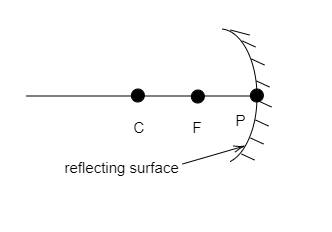
The above figure represents a concave mirror. The points marked as P, F and C represent the pole, principal focus and centre of curvature of the concave mirror.
The principal axis is a line passing through the geometric centre of the reflecting surface of the mirror. It also passes through the centre of curvature of the mirror. Here, the line on which the points P, F and C are marked is the principal axis. The object whose image is to be obtained can be placed anywhere along the principal axis.
In the above figure, the point P is positioned at the centre of the reflecting surface. Thus it represents the pole of the mirror. The pole of a mirror represents the geometric centre of the reflecting surface. It lies on the principal axis.
Therefore, the correct option is c.
Additional Information: A concave mirror is a spherical mirror with the reflecting surface on its inside. Concave mirrors are called converging mirrors as the light on striking the reflecting surface of the concave mirror will get reflected back and converge at a point.
When light rays parallel to the principal axis fall on the mirror, they get reflected and meet or converge at a particular point on the principal axis. This particular point on the principal axis is called the principal focus. It is denoted by F. The distance between the pole of the concave mirror (P) and its principal focus (F) is called the focal length of the concave mirror.
The point C in the figure represents the centre of curvature of the concave mirror. It refers to the centre of the sphere of which the mirror is a part of. The centre of curvature lies in front of the reflecting surface for a concave mirror. The distance between the pole of the mirror and the centre of curvature gives the radius of curvature R.
Note: The object can be placed anywhere along the principal axis except at the pole of the mirror. The pole is essentially a point inside the mirror. So to place an object at the pole you would have to break the mirror.
Complete step by step answer:
Step 1: Sketch the diagram and explain the different points represented.
Representation of a Concave Mirror
The above figure represents a concave mirror. The points marked as P, F and C represent the pole, principal focus and centre of curvature of the concave mirror.
The principal axis is a line passing through the geometric centre of the reflecting surface of the mirror. It also passes through the centre of curvature of the mirror. Here, the line on which the points P, F and C are marked is the principal axis. The object whose image is to be obtained can be placed anywhere along the principal axis.
In the above figure, the point P is positioned at the centre of the reflecting surface. Thus it represents the pole of the mirror. The pole of a mirror represents the geometric centre of the reflecting surface. It lies on the principal axis.
Therefore, the correct option is c.
Additional Information: A concave mirror is a spherical mirror with the reflecting surface on its inside. Concave mirrors are called converging mirrors as the light on striking the reflecting surface of the concave mirror will get reflected back and converge at a point.
When light rays parallel to the principal axis fall on the mirror, they get reflected and meet or converge at a particular point on the principal axis. This particular point on the principal axis is called the principal focus. It is denoted by F. The distance between the pole of the concave mirror (P) and its principal focus (F) is called the focal length of the concave mirror.
The point C in the figure represents the centre of curvature of the concave mirror. It refers to the centre of the sphere of which the mirror is a part of. The centre of curvature lies in front of the reflecting surface for a concave mirror. The distance between the pole of the mirror and the centre of curvature gives the radius of curvature R.
Note: The object can be placed anywhere along the principal axis except at the pole of the mirror. The pole is essentially a point inside the mirror. So to place an object at the pole you would have to break the mirror.
Recently Updated Pages
Master Class 11 English: Engaging Questions & Answers for Success

Master Class 11 Social Science: Engaging Questions & Answers for Success
Master Class 11 Maths: Engaging Questions & Answers for Success
Master Class 11 Biology: Engaging Questions & Answers for Success
Master Class 11 Physics: Engaging Questions & Answers for Success
Master Class 11 Chemistry: Engaging Questions & Answers for Success
Trending doubts
Explain the Treaty of Vienna of 1815 class 10 social science CBSE
What is the full form of POSCO class 10 social science CBSE
Define Potential, Developed, Stock and Reserved resources
The diagonals of a rhombus are 10cm and 24cm Find the class 10 maths CBSE
Fill the blanks with proper collective nouns 1 A of class 10 english CBSE
One number is chosen from numbers 1 to 200 Find the class 10 maths CBSE