




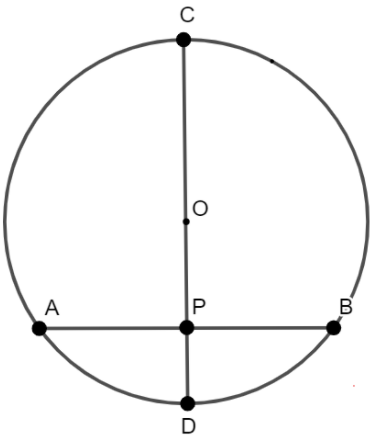
In the figure given below CD is the diameter of the circle which meets the chord AB at point P such that AP = BP = 12cm. If DP = 8cm, find the radius of the circle.
Answer
 Verified
618.6k+ views
Hint: We will first assume that the radius of the circle is r. So, we can say that OA =r, OB = r, OD = r. And, from the question, we know that DP = 8cm. So, OP = (r - 8)cm. Then, we will use the circle property that the line from the center of the circle to the chord AB such that it bisects the chord AB, then we can say that CD is perpendicular to AB. Then, we will find r by using the Pythagoras Theorem.
Complete step-by-step solution:
We are given a circle and we know from the question that CD is the diameter of the circle and AB is the chord of the circle and they intersect each other at point P such that AP = PB = 12 cm.
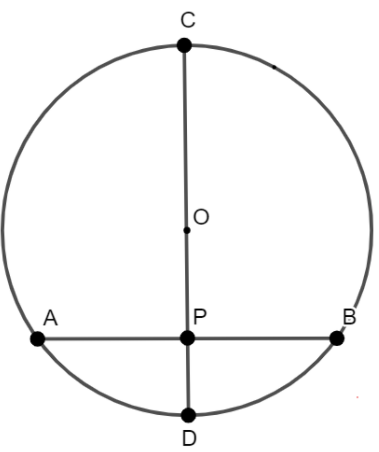
So, we can say that diameter CD bisects the chord AB at P.
And, from the properties of the circle, we know that if the diameter of the circle bisects the chord then the diameter must be perpendicular to the chord. So, we can say that the diameter CD is perpendicular to AB.
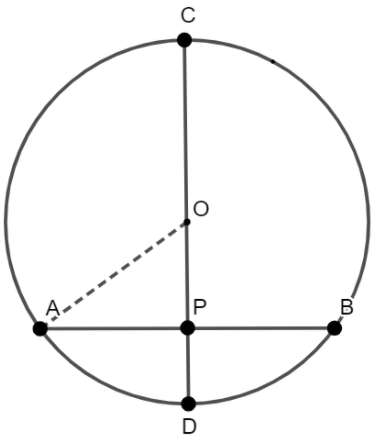
Now, we can say that $\Delta OPA$ is a right-angle triangle at P.
Let us assume that the radius of the circle is ‘r cm’. So, OA = OB = OD = r cm. And, from the question, we know that PD = 8cm.
Now, we can say that OD = OP + DP
So, OP = OD – PD = (r – 8) cm.
Also, we know from the question that AP = PB = 12 cm.
Since, $\Delta OPA$ is a right-angle triangle. So, by Pythagoras theorem we will get:
${{\left( AP \right)}^{2}}+{{\left( OP \right)}^{2}}={{\left( OA \right)}^{2}}$
$\Rightarrow {{\left( 12 \right)}^{2}}+{{\left( r-8 \right)}^{2}}={{r}^{2}}$
$\Rightarrow 144+{{r}^{2}}-16r+64={{r}^{2}}$
$\Rightarrow 16r=208$
$\therefore r=13$
Hence, r = 13. So, the radius of the circle is 13 cm. This is our required solution.
Note: We know that if a circle diameter bisects the chord then we say that diameter is perpendicular to the chord. Let us suppose that CD is the diameter of the circle which bisects the chord AB at P as shown in the below figure.
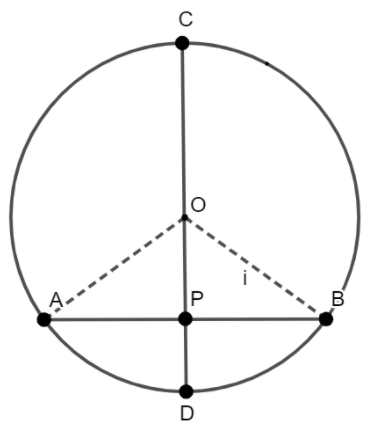
To prove AB perpendicular to OP we will first prove that $\Delta OPA$ and $\Delta OPB$ are congruent. We can say that in $\Delta OPA$ and $\Delta OPB$:
AP = PB (given)
OP = OP (common)
And, OA = OB (radius of the circle)
So, we can say that $\Delta OPA$ and $\Delta OPB$ are congruent. Hence, we can say that $\angle OPA=\angle OPB$.
Hence, $\angle OPA=\angle OPB=90{}^\circ $ as APB is a straight line.
Complete step-by-step solution:
We are given a circle and we know from the question that CD is the diameter of the circle and AB is the chord of the circle and they intersect each other at point P such that AP = PB = 12 cm.
So, we can say that diameter CD bisects the chord AB at P.
And, from the properties of the circle, we know that if the diameter of the circle bisects the chord then the diameter must be perpendicular to the chord. So, we can say that the diameter CD is perpendicular to AB.
Now, we can say that $\Delta OPA$ is a right-angle triangle at P.
Let us assume that the radius of the circle is ‘r cm’. So, OA = OB = OD = r cm. And, from the question, we know that PD = 8cm.
Now, we can say that OD = OP + DP
So, OP = OD – PD = (r – 8) cm.
Also, we know from the question that AP = PB = 12 cm.
Since, $\Delta OPA$ is a right-angle triangle. So, by Pythagoras theorem we will get:
${{\left( AP \right)}^{2}}+{{\left( OP \right)}^{2}}={{\left( OA \right)}^{2}}$
$\Rightarrow {{\left( 12 \right)}^{2}}+{{\left( r-8 \right)}^{2}}={{r}^{2}}$
$\Rightarrow 144+{{r}^{2}}-16r+64={{r}^{2}}$
$\Rightarrow 16r=208$
$\therefore r=13$
Hence, r = 13. So, the radius of the circle is 13 cm. This is our required solution.
Note: We know that if a circle diameter bisects the chord then we say that diameter is perpendicular to the chord. Let us suppose that CD is the diameter of the circle which bisects the chord AB at P as shown in the below figure.
To prove AB perpendicular to OP we will first prove that $\Delta OPA$ and $\Delta OPB$ are congruent. We can say that in $\Delta OPA$ and $\Delta OPB$:
AP = PB (given)
OP = OP (common)
And, OA = OB (radius of the circle)
So, we can say that $\Delta OPA$ and $\Delta OPB$ are congruent. Hence, we can say that $\angle OPA=\angle OPB$.
Hence, $\angle OPA=\angle OPB=90{}^\circ $ as APB is a straight line.
Recently Updated Pages
Master Class 11 English: Engaging Questions & Answers for Success

Master Class 11 Social Science: Engaging Questions & Answers for Success
Master Class 11 Maths: Engaging Questions & Answers for Success
Master Class 11 Biology: Engaging Questions & Answers for Success
Master Class 11 Physics: Engaging Questions & Answers for Success
Master Class 11 Chemistry: Engaging Questions & Answers for Success
Trending doubts
Explain the Treaty of Vienna of 1815 class 10 social science CBSE
What is the Total Duration of Football Match?
First Cotton Mill of India
In which year voting age was reduced from 21 to 18?
10 examples of evaporation in daily life with explanations
What planets have no moons Which one has only one moon class 10 physics CBSE