




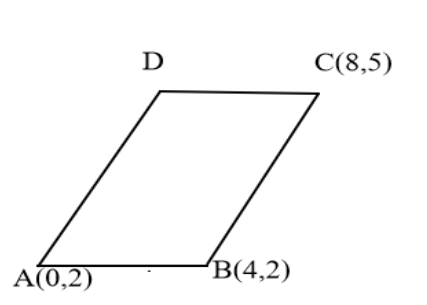
In the figure, ABCD is a parallelogram.
a) Write the coordinates of D.
b) What is the height of this parallelogram?
c) Find the perimeter and area of it.
Answer
 Verified
649.8k+ views
Hint: Here we will find the coordinates of D, height, perimeter and area of the parallelogram by considering the geometry concepts and properties of parallelogram.
Complete step-by-step answer:
a) Coordinates of D
Distance between A and B
$ \Rightarrow \sqrt {{{(4 - 0)}^2} + {{(2 - 2)}^2}} = \sqrt {16} = 4$
Since the opposite sides of a parallelogram are equal, the distance between C and D is also 4. Also, the y-coordinates of A and B are equal, the sides AB is parallel to the x-axis. And since ABCD is a parallelogram, CD is also parallel to the x-axis. So the y-coordinates of C and D are also equal.
Thus, the x-coordinate of $D = 8 - 4 = 4$
Hence, the coordinates of ’D’ are (4, 5).
b) Height of the parallelogram
The x-coordinates of D and B are equal. So the line BD is parallel to the y-axis or BD is perpendicular to the x-axis.
So, height of the parallelogram $ = DB = \left| {{y_1} - {y_2}} \right| = \left| {5 - 2} \right| = 3$
c) Perimeter and area of the parallelogram
Find the distance between B and C
$
BC = \sqrt {{{({x_2} - {x_1})}^2} + {{({y_2} - {y_1})}^2}} \\
BC = \sqrt {{{(8 - 4)}^2} + {{(5 - 2)}^2}} \\
BC = \sqrt {{{(4)}^2} + {{(3)}^2}} \\
BC = \sqrt {16 + 9} \\
BC = \sqrt {25} = 5 \\
$
$AD = BC = 5{\text{ units}}$
Perimeter=$2(4 + 5) = 2 \times 9 = 18$units.
Area=Base x Height
Area$ = 4 \times 3 = 12$ sq .units
Note: In this type of question we have to apply the relationship between the parallel line and perpendicular line and use the various formulas like distance formula to arrive at the solution.
Complete step-by-step answer:
a) Coordinates of D
Distance between A and B
$ \Rightarrow \sqrt {{{(4 - 0)}^2} + {{(2 - 2)}^2}} = \sqrt {16} = 4$
Since the opposite sides of a parallelogram are equal, the distance between C and D is also 4. Also, the y-coordinates of A and B are equal, the sides AB is parallel to the x-axis. And since ABCD is a parallelogram, CD is also parallel to the x-axis. So the y-coordinates of C and D are also equal.
Thus, the x-coordinate of $D = 8 - 4 = 4$
Hence, the coordinates of ’D’ are (4, 5).
b) Height of the parallelogram
The x-coordinates of D and B are equal. So the line BD is parallel to the y-axis or BD is perpendicular to the x-axis.
So, height of the parallelogram $ = DB = \left| {{y_1} - {y_2}} \right| = \left| {5 - 2} \right| = 3$
c) Perimeter and area of the parallelogram
Find the distance between B and C
$
BC = \sqrt {{{({x_2} - {x_1})}^2} + {{({y_2} - {y_1})}^2}} \\
BC = \sqrt {{{(8 - 4)}^2} + {{(5 - 2)}^2}} \\
BC = \sqrt {{{(4)}^2} + {{(3)}^2}} \\
BC = \sqrt {16 + 9} \\
BC = \sqrt {25} = 5 \\
$
$AD = BC = 5{\text{ units}}$
Perimeter=$2(4 + 5) = 2 \times 9 = 18$units.
Area=Base x Height
Area$ = 4 \times 3 = 12$ sq .units
Note: In this type of question we have to apply the relationship between the parallel line and perpendicular line and use the various formulas like distance formula to arrive at the solution.
Recently Updated Pages
Master Class 12 Economics: Engaging Questions & Answers for Success

Master Class 12 English: Engaging Questions & Answers for Success
Master Class 12 Social Science: Engaging Questions & Answers for Success
Master Class 12 Maths: Engaging Questions & Answers for Success
Master Class 12 Physics: Engaging Questions & Answers for Success
Master Class 10 English: Engaging Questions & Answers for Success
Trending doubts
Explain the Treaty of Vienna of 1815 class 10 social science CBSE
Who Won 36 Oscar Awards? Record Holder Revealed
Why is it 530 pm in india when it is 1200 afternoon class 10 social science CBSE
What is the full form of POSCO class 10 social science CBSE
Define Potential, Developed, Stock and Reserved resources
The speaker of the Lok Sabha is elected by the APresident class 10 social science CBSE