




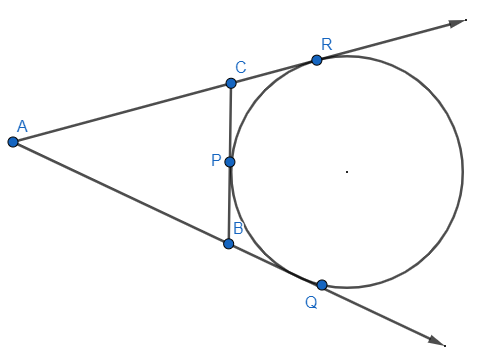
In the figure, a circle touches the side BC of $\Delta ABC$ at P and sides AB and AC produced at Q and R respectively. What is the perimeter of $\Delta ABC$ if AQ = 5cm?
a) 10cm
b) 3cm
c) 17cm
d) 7cm
Answer
 Verified
663.6k+ views
Hint: AR and AQ are tangents to the circle from A. Similarly BP and BQ are tangent from point B. Thus these values are equal. Now from the figure get an equation for AQ and AR. Add them to get perimeter of $\Delta ABC$
Complete step-by-step answer:
From the figure you can understand $\Delta ABC$ , AB and AC are produced to Q and R. Thus it becomes AQ and AR. Now the circle touches $\Delta ABC$ at point P, where P is a point on the side BC of the given triangle ABC.
From the figure you say that AR and AQ are tangents from the point A. Thus AR will be equal to AQ.
i.e. AR = AQ, which is the length of the tangents from A to the circle. Hence as AR = AQ, we can also say that BQ = BP i.e. they are length of tangent from the point B to the circle.
Similarly CR = CP = length of the tangent from point C onto the circle. Hence we found out that
AR = AQ = 5cm
BQ = BP and CR = CP
From the figure we can say that AQ = AB + BQ as BQ = BP, it becomes
AQ = AB + BP…………………..(i)
Similarly from figure AR = AC + CR,
CR = CP
AR = AC + CP…………….(ii)
Now let add both (i) and (ii)
AQ + AR = AB + AC + BP + CP………………….(iii)
The perimeter of $\Delta ABC=AB+BC+CA$ .
Here BC = BP + BP and AQ = AR
Thus equation (iii) becomes
AQ + AQ = AB + AC + BC.
Perimeter of $\Delta ABC=5+5=10cm$
Hence we got the perimeter of $\Delta ABC$ as 10cm.
Therefore option (a) is correct.
Note: If a line is tangent to a circle, it is perpendicular to the radius drawn to the point of tangency. The tangent segment to a circle from the same external point is congruent.
Complete step-by-step answer:
From the figure you can understand $\Delta ABC$ , AB and AC are produced to Q and R. Thus it becomes AQ and AR. Now the circle touches $\Delta ABC$ at point P, where P is a point on the side BC of the given triangle ABC.
From the figure you say that AR and AQ are tangents from the point A. Thus AR will be equal to AQ.
i.e. AR = AQ, which is the length of the tangents from A to the circle. Hence as AR = AQ, we can also say that BQ = BP i.e. they are length of tangent from the point B to the circle.
Similarly CR = CP = length of the tangent from point C onto the circle. Hence we found out that
AR = AQ = 5cm
BQ = BP and CR = CP
From the figure we can say that AQ = AB + BQ as BQ = BP, it becomes
AQ = AB + BP…………………..(i)
Similarly from figure AR = AC + CR,
CR = CP
AR = AC + CP…………….(ii)
Now let add both (i) and (ii)
AQ + AR = AB + AC + BP + CP………………….(iii)
The perimeter of $\Delta ABC=AB+BC+CA$ .
Here BC = BP + BP and AQ = AR
Thus equation (iii) becomes
AQ + AQ = AB + AC + BC.
Perimeter of $\Delta ABC=5+5=10cm$
Hence we got the perimeter of $\Delta ABC$ as 10cm.
Therefore option (a) is correct.
Note: If a line is tangent to a circle, it is perpendicular to the radius drawn to the point of tangency. The tangent segment to a circle from the same external point is congruent.
Recently Updated Pages
Basicity of sulphurous acid and sulphuric acid are

Master Class 10 Computer Science: Engaging Questions & Answers for Success
Master Class 10 Social Science: Engaging Questions & Answers for Success
Master Class 10 Science: Engaging Questions & Answers for Success
Class 10 Question and Answer - Your Ultimate Solutions Guide
Master Class 10 Maths: Engaging Questions & Answers for Success
Trending doubts
What is the Total Duration of Football Match?
Explain the Treaty of Vienna of 1815 class 10 social science CBSE
In football, which nation is called "La Roja"?
Why is there a time difference of about 5 hours between class 10 social science CBSE
10 examples of evaporation in daily life with explanations
What is the full form of POSCO class 10 social science CBSE