




In the diagram, PQRS is a rhombus with sides 3 cm. PQR and PSR are the two sectors of a circle with centers Q and S respectively.
Which of the following statements is false?
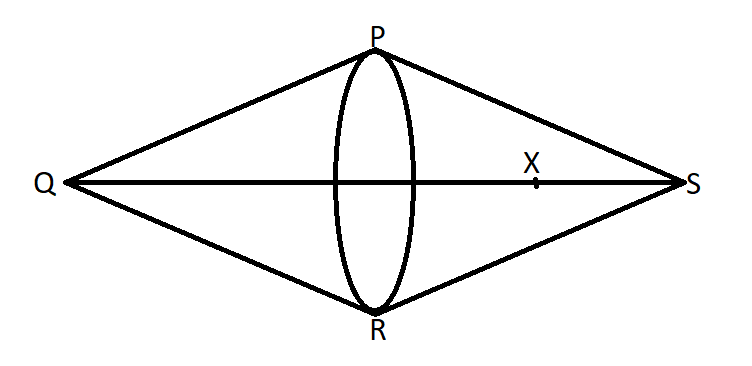
- (a) X is more than 3 cm from Q.
(b) X is less than 3 cm from S.
(c) X is equidistant from points P and Q.
(d) X is more than 3 cm from P.
- (a) X is more than 3 cm from Q.
Answer
 Verified
639.6k+ views
Hint: Mathematics includes the study of topics which are related to quantity, structure, space and change. It has no generally accepted definition. Mathematics deals with a variety of numbers ranging from natural numbers to irrational numbers. In this problem we are given a rhombus with sides 3cm. By using the properties of rhombus, we can establish the relationship between length of diagonal and hence we can find a solution for this problem.
Complete step-by-step answer:
Mathematics is related to all the phenomena occurring in the world. When mathematical structures are good models of real phenomena mathematical reasoning can be used to provide insight or predictions about nature. One of the most important branches of mathematics is geometry. It includes the analysis of figures using simple theorems and results.
In our problem we are given a rhombus PQRS with a diagonal QS. A point X lies on the diagonal QS.
Since, X lies closer to the end S so it cannot be equidistant from points P and Q.
Also, by observation $QP>PX$ which provides evidence that X is less than 3 cm from P.
Hence, two options are false.
This implies that option (c) and option (d) are correct.
Note: The key step in solving this problem is the knowledge of geometrical figures, particularly rhombus. By using some properties and visual observation we can easily identify which statements are false with conclusive evidence. These observation skills will enhance the confidence of students.
Complete step-by-step answer:
Mathematics is related to all the phenomena occurring in the world. When mathematical structures are good models of real phenomena mathematical reasoning can be used to provide insight or predictions about nature. One of the most important branches of mathematics is geometry. It includes the analysis of figures using simple theorems and results.
In our problem we are given a rhombus PQRS with a diagonal QS. A point X lies on the diagonal QS.
Since, X lies closer to the end S so it cannot be equidistant from points P and Q.
Also, by observation $QP>PX$ which provides evidence that X is less than 3 cm from P.
Hence, two options are false.
This implies that option (c) and option (d) are correct.
Note: The key step in solving this problem is the knowledge of geometrical figures, particularly rhombus. By using some properties and visual observation we can easily identify which statements are false with conclusive evidence. These observation skills will enhance the confidence of students.
Recently Updated Pages
Master Class 10 Computer Science: Engaging Questions & Answers for Success

Master Class 10 General Knowledge: Engaging Questions & Answers for Success
Master Class 10 English: Engaging Questions & Answers for Success
Master Class 10 Social Science: Engaging Questions & Answers for Success
Master Class 10 Maths: Engaging Questions & Answers for Success
Master Class 10 Science: Engaging Questions & Answers for Success
Trending doubts
Select the word that is correctly spelled a Twelveth class 10 english CBSE
Why is there a time difference of about 5 hours between class 10 social science CBSE
Father of Indian Constitution?
Write an application to the principal requesting five class 10 english CBSE
Fill the blanks with proper collective nouns 1 A of class 10 english CBSE
Write a letter to the principal requesting him to grant class 10 english CBSE