




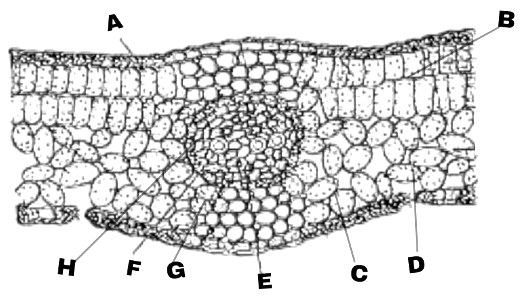
In the diagram of the portion of the T.S. of Helianthus leaf passing through the midrib, certain parts have been indicated by alphabets, choose the answer in which these alphabets have been correctly matched with the parts which they indicate.
a. A- Epidermis, B- Spongy parenchyma, C-Palisade parenchyma, D- Stomata, F- Phloem, G-Metaxylem, H- Protoxylem.
b. A-Epidermis, B- Palisade parenchyma. C-Spongy Parenchyma. D-Sub stomatal cavity. F Phloem, G- Meta Xylem, H- Protoxylem
c. A- Epidermis, B- Palisade parenchyma. C- Spongy parenchyma, D- Stomata, F- Endodermis, G- Xylem, H- Phloem
d. A- Epidermis, B- Palisade parenchyma, C- Spongy parenchyma, D- Stomata, F- Phloem, G-Metaxylem, H- Protoxylem
Answer
 Verified
628.8k+ views
Hint: Image shown above is a transverse section through a leaf of a dicotyledonous plant, the Sunflower (Helianthus annuus), taken through the midrib of the leaf. Below the upper epidermis, the palisade mesophyll tissue is often seen to consist of two to 3 layers of vertically orientated cells containing many chloroplasts for photosynthesis.
Complete answer:
The central midrib contains the most vascular strand . Large xylem vessels (stained red) are visible, and a neighborhood below these containing the phloem tissue. The plant tissue is surrounded by large parenchyma cells, which help to support the leaf by their turgidity. a dicot plant and have dorsi-ventral leaves which are present at an angle to the foremost axis and perpendicular (normal) to sunlight direction.
The upper (A) and lower epidermis are formed of compactly arranged, barrel-shaped cells. They have no intercellular space and a cuticle is present on both the layers. Multicellular hairs called trichomes are present on both the layers but stomata are present only within the lower epidermis. i.e., hypostomatic. Thus, substomatal cavities are in lower epidermis (D).
Mesophyll, rock bottom tissue, is exclusively composed of chlorenchyma cells.
The mesophyll tissue is differentiated into upper palisade parenchyma (B) and a lower spongy parenchyma (C).
Vascular bundles (VB) are found irregularly scattered within the mesophyll with the foremost importance and thus the oldest one at centre and is termed as midrib vein.
Hence, the correct answer is option (B).
Note: Each vascular bundle is having a bundle sheath of compactly arranged barrel shaped parenchyma cells which covers both xylem and phloem. Xylem is generally found near the upper epidermis and phloem near the lower one (F). Xylem has protoxylem and metaxylem (G) vessels with protoxylem (H) present towards upper epidermis, the conjoint and collateral VB with endarch xylem.
Complete answer:
The central midrib contains the most vascular strand . Large xylem vessels (stained red) are visible, and a neighborhood below these containing the phloem tissue. The plant tissue is surrounded by large parenchyma cells, which help to support the leaf by their turgidity. a dicot plant and have dorsi-ventral leaves which are present at an angle to the foremost axis and perpendicular (normal) to sunlight direction.
The upper (A) and lower epidermis are formed of compactly arranged, barrel-shaped cells. They have no intercellular space and a cuticle is present on both the layers. Multicellular hairs called trichomes are present on both the layers but stomata are present only within the lower epidermis. i.e., hypostomatic. Thus, substomatal cavities are in lower epidermis (D).
Mesophyll, rock bottom tissue, is exclusively composed of chlorenchyma cells.
The mesophyll tissue is differentiated into upper palisade parenchyma (B) and a lower spongy parenchyma (C).
Vascular bundles (VB) are found irregularly scattered within the mesophyll with the foremost importance and thus the oldest one at centre and is termed as midrib vein.
Hence, the correct answer is option (B).
Note: Each vascular bundle is having a bundle sheath of compactly arranged barrel shaped parenchyma cells which covers both xylem and phloem. Xylem is generally found near the upper epidermis and phloem near the lower one (F). Xylem has protoxylem and metaxylem (G) vessels with protoxylem (H) present towards upper epidermis, the conjoint and collateral VB with endarch xylem.
Recently Updated Pages
Master Class 11 Social Science: Engaging Questions & Answers for Success

Master Class 11 English: Engaging Questions & Answers for Success
Master Class 11 Accountancy: Engaging Questions & Answers for Success
Master Class 11 Physics: Engaging Questions & Answers for Success
Master Class 11 Computer Science: Engaging Questions & Answers for Success
Master Class 11 Business Studies: Engaging Questions & Answers for Success
Trending doubts
Find the value of the expression given below sin 30circ class 11 maths CBSE
Draw a diagram of nephron and explain its structur class 11 biology CBSE
Proton was discovered by A Thomson B Rutherford C Chadwick class 11 chemistry CBSE
The teeth used for biting and cutting food are called class 11 biology CBSE
Frogs heart when taken out of the body continues to class 11 biology CBSE
10 examples of diffusion in everyday life