




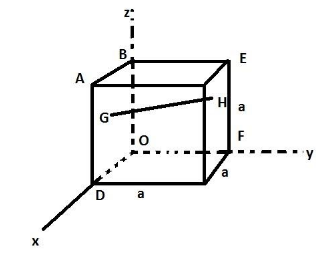
In the cube of side ' $ a $ ' shown in the figure, the vector from the central point of the face ABOD to the central point of the face BEFO will be:
(A) $ \dfrac{1}{2}a\left( {\hat i - \hat k} \right) $
(B) $ \dfrac{1}{2}a\left( {\hat j - \hat i} \right) $
(C) $ \dfrac{1}{2}a\left( {\hat k - \hat i} \right) $
(D) $ \dfrac{1}{2}a\left( {\hat j - \hat k} \right) $
Answer
 Verified
563.4k+ views
Hint: In geometry, a position or position vector, also known as location vector or radius vector, is a Euclidean vector that represents the position of a point P in space in relation to an arbitrary reference origin O. Calculate the coordinates of the mid-points of the faces and compute them in the formula for position vector.
Formula Used: The formulae used in the solution are given here.
Position vector $ \vec r = x\hat i + y\hat j + z\hat k $
Where,
$ \hat i $ = unit vector along x-direction,
$ \hat j $ = unit vector along y-direction,
$ \hat k $ = unit vector along z-direction.
Complete Answer:
It has been given that the length of the sides of the cube is $ a $ .
The centre of face ABOD is represented by point G as shown in the figure provided in the question. Similarly, the point H is the centre of the face BEFO of the cube. The line segment joining the two points on the opposite faces has been shown as the GH line.
The position vector is used to specify the position of a certain body. Knowing the position of a body is vital when it comes to describing the motion of that body. The position vector of an object is measured from the origin, in general.
Position vector $ \vec r = x\hat i + y\hat j + z\hat k $
Where,
$ \hat i $ = unit vector along x-direction
$ \hat j $ = unit vector along y-direction
$ \hat k $ = unit vector along z-direction
In the given figure, the coordinate of point O is (0,0,0), point D is (a,0,0), and B is(0,0,a). The coordinates of point G is therefore, $ \left( {\dfrac{a}{2},0,\dfrac{a}{2}} \right) $ .
The coordinates of point F is (0,a,0) and thus, the coordinates of point H is $ \left( {0,\dfrac{a}{2},\dfrac{a}{2}} \right) $
The value of the required vector is given by, $ \mathop {GH}\limits^ \to = \vec H - \vec G $ .
The vector $ \vec H = 0\hat i + \dfrac{a}{2}\hat j + \dfrac{a}{2}\hat k $ and the vector $ \vec G = \dfrac{a}{2}\hat i + 0\hat j + \dfrac{a}{2}\hat k $ .
The vector $ \mathop {GH}\limits^ \to $ is given by,
$ \mathop {GH}\limits^ \to = \left( {{x_2} - {x_1}} \right)\hat i + \left( {{y_2} - {y_1}} \right)\hat j + \left( {{z_2} - {z_1}} \right)\hat k $
Assigning the respective values in the equation, we get,
$ \overrightarrow {GH} = \left( {0 - \dfrac{a}{2}} \right)\hat i + \left( {\dfrac{a}{2} - 0} \right)\hat j + \left( {\dfrac{a}{2} - \dfrac{a}{2}} \right)\hat k $
$ \overrightarrow {GH} = \dfrac{a}{2}\hat i + \dfrac{a}{2}\hat j + 0\hat k $
Rearranging the values we get,
$ \overrightarrow {GH} = \dfrac{1}{2}a\left( {\hat j - \hat i} \right) $ .
Hence the correct answer is Option B.
Note:
In three dimensions, any set of three-dimensional coordinates and their corresponding basis vectors can be used to define the location of a point in space—whichever is the simplest for the task at hand may be used. The position in a three-dimensional space is defined with respect to the coordinates of the points joining the two.
Formula Used: The formulae used in the solution are given here.
Position vector $ \vec r = x\hat i + y\hat j + z\hat k $
Where,
$ \hat i $ = unit vector along x-direction,
$ \hat j $ = unit vector along y-direction,
$ \hat k $ = unit vector along z-direction.
Complete Answer:
It has been given that the length of the sides of the cube is $ a $ .
The centre of face ABOD is represented by point G as shown in the figure provided in the question. Similarly, the point H is the centre of the face BEFO of the cube. The line segment joining the two points on the opposite faces has been shown as the GH line.
The position vector is used to specify the position of a certain body. Knowing the position of a body is vital when it comes to describing the motion of that body. The position vector of an object is measured from the origin, in general.
Position vector $ \vec r = x\hat i + y\hat j + z\hat k $
Where,
$ \hat i $ = unit vector along x-direction
$ \hat j $ = unit vector along y-direction
$ \hat k $ = unit vector along z-direction
In the given figure, the coordinate of point O is (0,0,0), point D is (a,0,0), and B is(0,0,a). The coordinates of point G is therefore, $ \left( {\dfrac{a}{2},0,\dfrac{a}{2}} \right) $ .
The coordinates of point F is (0,a,0) and thus, the coordinates of point H is $ \left( {0,\dfrac{a}{2},\dfrac{a}{2}} \right) $
The value of the required vector is given by, $ \mathop {GH}\limits^ \to = \vec H - \vec G $ .
The vector $ \vec H = 0\hat i + \dfrac{a}{2}\hat j + \dfrac{a}{2}\hat k $ and the vector $ \vec G = \dfrac{a}{2}\hat i + 0\hat j + \dfrac{a}{2}\hat k $ .
The vector $ \mathop {GH}\limits^ \to $ is given by,
$ \mathop {GH}\limits^ \to = \left( {{x_2} - {x_1}} \right)\hat i + \left( {{y_2} - {y_1}} \right)\hat j + \left( {{z_2} - {z_1}} \right)\hat k $
Assigning the respective values in the equation, we get,
$ \overrightarrow {GH} = \left( {0 - \dfrac{a}{2}} \right)\hat i + \left( {\dfrac{a}{2} - 0} \right)\hat j + \left( {\dfrac{a}{2} - \dfrac{a}{2}} \right)\hat k $
$ \overrightarrow {GH} = \dfrac{a}{2}\hat i + \dfrac{a}{2}\hat j + 0\hat k $
Rearranging the values we get,
$ \overrightarrow {GH} = \dfrac{1}{2}a\left( {\hat j - \hat i} \right) $ .
Hence the correct answer is Option B.
Note:
In three dimensions, any set of three-dimensional coordinates and their corresponding basis vectors can be used to define the location of a point in space—whichever is the simplest for the task at hand may be used. The position in a three-dimensional space is defined with respect to the coordinates of the points joining the two.
Recently Updated Pages
Master Class 11 Computer Science: Engaging Questions & Answers for Success

Master Class 11 Business Studies: Engaging Questions & Answers for Success
Master Class 11 Economics: Engaging Questions & Answers for Success
Master Class 11 English: Engaging Questions & Answers for Success
Master Class 11 Maths: Engaging Questions & Answers for Success
Master Class 11 Biology: Engaging Questions & Answers for Success
Trending doubts
One Metric ton is equal to kg A 10000 B 1000 C 100 class 11 physics CBSE
There are 720 permutations of the digits 1 2 3 4 5 class 11 maths CBSE
Discuss the various forms of bacteria class 11 biology CBSE
Draw a diagram of a plant cell and label at least eight class 11 biology CBSE
State the laws of reflection of light
Explain zero factorial class 11 maths CBSE