




In the common base circuit of a transistor ,current amplification factor is 0.95. Calculate the emitter current if base current is 0.2 \[mA\]
A) 2 \[mA\]
B) 4\[mA\]
C) 6\[mA\]
D) 8\[mA\]
Answer
 Verified
614.1k+ views
Hint:We have given the current amplification factor (\[\alpha = 0.95\]) and given base current \[{I_b} = 0.2mA\] . First we will find the current gain \[\beta \], then we will calculate the current at collector(\[{I_c}\]) and in circuit of transistor we know that current at emitter is the sum of current at collector and base current ( \[{I_e} = {I_b} + {I_c}\])
Formula used:- \[\beta = \dfrac{{{I_c}}}{{{I_b}}}\], \[{I_c}\]is emitter current and \[{I_b}\]is the base current & \[\beta \] is the current gain
\[\beta = \dfrac{\alpha }{{1 - \alpha }}\], \[\alpha \] is the current amplification factor & \[\beta \] is the current gain
\[{I_e} = {I_b} + {I_c}\] , current at collector(\[{I_c}\]) , base current (\[{I_b}\]) , current at collector(\[{I_c}\])
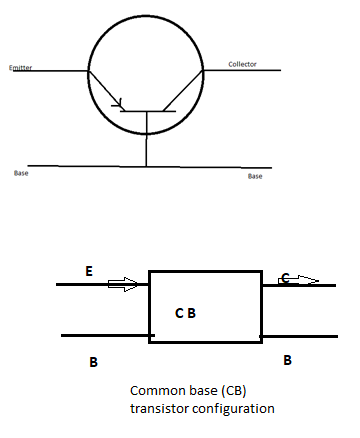
current amplification factor \[\alpha = 0.95\]
base current \[{I_b} = 0.2mA\]
current gain \[\beta = \dfrac{\alpha }{{1 - \alpha }}\]
putting the value of \[\alpha = 0.95\] in the formula \[\beta = \dfrac{\alpha }{{1 - \alpha }}\] in order to find the current gain\[\beta \].
\[ \Rightarrow \beta = \dfrac{{0.95}}{{1 - 0.95}} = \dfrac{{0.95}}{{0.5}} = 19\]
And we also know that the current gain\[\beta \]is the ratio of current at collector to base current.
\[\beta = \dfrac{{{I_c}}}{{{I_b}}}\]
Now , we will find the value of current at collector \[{I_c}\].
\[ \Rightarrow {I_c} = \beta .{I_b}\]
Putting the values \[\beta = 19\],\[{I_b} = 0.2mA\] and further simplifying.
\[\ \Rightarrow {I_c} = 19 \times 0.2 \\
\Rightarrow {I_c} = 3.8mA \\
\ \]
Current at collector \[{I_c} = 3.8mA\]
We have to find the emitter current \[{I_e}\], using the formula \[{I_e} = {I_b} + {I_c}\]
\[{I_e} = {I_b} + {I_c}\]
Putting the values \[{I_b} = 0.2mA\] & \[{I_b} = 0.2mA\]
\[ \Rightarrow {I_e} = 3.8 + 0.2 = 4mA\]
Current at the common emitter is \[4mA\].
Hence option (B) is the correct option.
Note :- In the common base circuit of a transistor current gain is always less than 1.
In the common base circuit of a transistor input resistance is low.
In the common base circuit of a transistor output resistance is very high.
Common base configuration of the transistor is suitable for high frequency.
Formula used:- \[\beta = \dfrac{{{I_c}}}{{{I_b}}}\], \[{I_c}\]is emitter current and \[{I_b}\]is the base current & \[\beta \] is the current gain
\[\beta = \dfrac{\alpha }{{1 - \alpha }}\], \[\alpha \] is the current amplification factor & \[\beta \] is the current gain
\[{I_e} = {I_b} + {I_c}\] , current at collector(\[{I_c}\]) , base current (\[{I_b}\]) , current at collector(\[{I_c}\])
current amplification factor \[\alpha = 0.95\]
base current \[{I_b} = 0.2mA\]
current gain \[\beta = \dfrac{\alpha }{{1 - \alpha }}\]
putting the value of \[\alpha = 0.95\] in the formula \[\beta = \dfrac{\alpha }{{1 - \alpha }}\] in order to find the current gain\[\beta \].
\[ \Rightarrow \beta = \dfrac{{0.95}}{{1 - 0.95}} = \dfrac{{0.95}}{{0.5}} = 19\]
And we also know that the current gain\[\beta \]is the ratio of current at collector to base current.
\[\beta = \dfrac{{{I_c}}}{{{I_b}}}\]
Now , we will find the value of current at collector \[{I_c}\].
\[ \Rightarrow {I_c} = \beta .{I_b}\]
Putting the values \[\beta = 19\],\[{I_b} = 0.2mA\] and further simplifying.
\[\ \Rightarrow {I_c} = 19 \times 0.2 \\
\Rightarrow {I_c} = 3.8mA \\
\ \]
Current at collector \[{I_c} = 3.8mA\]
We have to find the emitter current \[{I_e}\], using the formula \[{I_e} = {I_b} + {I_c}\]
\[{I_e} = {I_b} + {I_c}\]
Putting the values \[{I_b} = 0.2mA\] & \[{I_b} = 0.2mA\]
\[ \Rightarrow {I_e} = 3.8 + 0.2 = 4mA\]
Current at the common emitter is \[4mA\].
Hence option (B) is the correct option.
Note :- In the common base circuit of a transistor current gain is always less than 1.
In the common base circuit of a transistor input resistance is low.
In the common base circuit of a transistor output resistance is very high.
Common base configuration of the transistor is suitable for high frequency.
Recently Updated Pages
Master Class 12 Business Studies: Engaging Questions & Answers for Success

Master Class 12 Chemistry: Engaging Questions & Answers for Success
Master Class 12 Biology: Engaging Questions & Answers for Success
Class 12 Question and Answer - Your Ultimate Solutions Guide
Master Class 11 Social Science: Engaging Questions & Answers for Success
Master Class 11 Chemistry: Engaging Questions & Answers for Success
Trending doubts
Which are the Top 10 Largest Countries of the World?
Draw a labelled sketch of the human eye class 12 physics CBSE
Name the crygenes that control cotton bollworm and class 12 biology CBSE
Differentiate between homogeneous and heterogeneous class 12 chemistry CBSE
Ribosomal RNA is actively synthesised in A Nucleoplasm class 12 biology CBSE
How many molecules of ATP and NADPH are required information class 12 biology CBSE