




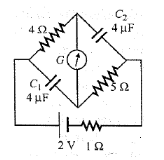
In the circuit shown here, the cell is ideal with emf of 2 volt. Then
(A) No current flows in the galvanometer.
(B) A current of 0.2 A flows through the galvanometer.
(C) Potential difference across C1 is 1.2 V.
(D) Potential difference across C1 is 1.0 V.
Answer
 Verified
590.4k+ views
Hint: The given resistors are connected in series and no current flows through the capacitors. C1 and 4Ω are connected in parallel. C2 and 5Ω are also connected in parallel.
Complete step by step answer:
When a capacitor is charged to full capacity, it will draw no current from the cell. So, no current will flow through the branches in which capacitors are connected. In the given figure, resistors $4\Omega, \, 5\Omega $ and $1\Omega $ are connected in series connection. So, their effective resistance will be $R = 4\Omega + 5\Omega + 1\Omega = 10\Omega $
EMF of the cell = 2 V
Current flowing through the galvanometer $I = \dfrac{{2V}}{{10\Omega }} = 0.2A$
As resistor 4Ω and C1 are connected in parallel, so potential across C1 = potential difference across 4Ω
$\Rightarrow 4I = 4 \times 0.2 = 0.8V$
Similarly, Potential difference across ${C_2} = 5I = 5 \times 0.2 = 1V$
Hence the correct options are option B and D.
Additional information: Resistors are said to be in series connection, if the same current is flowing through each resistor when the same potential difference is applied across the combination. The effective resistance of a series combination of resistors is always greater than the resistance of an individual resistor. In a series connection, the current is the same in every resistor. The current in the circuit is independent on the relative positions of different resistors in the connection. The potential difference across any resistor in the circuit is directly proportional to the resistance of that resistor.
Note:Remember that when resistors are connected in series, the current through each resistor will be same and potential difference is not same while in parallel connection, potential difference across each resistor will be same and current will be different.
Complete step by step answer:
When a capacitor is charged to full capacity, it will draw no current from the cell. So, no current will flow through the branches in which capacitors are connected. In the given figure, resistors $4\Omega, \, 5\Omega $ and $1\Omega $ are connected in series connection. So, their effective resistance will be $R = 4\Omega + 5\Omega + 1\Omega = 10\Omega $
EMF of the cell = 2 V
Current flowing through the galvanometer $I = \dfrac{{2V}}{{10\Omega }} = 0.2A$
As resistor 4Ω and C1 are connected in parallel, so potential across C1 = potential difference across 4Ω
$\Rightarrow 4I = 4 \times 0.2 = 0.8V$
Similarly, Potential difference across ${C_2} = 5I = 5 \times 0.2 = 1V$
Hence the correct options are option B and D.
Additional information: Resistors are said to be in series connection, if the same current is flowing through each resistor when the same potential difference is applied across the combination. The effective resistance of a series combination of resistors is always greater than the resistance of an individual resistor. In a series connection, the current is the same in every resistor. The current in the circuit is independent on the relative positions of different resistors in the connection. The potential difference across any resistor in the circuit is directly proportional to the resistance of that resistor.
Note:Remember that when resistors are connected in series, the current through each resistor will be same and potential difference is not same while in parallel connection, potential difference across each resistor will be same and current will be different.
Recently Updated Pages
Basicity of sulphurous acid and sulphuric acid are

Master Class 12 English: Engaging Questions & Answers for Success
Master Class 12 Social Science: Engaging Questions & Answers for Success
Master Class 12 Maths: Engaging Questions & Answers for Success
Master Class 12 Economics: Engaging Questions & Answers for Success
Master Class 12 Physics: Engaging Questions & Answers for Success
Trending doubts
Which are the Top 10 Largest Countries of the World?
Draw a labelled sketch of the human eye class 12 physics CBSE
Draw ray diagrams each showing i myopic eye and ii class 12 physics CBSE
Give 10 examples of unisexual and bisexual flowers
Give simple chemical tests to distinguish between the class 12 chemistry CBSE
Define Vant Hoff factor How is it related to the degree class 12 chemistry CBSE