




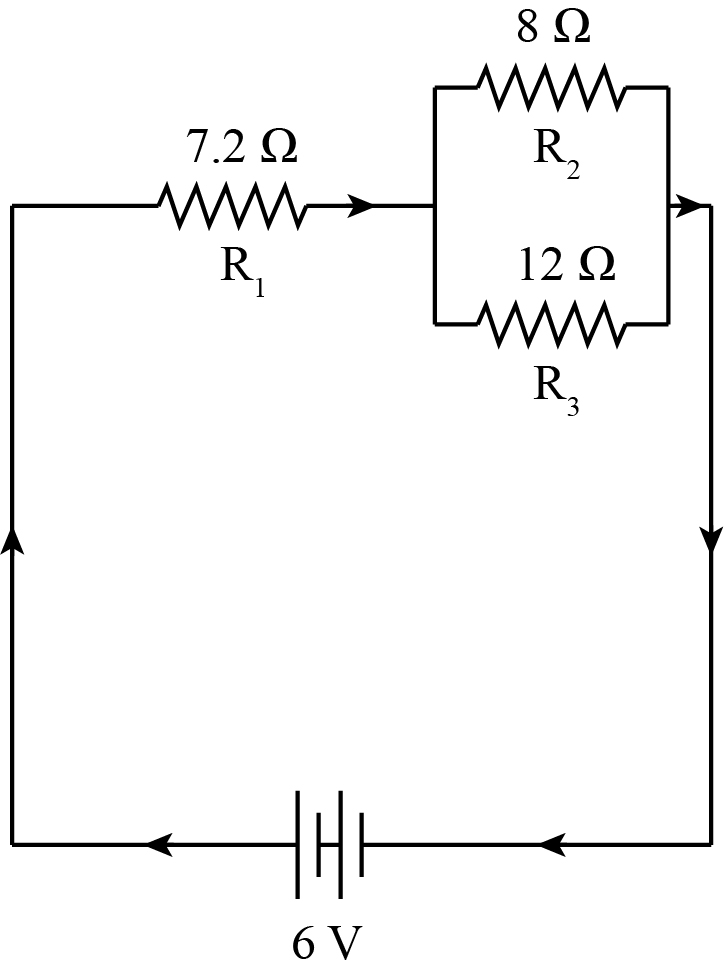
-In the circuit Diagram is given below find
A. A total resistance of the circuit
B. Total current flowing in the circuit
C. The potential difference across ${R_1}$
Answer
 Verified
609.3k+ views
Hint: The circuit is made up of resistances in series and parallel. So we will use the formula of equivalent resistances in series and parallel. ${R_2}$ and ${R_3}$ are connected parallelly. First, we will solve the Equivalent resistance for these two ${R_2}$ and ${R_3}$ Resistances. Now the new calculated equivalent resistance is in series with the resistance ${R_1}$. In this way, the total equivalent resistance will be calculated for the circuit.
Complete step by step answer:
When the resistances are in parallel combination, then the voltage difference across all the resistance is the same, but the current is different through the resistances. And when the resistances are in series connection, then the same current flows through all the resistances, but the voltage difference across all the resistance is different.
A) First, we calculate the equivalent resistance in the parallel combination. In parallel combination, the reciprocal of equivalent resistance is the sum of the reciprocals of resistance in parallel.
$\dfrac{1}{{{R_{p.eq}}}} = \dfrac{1}{{{R_2}}} + \dfrac{1}{{{R_3}}}$
Now, putting the value of ${R_2}$ and ${R_3}$ to find out ${R_{p.eq}}$
$\begin{array}{c}
\dfrac{1}{{{R_{p.eq}}}} = \dfrac{1}{8} + \dfrac{1}{{12}}\\
\Rightarrow {R_{p.eq}} = \dfrac{{3 + 2}}{{24}}\\
\Rightarrow {R_{p.eq}} = \dfrac{5}{{24}}\;\Omega
\end{array}$
Hence, ${R_{p.eq}} = \dfrac{{24}}{5}\;\Omega $
Now we will calculate the equivalent resistance of${R_{p.eq}}$ and${R_1}$ which is in series combination now. And in series combination, the equivalent resistance is calculated by adding all the resistances in series.
So, $R = {R_1} + {R_{p.eq}}$
Now, putting the value of ${R_1}$ and${R_{p.eq}}$ to find out R.
$\begin{array}{l}
R = 7.2 + \dfrac{{24}}{5}\\
\Rightarrow R = 7.2 + 4.8\\
\Rightarrow R = 13\;\Omega
\end{array}$
B) The total current flowing in the circuit can be obtained from the Ohm’s Law.
The total current $I = \dfrac{V}{R}$
Putting the value of V and R in the current expression.
$\begin{array}{l}
I = \dfrac{6}{{13}}\\
\Rightarrow I = 0.461\;{\rm{A}}
\end{array}$
C) The potential difference across${R_1}$is,
${V_1} = I{R_1}$ (According to the Ohm’s law)
Putting the value of I And ${R_1}$in the above expression,
$\begin{array}{c}
{V_1} = 0.461 \times 7.2\\
\Rightarrow {V_1} = 3.32\;{\rm{Volt}}
\end{array}$
The given circuit is hence can be converted into a circuit have only one resistance and a current flowing in it.
Note:
You can go wrong while calculating the equivalent resistance for series and parallel because sometimes the circuits are very complicated to understand which resistances are in parallel and which are in series.
Complete step by step answer:
When the resistances are in parallel combination, then the voltage difference across all the resistance is the same, but the current is different through the resistances. And when the resistances are in series connection, then the same current flows through all the resistances, but the voltage difference across all the resistance is different.
A) First, we calculate the equivalent resistance in the parallel combination. In parallel combination, the reciprocal of equivalent resistance is the sum of the reciprocals of resistance in parallel.
$\dfrac{1}{{{R_{p.eq}}}} = \dfrac{1}{{{R_2}}} + \dfrac{1}{{{R_3}}}$
Now, putting the value of ${R_2}$ and ${R_3}$ to find out ${R_{p.eq}}$
$\begin{array}{c}
\dfrac{1}{{{R_{p.eq}}}} = \dfrac{1}{8} + \dfrac{1}{{12}}\\
\Rightarrow {R_{p.eq}} = \dfrac{{3 + 2}}{{24}}\\
\Rightarrow {R_{p.eq}} = \dfrac{5}{{24}}\;\Omega
\end{array}$
Hence, ${R_{p.eq}} = \dfrac{{24}}{5}\;\Omega $
Now we will calculate the equivalent resistance of${R_{p.eq}}$ and${R_1}$ which is in series combination now. And in series combination, the equivalent resistance is calculated by adding all the resistances in series.
So, $R = {R_1} + {R_{p.eq}}$
Now, putting the value of ${R_1}$ and${R_{p.eq}}$ to find out R.
$\begin{array}{l}
R = 7.2 + \dfrac{{24}}{5}\\
\Rightarrow R = 7.2 + 4.8\\
\Rightarrow R = 13\;\Omega
\end{array}$
B) The total current flowing in the circuit can be obtained from the Ohm’s Law.
The total current $I = \dfrac{V}{R}$
Putting the value of V and R in the current expression.
$\begin{array}{l}
I = \dfrac{6}{{13}}\\
\Rightarrow I = 0.461\;{\rm{A}}
\end{array}$
C) The potential difference across${R_1}$is,
${V_1} = I{R_1}$ (According to the Ohm’s law)
Putting the value of I And ${R_1}$in the above expression,
$\begin{array}{c}
{V_1} = 0.461 \times 7.2\\
\Rightarrow {V_1} = 3.32\;{\rm{Volt}}
\end{array}$
The given circuit is hence can be converted into a circuit have only one resistance and a current flowing in it.
Note:
You can go wrong while calculating the equivalent resistance for series and parallel because sometimes the circuits are very complicated to understand which resistances are in parallel and which are in series.
Recently Updated Pages
Master Class 12 Economics: Engaging Questions & Answers for Success

Master Class 12 English: Engaging Questions & Answers for Success
Master Class 12 Social Science: Engaging Questions & Answers for Success
Master Class 12 Maths: Engaging Questions & Answers for Success
Master Class 12 Physics: Engaging Questions & Answers for Success
Master Class 12 Business Studies: Engaging Questions & Answers for Success
Trending doubts
The ratio of E to B in electromagnetic waves is equal class 12 physics CBSE
Which of the following is referred to as the Evil Quartet class 12 biology CBSE
What causes instant death by hanging class 12 biology CBSE
Percentage of photosynthetically active radiation PAR class 12 biology CBSE
The electric field due to a uniformly charged nonconducting class 12 physics CBSE
One megawatt is equal to how many units of electri class 12 physics CBSE