




In the angle of elevation of a cloud from a point P which is 25m above a lake be ${30^ \circ }$ and the angle of depression of reflection of the cloud in the lake from P be ${60^ \circ }$ , then the height of cloud (in meter) from the surface of the lake is?
A. 42
B. 50
C. 45
D. 60
Answer
 Verified
588k+ views
Hint: Start by assuming the height of the cloud as some variable from the surface of the lake. Draw the diagram accordingly and take the triangle which involves clouds directly and apply the required trigonometric formula of $\tan \theta = \dfrac{{perpendicular}}{{base}}$, obtain the base value . Similarly take another triangle which involves reflection of clouds and apply the same formula. Solve the two relations formed and find the value of height.
Complete step-by-step answer:
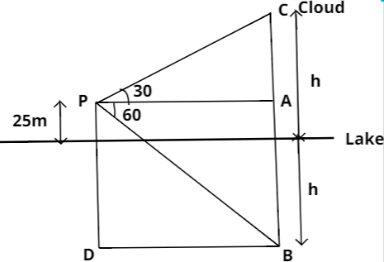
As we can see in the figure, Point C represents cloud and point B its reflection so both the points are equal distance from the surface of the lake.
Now , Let the height of the cloud be h from the surface of the lake
Now, In $\Delta PAC$
$\tan {30^ \circ } = \dfrac{{AC}}{{AP}}$
And from the figure, we can see AC = h – 25
$\tan {30^ \circ } = \dfrac{{h - 25}}{{AP}} = \dfrac{1}{{\sqrt 3 }}$
$ \Rightarrow AP = \sqrt 3 \left( {h - 25} \right) \to eqn.1$
Now, In $\Delta PBD$
$\angle APB = \angle PBD = {60^ \circ }({\text{Alternate angle)}}$
$\tan {60^ \circ } = \dfrac{{PD}}{{BD}}$
We can easily see PABD is a rectangle so
AP = BD
$\tan {60^ \circ } = \dfrac{{PD}}{{AP}}$
From the figure we can see PD = h+25
$
\tan {60^ \circ } = \dfrac{{h + 25}}{{AP}} = \sqrt 3 \\
AP = \dfrac{{h + 25}}{{\sqrt 3 }} \to eqn.1 \\
$
From equation(1) and equation(2) , we get
$
\sqrt 3 \left( {h - 25} \right) = \dfrac{{h + 25}}{{\sqrt 3 }} \\
\Rightarrow 3\left( {h + 25} \right) = h + 25 \\
\Rightarrow 3h + 75 = h + 25 \\
\Rightarrow 2h = 100 \\
\Rightarrow h = 50m \\
$
Therefore , the height of the cloud is 50 m from the water surface.
So, the correct answer is “Option B”.
Note: As we can see in the figure, Point C represents cloud and point B its reflection so both the points are equal distance from the surface of the lake.
Now , Let the height of the cloud be h from the surface of the lake
Now, In $\Delta PAC$
$\tan {30^ \circ } = \dfrac{{AC}}{{AP}}$
And from the figure, we can see AC = h – 25
$\tan {30^ \circ } = \dfrac{{h - 25}}{{AP}} = \dfrac{1}{{\sqrt 3 }}$
$ \Rightarrow AP = \sqrt 3 \left( {h - 25} \right) \to eqn.1$
Now, In $\Delta PBD$
$\angle APB = \angle PBD = {60^ \circ }({\text{Alternate angle)}}$
$\tan {60^ \circ } = \dfrac{{PD}}{{BD}}$
We can easily see PABD is a rectangle so
AP = BD
$\tan {60^ \circ } = \dfrac{{PD}}{{AP}}$
From the figure we can see PD = h+25
$
\tan {60^ \circ } = \dfrac{{h + 25}}{{AP}} = \sqrt 3 \\
AP = \dfrac{{h + 25}}{{\sqrt 3 }} \to eqn.1 \\
$
From equation(1) and equation(2) , we get
$
\sqrt 3 \left( {h - 25} \right) = \dfrac{{h + 25}}{{\sqrt 3 }} \\
\Rightarrow 3\left( {h + 25} \right) = h + 25 \\
\Rightarrow 3h + 75 = h + 25 \\
\Rightarrow 2h = 100 \\
\Rightarrow h = 50m \\
$
Therefore , the height of the cloud is 50 m from the water surface.
Complete step-by-step answer:
As we can see in the figure, Point C represents cloud and point B its reflection so both the points are equal distance from the surface of the lake.
Now , Let the height of the cloud be h from the surface of the lake
Now, In $\Delta PAC$
$\tan {30^ \circ } = \dfrac{{AC}}{{AP}}$
And from the figure, we can see AC = h – 25
$\tan {30^ \circ } = \dfrac{{h - 25}}{{AP}} = \dfrac{1}{{\sqrt 3 }}$
$ \Rightarrow AP = \sqrt 3 \left( {h - 25} \right) \to eqn.1$
Now, In $\Delta PBD$
$\angle APB = \angle PBD = {60^ \circ }({\text{Alternate angle)}}$
$\tan {60^ \circ } = \dfrac{{PD}}{{BD}}$
We can easily see PABD is a rectangle so
AP = BD
$\tan {60^ \circ } = \dfrac{{PD}}{{AP}}$
From the figure we can see PD = h+25
$
\tan {60^ \circ } = \dfrac{{h + 25}}{{AP}} = \sqrt 3 \\
AP = \dfrac{{h + 25}}{{\sqrt 3 }} \to eqn.1 \\
$
From equation(1) and equation(2) , we get
$
\sqrt 3 \left( {h - 25} \right) = \dfrac{{h + 25}}{{\sqrt 3 }} \\
\Rightarrow 3\left( {h + 25} \right) = h + 25 \\
\Rightarrow 3h + 75 = h + 25 \\
\Rightarrow 2h = 100 \\
\Rightarrow h = 50m \\
$
Therefore , the height of the cloud is 50 m from the water surface.
So, the correct answer is “Option B”.
Note: As we can see in the figure, Point C represents cloud and point B its reflection so both the points are equal distance from the surface of the lake.
Now , Let the height of the cloud be h from the surface of the lake
Now, In $\Delta PAC$
$\tan {30^ \circ } = \dfrac{{AC}}{{AP}}$
And from the figure, we can see AC = h – 25
$\tan {30^ \circ } = \dfrac{{h - 25}}{{AP}} = \dfrac{1}{{\sqrt 3 }}$
$ \Rightarrow AP = \sqrt 3 \left( {h - 25} \right) \to eqn.1$
Now, In $\Delta PBD$
$\angle APB = \angle PBD = {60^ \circ }({\text{Alternate angle)}}$
$\tan {60^ \circ } = \dfrac{{PD}}{{BD}}$
We can easily see PABD is a rectangle so
AP = BD
$\tan {60^ \circ } = \dfrac{{PD}}{{AP}}$
From the figure we can see PD = h+25
$
\tan {60^ \circ } = \dfrac{{h + 25}}{{AP}} = \sqrt 3 \\
AP = \dfrac{{h + 25}}{{\sqrt 3 }} \to eqn.1 \\
$
From equation(1) and equation(2) , we get
$
\sqrt 3 \left( {h - 25} \right) = \dfrac{{h + 25}}{{\sqrt 3 }} \\
\Rightarrow 3\left( {h + 25} \right) = h + 25 \\
\Rightarrow 3h + 75 = h + 25 \\
\Rightarrow 2h = 100 \\
\Rightarrow h = 50m \\
$
Therefore , the height of the cloud is 50 m from the water surface.
Recently Updated Pages
Master Class 11 Business Studies: Engaging Questions & Answers for Success

Master Class 11 Computer Science: Engaging Questions & Answers for Success
Master Class 11 Economics: Engaging Questions & Answers for Success
Master Class 11 Social Science: Engaging Questions & Answers for Success
Master Class 11 English: Engaging Questions & Answers for Success
Master Class 11 Chemistry: Engaging Questions & Answers for Success
Trending doubts
Draw a diagram of nephron and explain its structur class 11 biology CBSE
Explain zero factorial class 11 maths CBSE
Chemical formula of Bleaching powder is A Ca2OCl2 B class 11 chemistry CBSE
Name the part of the brain responsible for the precision class 11 biology CBSE
The growth of tendril in pea plants is due to AEffect class 11 biology CBSE
One Metric ton is equal to kg A 10000 B 1000 C 100 class 11 physics CBSE