




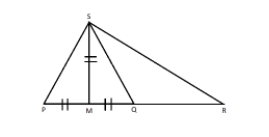
In the adjoining figure P, M, Q, R are collinear and PM = MQ = MS. $S{R^2} = PR .QR$. Then
A) $\angle SQR = \angle SMP$
B) $\angle QSR = \angle MSP$
C) $\angle QSR = \angle MSQ$
D) $\angle QSM = \angle PSM$
Answer
 Verified
581.1k+ views
Hint:
It is given in the question that in the adjoining figure P, M, Q, R are collinear and PM = MQ = MS. $S{R^2} = PR.PQ$
Firstly, by the equation $S{R^2} = PR.PQ$ , we will proportionate the equation and note that as (I)
Then after, from the $\Delta SPR$ and $\Delta SQR$ we will get the answer as proportion and note that as (II)
Finally, we will compare equation (I) and equation (II) and we will get an answer.
Complete step by step solution:
It is given in the question that in the adjoining figure P, M, Q, R are collinear and PM = MQ = MS. $S{R^2} = PR.PQ$
$\because PM = QM$
$\therefore \angle PSM = \angle QSM$
$\because $ $S{R^2} = PR.PQ$
$\therefore SR.SR = PR.PQ$
Now,
$\therefore \dfrac{{SR}}{{PR}} = \dfrac{{QR}}{{SR}}$ (given) (I)
Now, In $\Delta SPR$ and $\Delta SQR$
$\therefore $$\dfrac{{SR}}{{PR}} = \dfrac{{QR}}{{SR}}$ (II)
Hence, from equation (I) and (II), we get,
$\angle SQR = \angle SMP$
Hence, Proved.
Note:
Collinear Points: Three or more points are said to be collinear if they lie on a single straight line. A line on which points lie, especially if it is related to a geometric figure such as a triangle, is sometimes called an axis. Two points are trivially collinear since two points determine a line.
It is given in the question that in the adjoining figure P, M, Q, R are collinear and PM = MQ = MS. $S{R^2} = PR.PQ$
Firstly, by the equation $S{R^2} = PR.PQ$ , we will proportionate the equation and note that as (I)
Then after, from the $\Delta SPR$ and $\Delta SQR$ we will get the answer as proportion and note that as (II)
Finally, we will compare equation (I) and equation (II) and we will get an answer.
Complete step by step solution:
It is given in the question that in the adjoining figure P, M, Q, R are collinear and PM = MQ = MS. $S{R^2} = PR.PQ$
$\because PM = QM$
$\therefore \angle PSM = \angle QSM$
$\because $ $S{R^2} = PR.PQ$
$\therefore SR.SR = PR.PQ$
Now,
$\therefore \dfrac{{SR}}{{PR}} = \dfrac{{QR}}{{SR}}$ (given) (I)
Now, In $\Delta SPR$ and $\Delta SQR$
$\therefore $$\dfrac{{SR}}{{PR}} = \dfrac{{QR}}{{SR}}$ (II)
Hence, from equation (I) and (II), we get,
$\angle SQR = \angle SMP$
Hence, Proved.
Note:
Collinear Points: Three or more points are said to be collinear if they lie on a single straight line. A line on which points lie, especially if it is related to a geometric figure such as a triangle, is sometimes called an axis. Two points are trivially collinear since two points determine a line.
Recently Updated Pages
Master Class 10 Computer Science: Engaging Questions & Answers for Success

Master Class 10 General Knowledge: Engaging Questions & Answers for Success
Master Class 10 English: Engaging Questions & Answers for Success
Master Class 10 Social Science: Engaging Questions & Answers for Success
Master Class 10 Maths: Engaging Questions & Answers for Success
Master Class 10 Science: Engaging Questions & Answers for Success
Trending doubts
What is the median of the first 10 natural numbers class 10 maths CBSE
Which women's tennis player has 24 Grand Slam singles titles?
Who is the Brand Ambassador of Incredible India?
Why is there a time difference of about 5 hours between class 10 social science CBSE
Write a letter to the principal requesting him to grant class 10 english CBSE
State and prove converse of BPT Basic Proportionality class 10 maths CBSE