




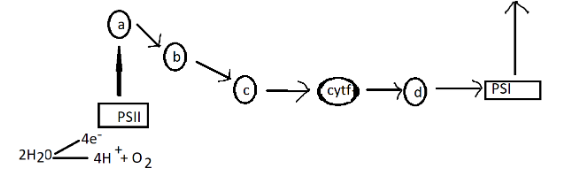
In the above schematic diagram, which is plastocyanin?
A)a
B)b
C)c
D)d
Answer
 Verified
583.8k+ views
Hint: The schematic diagram represents the transfer of electrons through the photosystems involved in the photosynthesis. The Photosystems are the structural and functional protein complexes which altogether carry out the process of photosynthesis and produce energy.
Complete answer:
PSII- The photosystem II is a protein complex which is a multi- pigment complex. This complex receives electrons through the photolysis of water. The oxygen evolved combines to form molecular oxygen which is released into the atmosphere.
PSI- It is an integral membrane protein complex which utilises the light energy and transfers the electron across the membrane of the thylakoid from plastocyanin to ferredoxin. This electron transfer produces the energy carrier molecule called NADPH.
The electron transfers start from PSII and pass through primary electron acceptor ferredoxin (a) and then to plastoquinone (b) and then to cytochrome f. The electron moves to PS I through plastocyanin (d). This produces oxygen and NADPH.
Ferredoxin- It is an iron-sulphur protein complex which involves flow of electrons.
Plastoquinone- It is a quinone molecule which takes part in the electron transport chain of light reaction in photosynthesis.
Hence, the correct answer is option (D)
Note: Plastocyanin is a copper containing molecule which helps in transfer of electrons from PSII to PSI. It receives the electron from cytochrome f and transfers it to the PSI. The plastocyanin also helps in cyclic electron flow in the photosynthetic prokaryotes.
Complete answer:
PSII- The photosystem II is a protein complex which is a multi- pigment complex. This complex receives electrons through the photolysis of water. The oxygen evolved combines to form molecular oxygen which is released into the atmosphere.
PSI- It is an integral membrane protein complex which utilises the light energy and transfers the electron across the membrane of the thylakoid from plastocyanin to ferredoxin. This electron transfer produces the energy carrier molecule called NADPH.
The electron transfers start from PSII and pass through primary electron acceptor ferredoxin (a) and then to plastoquinone (b) and then to cytochrome f. The electron moves to PS I through plastocyanin (d). This produces oxygen and NADPH.
Ferredoxin- It is an iron-sulphur protein complex which involves flow of electrons.
Plastoquinone- It is a quinone molecule which takes part in the electron transport chain of light reaction in photosynthesis.
Hence, the correct answer is option (D)
Note: Plastocyanin is a copper containing molecule which helps in transfer of electrons from PSII to PSI. It receives the electron from cytochrome f and transfers it to the PSI. The plastocyanin also helps in cyclic electron flow in the photosynthetic prokaryotes.
Recently Updated Pages
Master Class 11 English: Engaging Questions & Answers for Success

Master Class 11 Social Science: Engaging Questions & Answers for Success
Master Class 11 Maths: Engaging Questions & Answers for Success
Master Class 11 Biology: Engaging Questions & Answers for Success
Master Class 11 Physics: Engaging Questions & Answers for Success
Master Class 11 Chemistry: Engaging Questions & Answers for Success
Trending doubts
One Metric ton is equal to kg A 10000 B 1000 C 100 class 11 physics CBSE
Difference Between Prokaryotic Cells and Eukaryotic Cells
Find the value of the expression given below sin 30circ class 11 maths CBSE
1 ton equals to A 100 kg B 1000 kg C 10 kg D 10000 class 11 physics CBSE
Two of the body parts which do not appear in MRI are class 11 biology CBSE
What are hard magnetic materials class 11 physics CBSE