




In sickle cell anemia, the shape of RBCs under oxygen tension becomes:
(a) Biconcave disc- like
(b) Elongated and curved
(c) Circular
(d) Spherical
Answer
 Verified
641.7k+ views
Hint: Sickle cell anemia is a red blood cell disorder in which they are not healthy enough to carry oxygen throughout the body. RBCs attain sickle- like shape. A sickle is an agricultural tool that has non- linear blades used to harvest crops, a similar shape is attained by the RBCs.
Complete answer:
In normal conditions, RBCs are Biconcave disc- like. Sickle cell anemia is a group of disorders which comes under the sickle cell disease. It is an autosomal recessive disease therefore it can be transmitted from parents of the offspring when both female and male individuals are carriers for the gene. The disease is controlled by a single pair of alleles, HbA and HbS. Thus, three genotypes are possible in this situation:
- HbA HbA (normal homozygous) - HbA HbS (normal carrier) - HbA HbS HbS (diseased, die before attaining maturity)
Heterozygous (HbA HbS) individuals appear unaffected but they are carriers of the disease as there is a 50% probability of transmission of the mutant gene to the progeny, thus exhibiting sickle cell trait.
The disease or defect is caused by a mutation (transversion) of the gene controlling the β-chain of hemoglobin. It replaces glutamic acid (Glu) present at the 6th position of the β-chain by amino acid Valine (Val) . The mutant hemoglobin molecules undergo polymerization under low oxygen tension causing the change in the shape of RBCs from biconcave to elongated sickle- like (curve) structure.
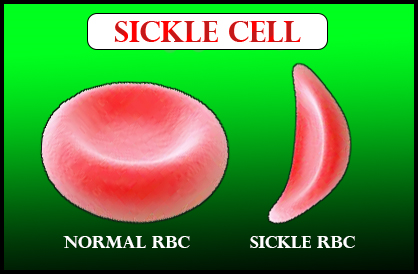
So, the answer is, ‘Elongated and curved.’
Additional Information: When the polymerization occurs under low oxygen tension these sickle- shaped RBCs become rigid, sticky cells that get stuck in the blood vessels, which can slow or block the blood flow and oxygen to parts of the body.
Note:
- There is no cure for most people with sickle cell anemia but treatments relieve pain and help prevent complications associated with the disease.
- In carriers, the RBCs are biconcave in shape in normal conditions, only changes to curved shape when there is low oxygen tension in the body.
- In the carriers, people make both, normal hemoglobin and sickle celled hemoglobin.
- Their blood might contain some sickle cell but they generally don’t have any symptoms.
Complete answer:
In normal conditions, RBCs are Biconcave disc- like. Sickle cell anemia is a group of disorders which comes under the sickle cell disease. It is an autosomal recessive disease therefore it can be transmitted from parents of the offspring when both female and male individuals are carriers for the gene. The disease is controlled by a single pair of alleles, HbA and HbS. Thus, three genotypes are possible in this situation:
- HbA HbA (normal homozygous) - HbA HbS (normal carrier) - HbA HbS HbS (diseased, die before attaining maturity)
Heterozygous (HbA HbS) individuals appear unaffected but they are carriers of the disease as there is a 50% probability of transmission of the mutant gene to the progeny, thus exhibiting sickle cell trait.
The disease or defect is caused by a mutation (transversion) of the gene controlling the β-chain of hemoglobin. It replaces glutamic acid (Glu) present at the 6th position of the β-chain by amino acid Valine (Val) . The mutant hemoglobin molecules undergo polymerization under low oxygen tension causing the change in the shape of RBCs from biconcave to elongated sickle- like (curve) structure.
So, the answer is, ‘Elongated and curved.’
Additional Information: When the polymerization occurs under low oxygen tension these sickle- shaped RBCs become rigid, sticky cells that get stuck in the blood vessels, which can slow or block the blood flow and oxygen to parts of the body.
Note:
- There is no cure for most people with sickle cell anemia but treatments relieve pain and help prevent complications associated with the disease.
- In carriers, the RBCs are biconcave in shape in normal conditions, only changes to curved shape when there is low oxygen tension in the body.
- In the carriers, people make both, normal hemoglobin and sickle celled hemoglobin.
- Their blood might contain some sickle cell but they generally don’t have any symptoms.
Recently Updated Pages
Basicity of sulphurous acid and sulphuric acid are

Master Class 11 English: Engaging Questions & Answers for Success
Master Class 11 Physics: Engaging Questions & Answers for Success
Master Class 11 Computer Science: Engaging Questions & Answers for Success
Master Class 11 Chemistry: Engaging Questions & Answers for Success
Master Class 11 Social Science: Engaging Questions & Answers for Success
Trending doubts
Difference Between Prokaryotic Cells and Eukaryotic Cells
Two of the body parts which do not appear in MRI are class 11 biology CBSE
One Metric ton is equal to kg A 10000 B 1000 C 100 class 11 physics CBSE
10 examples of friction in our daily life
Draw a diagram of nephron and explain its structur class 11 biology CBSE
What will happen if the mucus is not secreted by the class 11 biology CBSE