




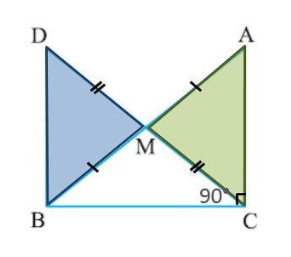
In right triangle ABC, right angled at C, M is the mid -point of hypotenuse AB. C joined M and produced a point D such that DM=CM. Point D is joined to point B.
Show that:
$
i)\vartriangle AMC \cong \vartriangle BMD \\
ii)\angle DBCis{\text{ }}a{\text{ }}right{\text{ }}angle \\
iii)\vartriangle DBC \cong \vartriangle ACB \\
iv)CM = \dfrac{1}{2}AB \\
$
Answer
 Verified
574.8k+ views
Hint: Vertically opposite angles are equal and sum of angles in a triangle is equal to 180.
From triangle ABC, we have a perpendicular angle at C. For the first part, we use SAS rule to prove congruence rule to prove the congruence. When we are proving $\angle DBC$ is right angled, we use the sum of angles in the triangle as ${180^o}$.
Complete step by step solution:
First, we can see that in $\vartriangle ABC,\angle C = {90^o}$
i)Now, proving the congruence of the triangles $\vartriangle DMB,\vartriangle AMC$
We are given that $DM = MC$
Since M is the midpoint of AB, we can say that
$AM = MC$
If we consider AB and CD are intersecting, then vertically opposite angles are equal.
$\angle DMC = \angle AMC$
Therefore ,we have proved $\vartriangle DMB \cong \vartriangle AMC$
ii) Now, let's prove that $\angle DBC$ is a right angle.
We can see that MC is bisecting the $\angle C$ in the \[\vartriangle DBC \cong \vartriangle ACB\].
Therefore
$\angle MCB = \angle MCA = {45^o}$.
Since, we know that alternate angles are equal.
\[\angle MCA = \angle DCB = {45^o}\]
Now, consider \[\vartriangle DBC\]
The sum of angles in a triangle is 180.
\[{45^o} + {45^o} + \angle DBC = {180^o}\]
\[\angle DBC = {90^o}\]
From, that we can say that
\[\angle DBC\] is right angle triangle
iii) Now, we are going to prove \[\vartriangle DBC \cong \vartriangle ACB\]
BC is the common side to the two triangles.
$\angle ACB = \angle DBC = {90^o}$
Since DB and AC are parts of congruent triangles. They are proved equal due to CPCT ( corresponding parts to corresponding triangles).
Therefore
\[
MC = \dfrac{1}{2}(AB) \\
= \dfrac{1}{2}(AB) \\
\]by SAS rule.
Also, we can conclude that
\[AB = {\text{ }}CD\] by CPCT.
As, we know that \[DM{\text{ }} = {\text{ }}MC\]
We can say that
\[
MC = \dfrac{1}{2}(CD) \\
= \dfrac{1}{2}(AB) \\
\]
Therefore
\[MC = \dfrac{1}{2}(AB)\]
Hence proved
Note: For CPCT to be applied, it is necessary that the side or anything, both the parts should be part of the triangles which have been proved congruent, or have been given as congruent triangles in the question. A bisecting line always divides angle into two equal angles.
From triangle ABC, we have a perpendicular angle at C. For the first part, we use SAS rule to prove congruence rule to prove the congruence. When we are proving $\angle DBC$ is right angled, we use the sum of angles in the triangle as ${180^o}$.
Complete step by step solution:
First, we can see that in $\vartriangle ABC,\angle C = {90^o}$
i)Now, proving the congruence of the triangles $\vartriangle DMB,\vartriangle AMC$
We are given that $DM = MC$
Since M is the midpoint of AB, we can say that
$AM = MC$
If we consider AB and CD are intersecting, then vertically opposite angles are equal.
$\angle DMC = \angle AMC$
Therefore ,we have proved $\vartriangle DMB \cong \vartriangle AMC$
ii) Now, let's prove that $\angle DBC$ is a right angle.
We can see that MC is bisecting the $\angle C$ in the \[\vartriangle DBC \cong \vartriangle ACB\].
Therefore
$\angle MCB = \angle MCA = {45^o}$.
Since, we know that alternate angles are equal.
\[\angle MCA = \angle DCB = {45^o}\]
Now, consider \[\vartriangle DBC\]
The sum of angles in a triangle is 180.
\[{45^o} + {45^o} + \angle DBC = {180^o}\]
\[\angle DBC = {90^o}\]
From, that we can say that
\[\angle DBC\] is right angle triangle
iii) Now, we are going to prove \[\vartriangle DBC \cong \vartriangle ACB\]
BC is the common side to the two triangles.
$\angle ACB = \angle DBC = {90^o}$
Since DB and AC are parts of congruent triangles. They are proved equal due to CPCT ( corresponding parts to corresponding triangles).
Therefore
\[
MC = \dfrac{1}{2}(AB) \\
= \dfrac{1}{2}(AB) \\
\]by SAS rule.
Also, we can conclude that
\[AB = {\text{ }}CD\] by CPCT.
As, we know that \[DM{\text{ }} = {\text{ }}MC\]
We can say that
\[
MC = \dfrac{1}{2}(CD) \\
= \dfrac{1}{2}(AB) \\
\]
Therefore
\[MC = \dfrac{1}{2}(AB)\]
Hence proved
Note: For CPCT to be applied, it is necessary that the side or anything, both the parts should be part of the triangles which have been proved congruent, or have been given as congruent triangles in the question. A bisecting line always divides angle into two equal angles.
Recently Updated Pages
Master Class 12 Economics: Engaging Questions & Answers for Success

Master Class 12 English: Engaging Questions & Answers for Success
Master Class 12 Social Science: Engaging Questions & Answers for Success
Master Class 12 Maths: Engaging Questions & Answers for Success
Master Class 12 Physics: Engaging Questions & Answers for Success
Master Class 9 General Knowledge: Engaging Questions & Answers for Success
Trending doubts
The speaker of the Lok Sabha is elected by the APresident class 10 social science CBSE
Complete the sentence with the most appropriate word class 10 english CBSE
a Draw a labelled diagram of a sectional view of the class 10 biology CBSE
What were the majoritarian measures taken in Sri Lanka class 10 social science CBSE
Fill the blanks with proper collective nouns 1 A of class 10 english CBSE
Identify the feminine form of the noun Bachelor a Bachelorette class 10 english CBSE