




In reversible cycle, the entropy of the system:
A) Increases
B) Decreases
C) Does not change
D First increase and then decrease
Answer
 Verified
625.5k+ views
Hint: A reversible process in simple words can be understood as ‘’the process which can be reversed’’, which means a process in which the both system and surroundings can be returned to the previous conditions without producing any changes in the thermodynamics properties.
Complete step-by-step answer:
Entropy change is a state function. Its value depends only on the initial and final values and is independent of the path followed.
Consider the following reversible cyclic process.
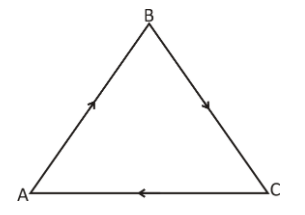
The reversible cyclic process starts from point A and goes through points B and C and returns to point A. The entropy change for the entire process is zero.
\[\Delta {S_{{\text{process}}}} = \Delta {S_{A \to B}} + \Delta {S_{B \to C}} + \Delta {S_{C \to A}} = 0\]
As we know Entropy is randomness or disorder orderliness. It is the measure of a system’s thermal energy per unit temperature which is unavailable for doing useful work. For example - the entropy of solid is more in comparison to the gas because the particles in gases have more randomness.
Now let’s discuss the entropy of the system in reversible process, the entropy of the system neither increases nor decreases which means it does not change during reversible process.
Additional Information:
In case of irreversible processes the change in entropy for a system and its surroundings is always positive which means the disorderness increases in case of an irreversible process. If the process is irreversible, then the total entropy of an isolated system always increases.
Hence, the correct answer is option (C)
Note: Students may confuse two terms of thermodynamics enthalpy & entropy due to slightly similar pronunciation. These two terms are far different from each other although. Enthalpy is represented as the total heat content whereas entropy is the degree of disorder.
Complete step-by-step answer:
Entropy change is a state function. Its value depends only on the initial and final values and is independent of the path followed.
Consider the following reversible cyclic process.
The reversible cyclic process starts from point A and goes through points B and C and returns to point A. The entropy change for the entire process is zero.
\[\Delta {S_{{\text{process}}}} = \Delta {S_{A \to B}} + \Delta {S_{B \to C}} + \Delta {S_{C \to A}} = 0\]
As we know Entropy is randomness or disorder orderliness. It is the measure of a system’s thermal energy per unit temperature which is unavailable for doing useful work. For example - the entropy of solid is more in comparison to the gas because the particles in gases have more randomness.
Now let’s discuss the entropy of the system in reversible process, the entropy of the system neither increases nor decreases which means it does not change during reversible process.
Additional Information:
In case of irreversible processes the change in entropy for a system and its surroundings is always positive which means the disorderness increases in case of an irreversible process. If the process is irreversible, then the total entropy of an isolated system always increases.
Hence, the correct answer is option (C)
Note: Students may confuse two terms of thermodynamics enthalpy & entropy due to slightly similar pronunciation. These two terms are far different from each other although. Enthalpy is represented as the total heat content whereas entropy is the degree of disorder.
Recently Updated Pages
Master Class 11 Social Science: Engaging Questions & Answers for Success

Master Class 11 English: Engaging Questions & Answers for Success
Master Class 11 Accountancy: Engaging Questions & Answers for Success
Master Class 11 Physics: Engaging Questions & Answers for Success
Master Class 11 Computer Science: Engaging Questions & Answers for Success
Master Class 11 Business Studies: Engaging Questions & Answers for Success
Trending doubts
Find the value of the expression given below sin 30circ class 11 maths CBSE
One Metric ton is equal to kg A 10000 B 1000 C 100 class 11 physics CBSE
Draw a diagram of nephron and explain its structur class 11 biology CBSE
10 examples of friction in our daily life
Proton was discovered by A Thomson B Rutherford C Chadwick class 11 chemistry CBSE
The teeth used for biting and cutting food are called class 11 biology CBSE