




In respiration, air passes through
A. Pharynx → nasal cavity → larynx → trachea bronchi → bronchioles
B. Nasal cavity → pharynx → larynx → trachea → bronchi → bronchioles
C. Larynx → nasal cavity’ → pharynx → trachea
D. Larynx → pharynx trachea → lungs
Answer
 Verified
594.6k+ views
Hint: Respiration is a biochemical process. During the process of respiration cells of an organism get energy by combining oxygen and glucose. As a result, it releases CO2, water, and ATP.
Complete answer:
Respiration is a biochemical process that incorporates breathing and reaction of food with the discharge of energy. Breathing basically is inhaling air rich in oxygen and giving out air rich in carbon dioxide. All living organisms respire to urge energy. The energy made throughout respiration is in the type of heat.
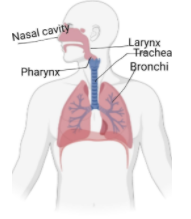
The cells of the human body need a relentless stream of oxygen to remain alive. The human respiratory system provides oxygen to the body's cells along with removing carbon dioxide, a waste matter that may be fatal if allowed to accumulate. There are three major components of the metabolic respiratory system: the airway, the lungs, and also the muscles used in respiration. The airway, which includes organs like the nose, our mouth, pharynx, larynx, trachea, bronchi, and bronchioles which are responsible for carrying air between the lungs and additionally the body's exterior. The lungs act as purposeful units of the system by passing oxygen into the body and carbon dioxide out of the body. Finally, the muscles responsible for respiration, as well as the diaphragm and intercostal muscles, work together to act as a pump, pushing air into the lungs and then out of the lungs throughout the process of respiration.
So, the answer is nasal cavity pharynx, larynx, trachea, bronchi, bronchiole, lungs, which is option B.
Note: There are four types of respiration-cellular respiration (in this the metabolic reaction occurs within the body of an organism to convert them into biochemical material), Internal respiration(here a gaseous exchange of material takes place between blood and tissue fluid), External respiration(exchange of material between inhaled air and blood ), Breathing or ventilation(exchange of gases with the outer environment).
Complete answer:
Respiration is a biochemical process that incorporates breathing and reaction of food with the discharge of energy. Breathing basically is inhaling air rich in oxygen and giving out air rich in carbon dioxide. All living organisms respire to urge energy. The energy made throughout respiration is in the type of heat.
The cells of the human body need a relentless stream of oxygen to remain alive. The human respiratory system provides oxygen to the body's cells along with removing carbon dioxide, a waste matter that may be fatal if allowed to accumulate. There are three major components of the metabolic respiratory system: the airway, the lungs, and also the muscles used in respiration. The airway, which includes organs like the nose, our mouth, pharynx, larynx, trachea, bronchi, and bronchioles which are responsible for carrying air between the lungs and additionally the body's exterior. The lungs act as purposeful units of the system by passing oxygen into the body and carbon dioxide out of the body. Finally, the muscles responsible for respiration, as well as the diaphragm and intercostal muscles, work together to act as a pump, pushing air into the lungs and then out of the lungs throughout the process of respiration.
So, the answer is nasal cavity pharynx, larynx, trachea, bronchi, bronchiole, lungs, which is option B.
Note: There are four types of respiration-cellular respiration (in this the metabolic reaction occurs within the body of an organism to convert them into biochemical material), Internal respiration(here a gaseous exchange of material takes place between blood and tissue fluid), External respiration(exchange of material between inhaled air and blood ), Breathing or ventilation(exchange of gases with the outer environment).
Recently Updated Pages
Master Class 11 Social Science: Engaging Questions & Answers for Success

Master Class 11 Physics: Engaging Questions & Answers for Success
Master Class 11 Maths: Engaging Questions & Answers for Success
Master Class 11 Economics: Engaging Questions & Answers for Success
Master Class 11 Computer Science: Engaging Questions & Answers for Success
Master Class 11 Chemistry: Engaging Questions & Answers for Success
Trending doubts
One Metric ton is equal to kg A 10000 B 1000 C 100 class 11 physics CBSE
There are 720 permutations of the digits 1 2 3 4 5 class 11 maths CBSE
1 Quintal is equal to a 110 kg b 10 kg c 100kg d 1000 class 11 physics CBSE
State and prove Bernoullis theorem class 11 physics CBSE
Difference Between Prokaryotic Cells and Eukaryotic Cells
Discuss the various forms of bacteria class 11 biology CBSE