




In parallel combination of n cells, we obtain:
(A) More voltage
(B) More current
(C) Less voltage
(D) Less current
Answer
 Verified
625.5k+ views
Hint: When n cells are connected in parallel combination, the internal resistance of n individual cells taken together is reduced as we know that when resistances are connected in parallel, the equivalent resistance decreases as a result current increases.
Complete step by step answer:
Let us consider n cells connected in parallel combination, to make the calculations simple let the voltage across their positive and negative terminals or emf (electromotive force) be equal,
${{E}_{1}}={{E}_{2}}=...={{E}_{n}}=E$
And their internal resistance be,
${{r}_{1}}={{r}_{2}}=...={{r}_{n}}=r$
The circuit below shows n cells connected in parallel across a resistance R, with current I flowing in the circuit.
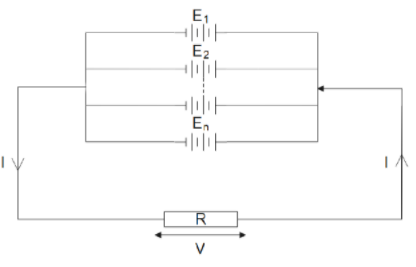
The emf of n cells connected in parallel will be equal to the emf of individual cell i.e. E.
Now, let us calculate the equivalent internal resistance of n cells, we get,
$\dfrac{1}{{{r}_{eq}}}=\dfrac{1}{{{r}_{1}}}+\dfrac{1}{{{r}_{2}}}+...+\dfrac{1}{{{r}_{n}}}=\dfrac{n}{r}$ (Since, ${{r}_{1}}={{r}_{2}}=...={{r}_{n}}=r$)
$\Rightarrow {{r}_{eq}}=\dfrac{r}{n}$
Thus, we see that the equivalent internal resistance of n cells is the internal resistance of an individual cell divided by n. The resistance in the equivalent circuit thus decreases and hence the current in the circuit increases.
Therefore, the correct answer is option (B).
Additional Information:
When n cells are connected in series combination, the equivalent emf is equal to the sum of individual emf,
${{E}_{1}}+{{E}_{2}}+...+{{E}_{n}}=nE$
And the equivalent internal resistance of n cells is,
${{r}_{1}}+{{r}_{2}}+...+{{r}_{n}}=nr$
Thus, we see in series combination the current in the circuit decreases as the equivalent internal resistance is n multiplied by resistance of an individual cell.
Note:
When the resistance to current flow in the circuit is increased the current in the circuit decreases and when the resistance to current flow in the circuit is decreased the current in the circuit increases, as according to Ohm’s law ($V=IR$), resistance and current are inversely proportional to each other.
Complete step by step answer:
Let us consider n cells connected in parallel combination, to make the calculations simple let the voltage across their positive and negative terminals or emf (electromotive force) be equal,
${{E}_{1}}={{E}_{2}}=...={{E}_{n}}=E$
And their internal resistance be,
${{r}_{1}}={{r}_{2}}=...={{r}_{n}}=r$
The circuit below shows n cells connected in parallel across a resistance R, with current I flowing in the circuit.
The emf of n cells connected in parallel will be equal to the emf of individual cell i.e. E.
Now, let us calculate the equivalent internal resistance of n cells, we get,
$\dfrac{1}{{{r}_{eq}}}=\dfrac{1}{{{r}_{1}}}+\dfrac{1}{{{r}_{2}}}+...+\dfrac{1}{{{r}_{n}}}=\dfrac{n}{r}$ (Since, ${{r}_{1}}={{r}_{2}}=...={{r}_{n}}=r$)
$\Rightarrow {{r}_{eq}}=\dfrac{r}{n}$
Thus, we see that the equivalent internal resistance of n cells is the internal resistance of an individual cell divided by n. The resistance in the equivalent circuit thus decreases and hence the current in the circuit increases.
Therefore, the correct answer is option (B).
Additional Information:
When n cells are connected in series combination, the equivalent emf is equal to the sum of individual emf,
${{E}_{1}}+{{E}_{2}}+...+{{E}_{n}}=nE$
And the equivalent internal resistance of n cells is,
${{r}_{1}}+{{r}_{2}}+...+{{r}_{n}}=nr$
Thus, we see in series combination the current in the circuit decreases as the equivalent internal resistance is n multiplied by resistance of an individual cell.
Note:
When the resistance to current flow in the circuit is increased the current in the circuit decreases and when the resistance to current flow in the circuit is decreased the current in the circuit increases, as according to Ohm’s law ($V=IR$), resistance and current are inversely proportional to each other.
Recently Updated Pages
Which of the following graphs shows the variation of class 12 physics CBSE

Draw a labelled diagram of the human male reproductive class 12 biology CBSE
Describe the experiment to compare the emf of two cells class 12 physics CBSE
What is standard hydrogen electrode
What is conventional current and electric current class 12 physics CBSE
2Bromopentane is treated with an alcoholic KOH solution class 12 chemistry CBSE
Trending doubts
Draw a labelled sketch of the human eye class 12 physics CBSE
Which are the Top 10 Largest Countries of the World?
Differentiate between homogeneous and heterogeneous class 12 chemistry CBSE
Draw ray diagrams each showing i myopic eye and ii class 12 physics CBSE
Which is the correct genotypic ratio of mendel dihybrid class 12 biology CBSE
What is the Full Form of PVC, PET, HDPE, LDPE, PP and PS ?