




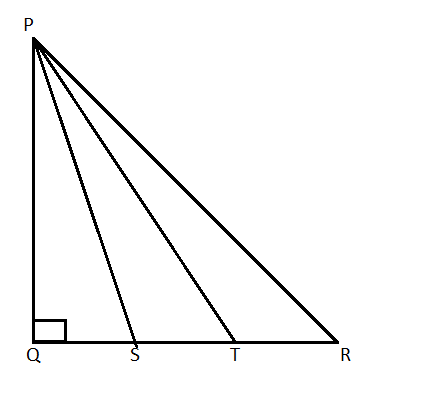
In figure, S and T trisect the side QR of a right triangle PQR, prove that $8P{T^2} = 3P{R^2} + 5P{S^2}$
Answer
 Verified
593.4k+ views
Hint: Follow the step by step approach. First find the relation of individual hypotenuse so formed three right angled triangles. Also, suppose the variable “x” for the base is formed by the trisection. Trisection means three equal sections or portions.
Complete step-by-step answer:
Given that S and T trisects the side QR.
Therefore the three line-segments so formed are equal in length.
$ \Rightarrow QS = TS = RT$
Let us suppose that all the equal lengths are of measure “x”
$\therefore QS = TS = RT = x$
The above supposition implies that –
$QR = 3x$
And $QT = 2x$
Now, using Pythagora's theorem which states that in any right angled triangle the square of the hypotenuse is the sum of the square of the adjacent side and the square of the opposite side.
Therefore in the given right angled triangle PQR,
$P{R^2} = P{Q^2} + Q{R^2}$
Place the values we know in terms of “x”
$ \Rightarrow P{R^2} = P{Q^2} + {(3x)^2}$
Simplify the above equation –
$ \Rightarrow P{R^2} = P{Q^2} + 9{x^2}\;{\text{ }}.....{\text{(i)}}$
Similarly, in the given right angled triangle PQS,
$P{S^2} = P{Q^2} + Q{S^2}$
Place the values we know in terms of “x”
$ \Rightarrow P{S^2} = P{Q^2} + {(x)^2}$
Simplify the above equation –
$ \Rightarrow P{S^2} = P{Q^2} + {x^2}\;{\text{ }}.....{\text{(ii)}}$
Similarly in the given right angled triangle PQT,
$P{T^2} = P{Q^2} + Q{T^2}$
Place the values we know in terms of “x”
$ \Rightarrow P{T^2} = P{Q^2} + {(2x)^2}$
Simplify the above equation –
$ \Rightarrow P{T^2} = P{Q^2} + 4{x^2}\;{\text{ }}.....{\text{(iii)}}$
Now, take Left hand side of the equation –
LHS $ = P{T^2}$
Place values by using equation (iii)
LHS $ = 8(P{Q^2} + 4{x^2})$
Simplify the above equation –
LHS $ = 8P{Q^2} + 32{x^2}$
In order to get the required RHS in terms of and , split the terms of “x” and
We can write $32 = 27 + 5$ and $8 = 3 + 5$ in the above terms-
LHS $ = \underline {3P{Q^2} + 5P{Q^2}} + \underline {27{x^2} + 5{x^2}} $
We can rearrange the above terms –
LHS $ = \underline {3P{Q^2} + 27{x^2}} + \underline {5P{Q^2} + 5{x^2}} $
Take common terms from the above pair of terms –
LHS $ = 3(P{Q^2} + 9{x^2}) + 5(P{Q^2} + {x^2})$
Simplify by using the equations (i) and (ii) –
LHS $ = 3P{R^2} + 5P{S^2}$
LHS$ = $ RHS
$ \Rightarrow 8P{T^2} = 3P{R^2} + 5P{S^2}$
Hence, the required equation is proved.
Note: Remember the concepts of Pythagoras theorem and apply accordingly identifying the right angled triangles in the given figure. Simplify the equation so formed as per the required answer.
Complete step-by-step answer:
Given that S and T trisects the side QR.
Therefore the three line-segments so formed are equal in length.
$ \Rightarrow QS = TS = RT$
Let us suppose that all the equal lengths are of measure “x”
$\therefore QS = TS = RT = x$
The above supposition implies that –
$QR = 3x$
And $QT = 2x$
Now, using Pythagora's theorem which states that in any right angled triangle the square of the hypotenuse is the sum of the square of the adjacent side and the square of the opposite side.
Therefore in the given right angled triangle PQR,
$P{R^2} = P{Q^2} + Q{R^2}$
Place the values we know in terms of “x”
$ \Rightarrow P{R^2} = P{Q^2} + {(3x)^2}$
Simplify the above equation –
$ \Rightarrow P{R^2} = P{Q^2} + 9{x^2}\;{\text{ }}.....{\text{(i)}}$
Similarly, in the given right angled triangle PQS,
$P{S^2} = P{Q^2} + Q{S^2}$
Place the values we know in terms of “x”
$ \Rightarrow P{S^2} = P{Q^2} + {(x)^2}$
Simplify the above equation –
$ \Rightarrow P{S^2} = P{Q^2} + {x^2}\;{\text{ }}.....{\text{(ii)}}$
Similarly in the given right angled triangle PQT,
$P{T^2} = P{Q^2} + Q{T^2}$
Place the values we know in terms of “x”
$ \Rightarrow P{T^2} = P{Q^2} + {(2x)^2}$
Simplify the above equation –
$ \Rightarrow P{T^2} = P{Q^2} + 4{x^2}\;{\text{ }}.....{\text{(iii)}}$
Now, take Left hand side of the equation –
LHS $ = P{T^2}$
Place values by using equation (iii)
LHS $ = 8(P{Q^2} + 4{x^2})$
Simplify the above equation –
LHS $ = 8P{Q^2} + 32{x^2}$
In order to get the required RHS in terms of and , split the terms of “x” and
We can write $32 = 27 + 5$ and $8 = 3 + 5$ in the above terms-
LHS $ = \underline {3P{Q^2} + 5P{Q^2}} + \underline {27{x^2} + 5{x^2}} $
We can rearrange the above terms –
LHS $ = \underline {3P{Q^2} + 27{x^2}} + \underline {5P{Q^2} + 5{x^2}} $
Take common terms from the above pair of terms –
LHS $ = 3(P{Q^2} + 9{x^2}) + 5(P{Q^2} + {x^2})$
Simplify by using the equations (i) and (ii) –
LHS $ = 3P{R^2} + 5P{S^2}$
LHS$ = $ RHS
$ \Rightarrow 8P{T^2} = 3P{R^2} + 5P{S^2}$
Hence, the required equation is proved.
Note: Remember the concepts of Pythagoras theorem and apply accordingly identifying the right angled triangles in the given figure. Simplify the equation so formed as per the required answer.
Recently Updated Pages
Master Class 10 Social Science: Engaging Questions & Answers for Success

Master Class 10 Science: Engaging Questions & Answers for Success
Master Class 10 Maths: Engaging Questions & Answers for Success
Master Class 10 General Knowledge: Engaging Questions & Answers for Success
Master Class 10 Computer Science: Engaging Questions & Answers for Success
Class 10 Question and Answer - Your Ultimate Solutions Guide
Trending doubts
What is the full form of PNG A Petrol Natural Gas B class 10 chemistry CBSE
Explain the Treaty of Vienna of 1815 class 10 social science CBSE
In cricket, how many legal balls are there in a standard over?
Why is there a time difference of about 5 hours between class 10 social science CBSE
Who Won 36 Oscar Awards? Record Holder Revealed
What is the median of the first 10 natural numbers class 10 maths CBSE