




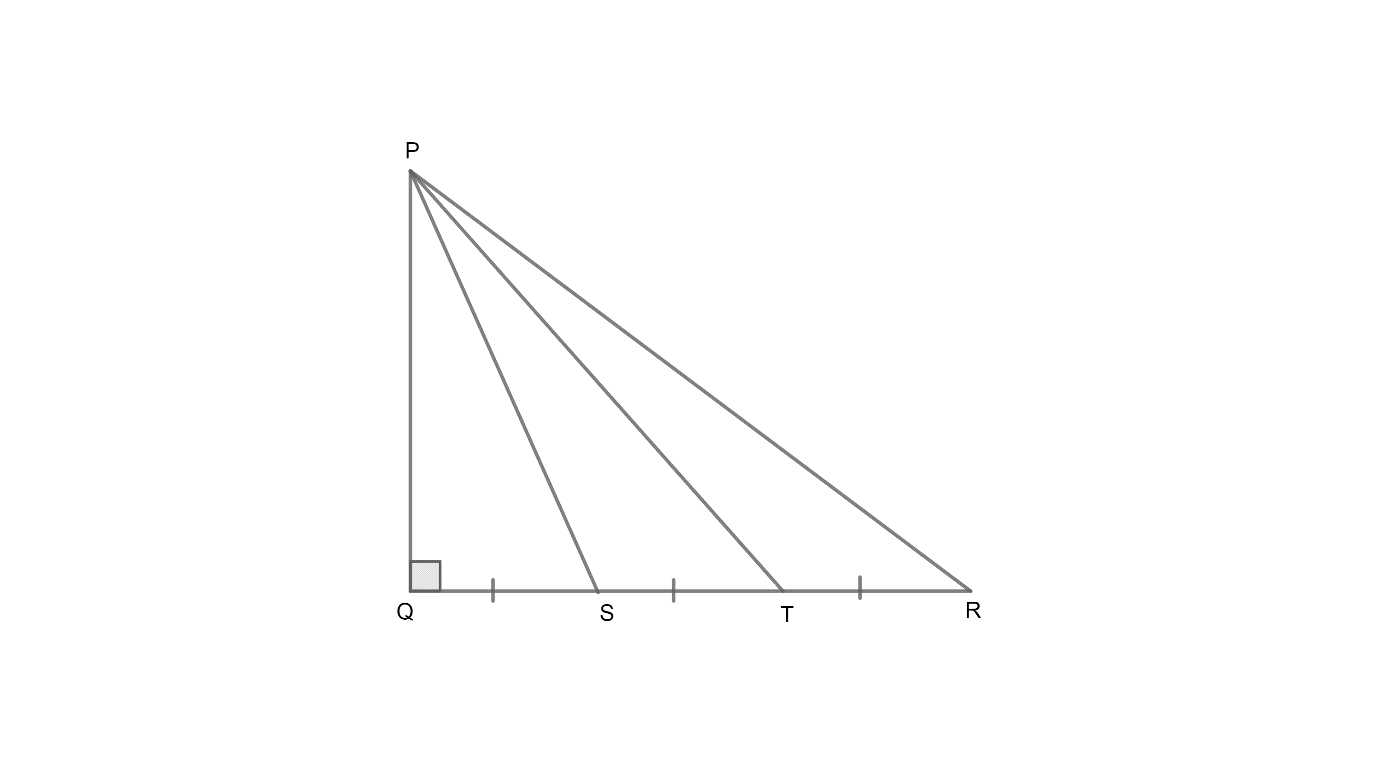
In figure, S and T trisect the side QR of a triangle PQR. Then $8P{{R}^{2}}=2P{{R}^{2}}+9P{{S}^{2}}$. State whether the above statement is true or false.
A. True
B. False
Answer
 Verified
615.9k+ views
Hint: We will use the fact given to us that S and T trisect QR. We will first apply Pythagoras Theorem in $\Delta PQR$. Then in $\Delta PTQ$ and finally in $\Delta PSQ$, then we will use these three equations to prove the given equation.
Complete step-by-step answer:
Now, we have been given that S and T trisect the side QR of a right triangle PQR.
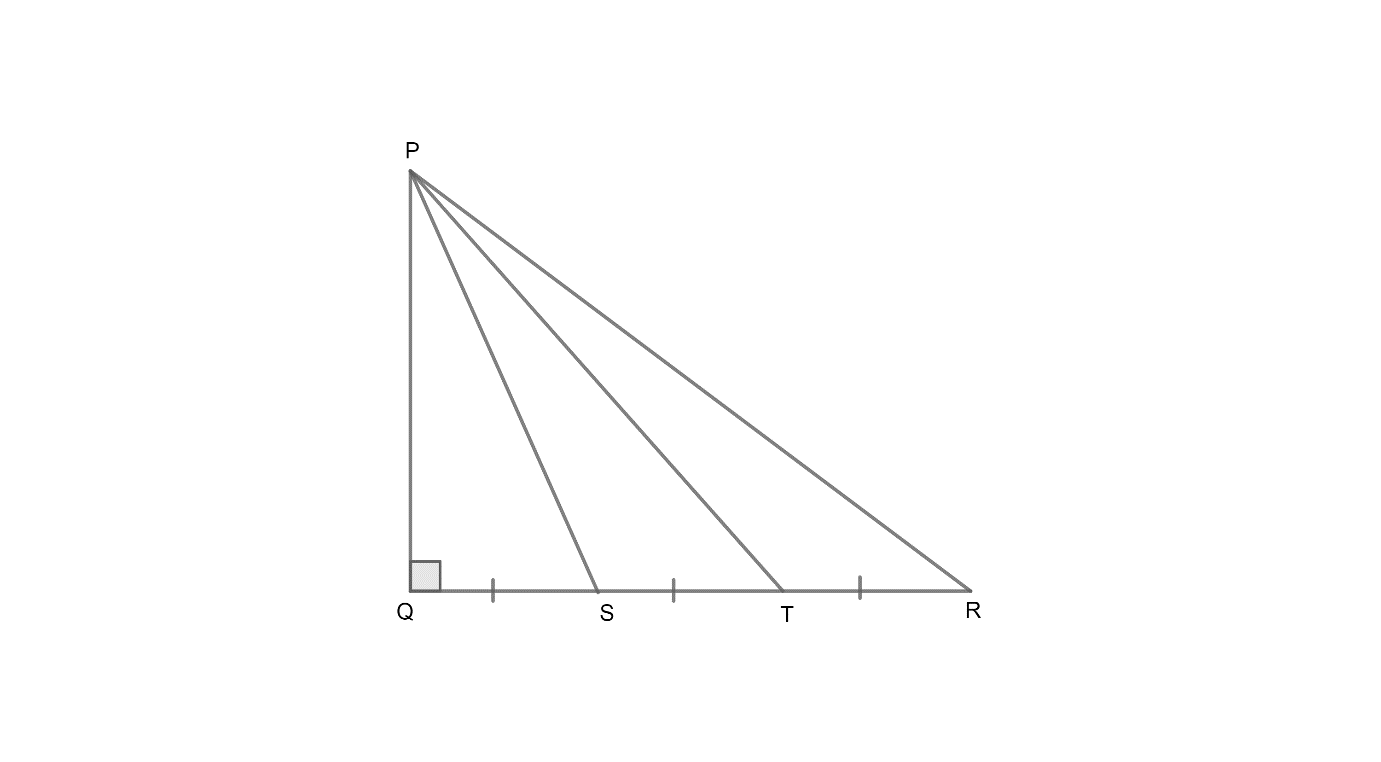
So, we have,
$\begin{align}
& QS=ST=TR.........\left( 1 \right) \\
& QT=2QS........\left( 2 \right) \\
& QR=3QS.........\left( 3 \right) \\
\end{align}$
Now, we will apply the Pythagoras Theorem in $\Delta PQR$. So, we have,
$P{{R}^{2}}=P{{Q}^{2}}+Q{{R}^{2}}$
Now, from (3) we have,
$\begin{align}
& P{{R}^{2}}=P{{Q}^{2}}+{{\left( 3QS \right)}^{2}} \\
& P{{R}^{2}}=P{{Q}^{2}}+9Q{{S}^{2}} \\
\end{align}$
Now, multiplying both sides by 3 we have,
$3P{{R}^{2}}=3P{{Q}^{2}}+27Q{{S}^{2}}...........\left( 4 \right)$
Now, we will apply Pythagoras in $\Delta PTQ$. So, we have,
$P{{T}^{2}}=P{{Q}^{2}}+Q{{T}^{2}}$
Now, from (2) we have,
$\begin{align}
& P{{T}^{2}}=P{{Q}^{2}}+{{\left( 2QS \right)}^{2}} \\
& P{{T}^{2}}=P{{Q}^{2}}+4Q{{S}^{2}} \\
\end{align}$
Multiplying both side by 8 we have,
$8P{{T}^{2}}=8P{{Q}^{2}}+32Q{{S}^{2}}...........\left( 5 \right)$
Now, we will apply Pythagoras in $\Delta PQS$. So, we have,
$P{{S}^{2}}=P{{Q}^{2}}+Q{{S}^{2}}$
Now, we multiply both sides by 5. So, we have,
$5P{{S}^{2}}=5P{{Q}^{2}}+5Q{{S}^{2}}...........\left( 6 \right)$
Now, adding (4) and (6) we have,
$5P{{S}^{2}}+3P{{R}^{2}}=8P{{Q}^{2}}+32Q{{S}^{2}}$
Now, equating with (5), we have,
$8P{{T}^{2}}=5P{{S}^{2}}+3P{{R}^{2}}$
Hence, the statement is true and the correct option is (B).
Note: It is important to note that we have used a fact that if a $\Delta ABC$ is $90{}^\circ $ at B. Then we have $A{{C}^{2}}=A{{B}^{2}}+B{{C}^{2}}$ also, it is important to note that we have converted QR, QT in terms of QS and then multiplied the equation with the constant as per the given equation to find the answer.
Complete step-by-step answer:
Now, we have been given that S and T trisect the side QR of a right triangle PQR.
So, we have,
$\begin{align}
& QS=ST=TR.........\left( 1 \right) \\
& QT=2QS........\left( 2 \right) \\
& QR=3QS.........\left( 3 \right) \\
\end{align}$
Now, we will apply the Pythagoras Theorem in $\Delta PQR$. So, we have,
$P{{R}^{2}}=P{{Q}^{2}}+Q{{R}^{2}}$
Now, from (3) we have,
$\begin{align}
& P{{R}^{2}}=P{{Q}^{2}}+{{\left( 3QS \right)}^{2}} \\
& P{{R}^{2}}=P{{Q}^{2}}+9Q{{S}^{2}} \\
\end{align}$
Now, multiplying both sides by 3 we have,
$3P{{R}^{2}}=3P{{Q}^{2}}+27Q{{S}^{2}}...........\left( 4 \right)$
Now, we will apply Pythagoras in $\Delta PTQ$. So, we have,
$P{{T}^{2}}=P{{Q}^{2}}+Q{{T}^{2}}$
Now, from (2) we have,
$\begin{align}
& P{{T}^{2}}=P{{Q}^{2}}+{{\left( 2QS \right)}^{2}} \\
& P{{T}^{2}}=P{{Q}^{2}}+4Q{{S}^{2}} \\
\end{align}$
Multiplying both side by 8 we have,
$8P{{T}^{2}}=8P{{Q}^{2}}+32Q{{S}^{2}}...........\left( 5 \right)$
Now, we will apply Pythagoras in $\Delta PQS$. So, we have,
$P{{S}^{2}}=P{{Q}^{2}}+Q{{S}^{2}}$
Now, we multiply both sides by 5. So, we have,
$5P{{S}^{2}}=5P{{Q}^{2}}+5Q{{S}^{2}}...........\left( 6 \right)$
Now, adding (4) and (6) we have,
$5P{{S}^{2}}+3P{{R}^{2}}=8P{{Q}^{2}}+32Q{{S}^{2}}$
Now, equating with (5), we have,
$8P{{T}^{2}}=5P{{S}^{2}}+3P{{R}^{2}}$
Hence, the statement is true and the correct option is (B).
Note: It is important to note that we have used a fact that if a $\Delta ABC$ is $90{}^\circ $ at B. Then we have $A{{C}^{2}}=A{{B}^{2}}+B{{C}^{2}}$ also, it is important to note that we have converted QR, QT in terms of QS and then multiplied the equation with the constant as per the given equation to find the answer.
Recently Updated Pages
Basicity of sulphurous acid and sulphuric acid are

Master Class 10 English: Engaging Questions & Answers for Success
Master Class 10 Social Science: Engaging Questions & Answers for Success
Master Class 10 Computer Science: Engaging Questions & Answers for Success
Class 10 Question and Answer - Your Ultimate Solutions Guide
Master Class 10 General Knowledge: Engaging Questions & Answers for Success
Trending doubts
Who is known as the "Little Master" in Indian cricket history?
Explain the Treaty of Vienna of 1815 class 10 social science CBSE
A boat goes 24 km upstream and 28 km downstream in class 10 maths CBSE
The highest dam in India is A Bhakra dam B Tehri dam class 10 social science CBSE
Describe the process of Unification of Italy class 10 social science CBSE
Who Won 36 Oscar Awards? Record Holder Revealed