




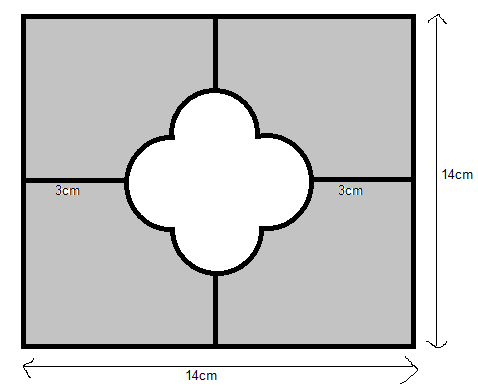
In figure, find the area of the shaded region. (Use π = 3.14)
Answer
 Verified
565.2k+ views
Hint: To find the area of the shaded region we compute the total area of the square and subtract the area of the unshaded region from it. The unshaded region can be divided into a square and 4 semi-circles.
Complete step-by-step answer:
It is impossible to compute the area of an unshaded region with the given data as we do not know the formula of the area of that shape.
So to find the area of unshaded region, we divide it into a square in the middle and 4 semi-circles around it, which looks like the figure below
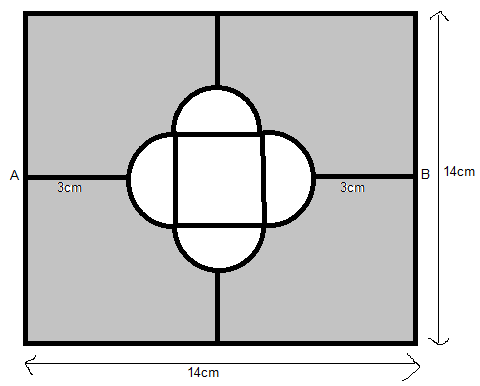
From the figure if we observe the line segment from A to B = 14 cm.
AB = 3 + 3 + 2(diameter D of the circle)
= 6 + 2(2r)
14 = 6 + 4r
Hence radius of the semi-circle (r) = 2cm.
Now, AB can also be written as AB = 3 + 3 + r + r + a (side of the inside square)
⟹14 = 6 + 2 + 2 + a
Therefore the side of the inner square = 4cm.
Now, area of the whole big square whose side is 14cm is ${{\text{s}}^2}$= ${\left( {14} \right)^2} = 196{\text{c}}{{\text{m}}^2}$
Area of small inside square whose side is 4cm is ${{\text{a}}^2} = {4^2} = 16{\text{c}}{{\text{m}}^2}$
Area of 4 semi-circles is A = $4 \times \dfrac{{\pi {{\text{r}}^2}}}{2} = 4 \times \dfrac{{3.14 \times {2^2}}}{2} = 25.12{\text{c}}{{\text{m}}^2}$
Now, area of shaded region = area of big whole square – area of small inner square – area of 4 semi-circles.
⟹Area of shaded region = 196 – 16 – 25.12 = 154.88${\text{c}}{{\text{m}}^2}$.
Note: In order to solve this type of question the key is to divide the unshaded region into known shapes and then we compute its area. We then subtract this from the total area to find the area of the unshaded part.
Area of square with side a = ${{\text{a}}^2}$
Area of a semicircle with radius r =$\dfrac{{\pi {{\text{r}}^2}}}{2}$.
Complete step-by-step answer:
It is impossible to compute the area of an unshaded region with the given data as we do not know the formula of the area of that shape.
So to find the area of unshaded region, we divide it into a square in the middle and 4 semi-circles around it, which looks like the figure below
From the figure if we observe the line segment from A to B = 14 cm.
AB = 3 + 3 + 2(diameter D of the circle)
= 6 + 2(2r)
14 = 6 + 4r
Hence radius of the semi-circle (r) = 2cm.
Now, AB can also be written as AB = 3 + 3 + r + r + a (side of the inside square)
⟹14 = 6 + 2 + 2 + a
Therefore the side of the inner square = 4cm.
Now, area of the whole big square whose side is 14cm is ${{\text{s}}^2}$= ${\left( {14} \right)^2} = 196{\text{c}}{{\text{m}}^2}$
Area of small inside square whose side is 4cm is ${{\text{a}}^2} = {4^2} = 16{\text{c}}{{\text{m}}^2}$
Area of 4 semi-circles is A = $4 \times \dfrac{{\pi {{\text{r}}^2}}}{2} = 4 \times \dfrac{{3.14 \times {2^2}}}{2} = 25.12{\text{c}}{{\text{m}}^2}$
Now, area of shaded region = area of big whole square – area of small inner square – area of 4 semi-circles.
⟹Area of shaded region = 196 – 16 – 25.12 = 154.88${\text{c}}{{\text{m}}^2}$.
Note: In order to solve this type of question the key is to divide the unshaded region into known shapes and then we compute its area. We then subtract this from the total area to find the area of the unshaded part.
Area of square with side a = ${{\text{a}}^2}$
Area of a semicircle with radius r =$\dfrac{{\pi {{\text{r}}^2}}}{2}$.
Recently Updated Pages
Master Class 11 English: Engaging Questions & Answers for Success

Master Class 11 Social Science: Engaging Questions & Answers for Success
Master Class 11 Maths: Engaging Questions & Answers for Success
Master Class 11 Biology: Engaging Questions & Answers for Success
Master Class 11 Physics: Engaging Questions & Answers for Success
Master Class 11 Chemistry: Engaging Questions & Answers for Success
Trending doubts
Explain the Treaty of Vienna of 1815 class 10 social science CBSE
In cricket, what is a "Yorker" designed to do?
What is the full form of POSCO class 10 social science CBSE
Define Potential, Developed, Stock and Reserved resources
Identify the plural form of the word child from the class 10 english CBSE
Draw a circuit diagram showing the cell switch and class 10 physics CBSE