




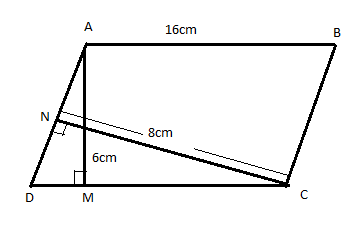
In fig. ABCD is a parallelogram with AB = 16cm. the altitude AM and CN are respectively 6cm and 8cm, then AD is equal to :
A. 3cm
B. 6cm
C. 12cm
D. 16cm
Answer
 Verified
664.8k+ views
Hint: A parallelogram is a quadrilateral with opposite sides parallel and therefore opposite angles are also equal. And if we draw a vertex in the parallelogram then the opposite angles must be congruent to each other.
Complete step by step solution:
As we know that there are two altitudes in this figure and that are AM and CN.
And the base for altitude AM is DC and the base for altitude CN is AD.
Now the formula for area of parallelogram is base * height = \[AM \times DC = CN \times AD\]
\[AM \times DC = CN \times AD\] because areas with any of the altitude and base of a parallelogram are the same . And as we know that the opposite sides of parallelogram are equal so AB = DC.
Now putting the values of AM, DC and CN in the above equation.
\[ \Rightarrow 6 \times 16 = 8 \times AD\]
Now solving L.H.S and R.H.S
\[ \Rightarrow 96 = 8 \times AD\]
\[ \Rightarrow AD = \dfrac{{96}}{8} = 12cm\]
So, AD = 12cm
Hence C is the correct option.
Note: The area of parallelogram is always equal whether we take altitude CN and base AD or we take altitude AM and base DC we can also prove it with the help of formula ( i.e. 6 * 16 = 8 * 12 = 96\[c{m^2}\] ). This is possible because all the altitudes of a particular parallelogram when multiplied with its base will give the same result.
Complete step by step solution:
As we know that there are two altitudes in this figure and that are AM and CN.
And the base for altitude AM is DC and the base for altitude CN is AD.
Now the formula for area of parallelogram is base * height = \[AM \times DC = CN \times AD\]
\[AM \times DC = CN \times AD\] because areas with any of the altitude and base of a parallelogram are the same . And as we know that the opposite sides of parallelogram are equal so AB = DC.
Now putting the values of AM, DC and CN in the above equation.
\[ \Rightarrow 6 \times 16 = 8 \times AD\]
Now solving L.H.S and R.H.S
\[ \Rightarrow 96 = 8 \times AD\]
\[ \Rightarrow AD = \dfrac{{96}}{8} = 12cm\]
So, AD = 12cm
Hence C is the correct option.
Note: The area of parallelogram is always equal whether we take altitude CN and base AD or we take altitude AM and base DC we can also prove it with the help of formula ( i.e. 6 * 16 = 8 * 12 = 96\[c{m^2}\] ). This is possible because all the altitudes of a particular parallelogram when multiplied with its base will give the same result.
Recently Updated Pages
Write any three differences between metals and nonmetals class 10 social science CBSE

Amit standing on a horizontal plane finds a bird flying class 10 maths CBSE
Two circles of radii 5 cm and 3 cm intersect at two class 10 maths CBSE
Solve the following i John and Jivanti together have class 10 maths CBSE
What is the relation between orthocenter circumcentre class 10 maths CBSE
Two plane mirrors are inclined at 70circ A ray incident class 10 physics CBSE
Trending doubts
Which country is known as "The land of Fire and Ice"?
1 GB equals how many MB?
Which is the hottest planet in the Solar system A Earth class 10 social science CBSE
Name any four life processes in living things class 10 biology CBSE
Choose the feminine form of the given noun Fox AFoxess class 10 english CBSE
In which year voting age was reduced from 21 to 18?