




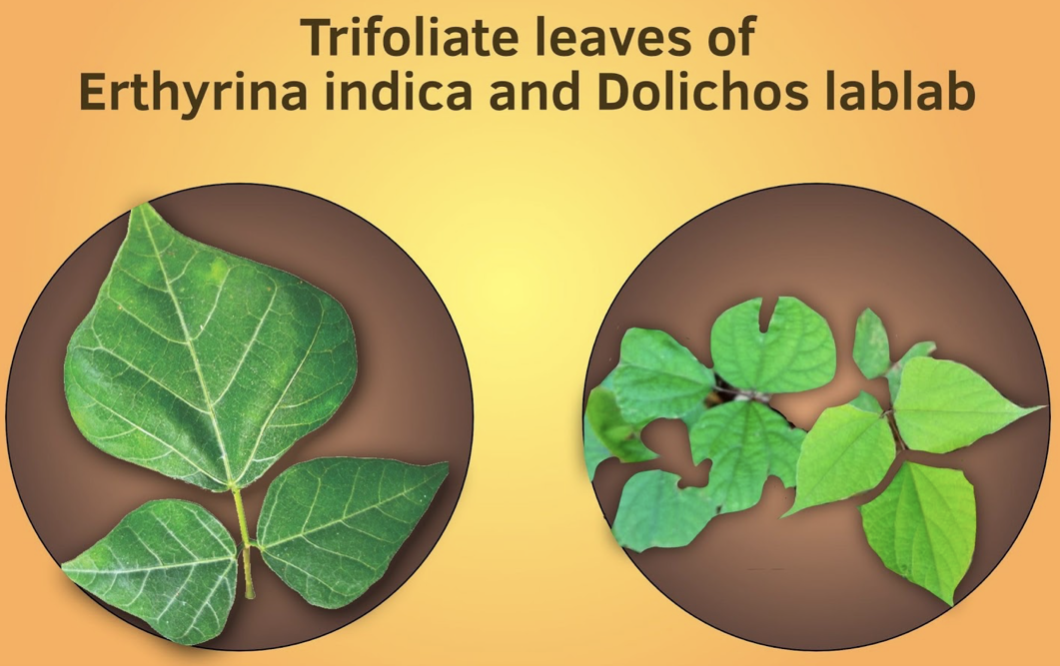
In Erythrina indica and Dolichos lablab, the leaves are
(a) Unipinnate
(b) Bipinnate
(c) Tripinnate
(d) Trifoliate
Answer
 Verified
616.5k+ views
Hint: These leaves are also called ternate leaves which have a unique shape and can be differentiated by the leaves which are divided into leaflets. Several plants such as Aquilegia grata and Aquilegia vulgaris show this kind of leaves.
Complete answer:
In Erythrina indica and Dolichos lablab, the leaves are trifoliate. Pinnation is an arrangement of different structures like leaflets, veins, branches that will be formed from multiple places through a common axis. Pinnately clustered leaves are trifoliate leaves that are characterized by the leaf shape that divides into leaflets (three normally) .
Additional information:
- Leaves are the major lateral attachment of the seams of a vascular plant that is commonly formed above the ground and is capable of photosynthesis.
- Shoot is the combination of the leaves and stems together. Mostly all the leaves have the palisade mesophyll which is the primary photosynthetic tissue, located at the top side of the lamina of the leaf.
- In rare cases, some plants have the palisade mesophyll present on either side of the leaves and are called as isobilateral. Example: Eucalyptus.
So, the correct answer is ‘(d)Trifoliate’.
Note:
- There are leaves with various structures, sizes and forms. The broad- leaved or megaphyllous are plants with wide, flat leaves with compound venation of flowering plants and the species that produce them are the megaphylls.
- Some species of plants have leaves submerged In water and these are commonly called aquatic plants. Plants which have thick fleshy leaves are called Succulent plants.
- Leaves contain xylem and phloem (vascularised) which provides water for photosynthesis and the products produced in the process of photosynthesis.
Complete answer:
In Erythrina indica and Dolichos lablab, the leaves are trifoliate. Pinnation is an arrangement of different structures like leaflets, veins, branches that will be formed from multiple places through a common axis. Pinnately clustered leaves are trifoliate leaves that are characterized by the leaf shape that divides into leaflets (three normally) .
Additional information:
- Leaves are the major lateral attachment of the seams of a vascular plant that is commonly formed above the ground and is capable of photosynthesis.
- Shoot is the combination of the leaves and stems together. Mostly all the leaves have the palisade mesophyll which is the primary photosynthetic tissue, located at the top side of the lamina of the leaf.
- In rare cases, some plants have the palisade mesophyll present on either side of the leaves and are called as isobilateral. Example: Eucalyptus.
So, the correct answer is ‘(d)Trifoliate’.
Note:
- There are leaves with various structures, sizes and forms. The broad- leaved or megaphyllous are plants with wide, flat leaves with compound venation of flowering plants and the species that produce them are the megaphylls.
- Some species of plants have leaves submerged In water and these are commonly called aquatic plants. Plants which have thick fleshy leaves are called Succulent plants.
- Leaves contain xylem and phloem (vascularised) which provides water for photosynthesis and the products produced in the process of photosynthesis.
Recently Updated Pages
Master Class 11 English: Engaging Questions & Answers for Success

Master Class 11 Social Science: Engaging Questions & Answers for Success
Master Class 11 Maths: Engaging Questions & Answers for Success
Master Class 11 Biology: Engaging Questions & Answers for Success
Master Class 11 Physics: Engaging Questions & Answers for Success
Master Class 11 Chemistry: Engaging Questions & Answers for Success
Trending doubts
One Metric ton is equal to kg A 10000 B 1000 C 100 class 11 physics CBSE
What is cell theory Who formulated it class 11 biology CBSE
Phyllotaxy is the arrangement of ALeaflets BLeaves class 11 biology CBSE
Difference Between Prokaryotic Cells and Eukaryotic Cells
The symbiotic association of fungi and algae is called class 11 biology CBSE
Cell theory was formulated by A Schleiden and Schwann class 11 biology CBSE