




In Dow’s process for manufacture of phenol, PhCl is fused with NaOH at elevated temperature under pressure.
\[PhCl\xrightarrow[{623K,300atm}]{{NaOH}}[Intermediate]\xrightarrow{{{H_2}O}}Phenol(A) + (B + C)sideproduct\]
Which of the following statements are correct?
(This question has multiple correct options)
(A) Phenol is formed via the formation of benzyne intermediate
(B) p – phenyl phenol is also formed as a by product
(C) Diphenyl ether is also formed as a by – product
(D) Biphenylene is also formed as a by – product
Answer
 Verified
633.3k+ views
Hint: Dow’s process is hydrolysis of chlorobenzene. It is a nucleophilic substitution reaction. It is formed by an intermediate of benzene. Nucleophilic substitution is a type of reaction in which an electron rich compound replaces a leaving group.
Complete answer:
- We refer to Dow's Process to the hydrolysis of chlorobenzene for the preparation of phenol.
-We can easily convert benzene chlorobenzene by electrophilic aromatic substitution.
- Dow’s process is preparation of phenol from haloarenes, it is an industrial preparation of phenol.
- Chlorobenzenes with 10% NaOH solution is heated at 623K under 300 atm pressure.
- The major product of Dow’s process is phenol but other by- products are also formed as a result of reaction between the species formed during the reaction.
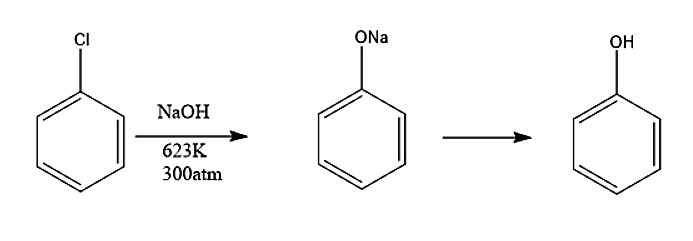
- Now let’s understand the reaction mechanism:
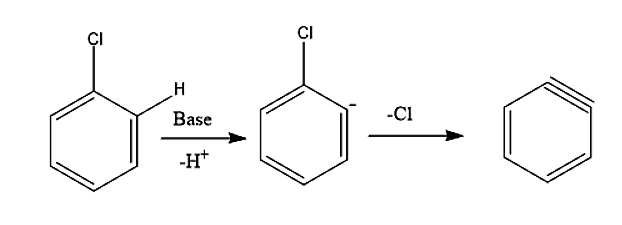
-In the first step, the base (NaOH) removes one hydrogen from the benzene ring and forms a carbanion which loses \[C{l^ - }\] ion to form benzyne intermediate.
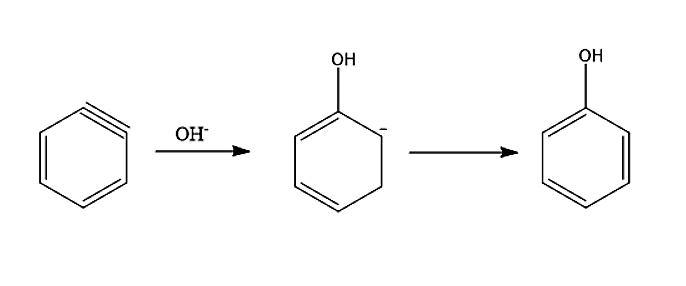
-In the second step, an attack of nucleophile takes place. The benzyne intermediate formed gets attacked by nucleophile \[O{H^ - }\]to form carbanion which subsequently gets protonated to form phenol.
- Now for side products, let’s see the conversion of reactants into reacting species.
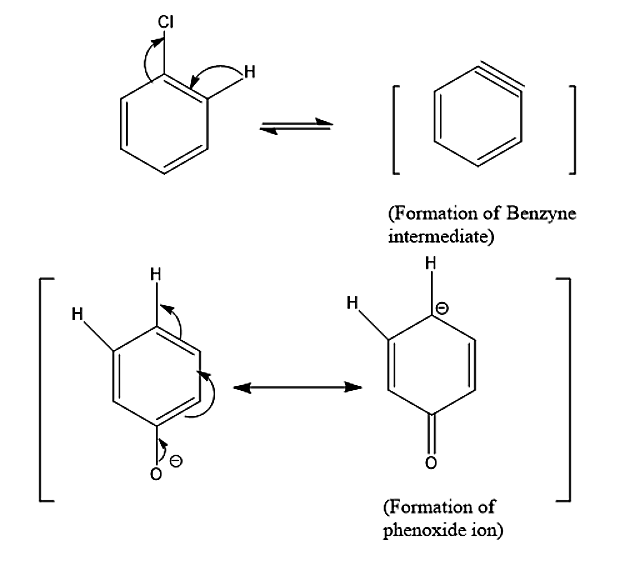
- Due to the presence of phenoxide ions diphenyl ether is also a by – product.
- Another by – product we see is para- phenyl phenol which is formed by benzyne and phenoxide ions.
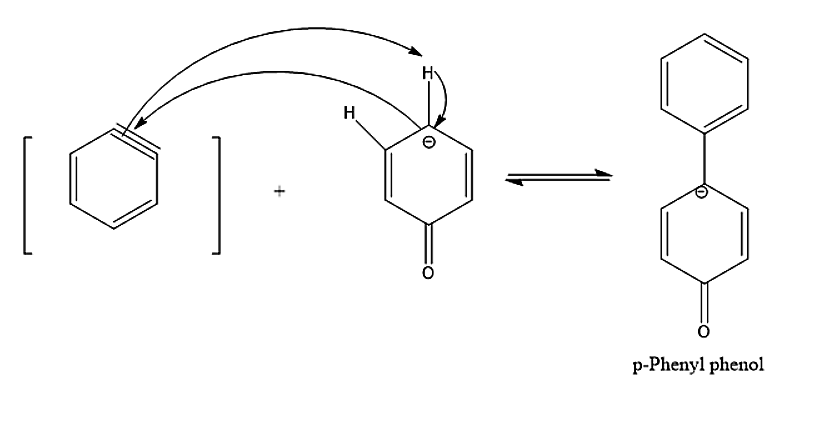
Therefore, the correct statements are options A. Phenol is formed via the formation of benzyne intermediate, B. p – phenyl phenol is also formed as a by-product, C. Diphenyl ether is also formed as a by – product.
Note:
-After the formation of benzyne, \[O{H^ - }\] nucleophilic attack takes place.
-The reaction mixture also contains some phenoxide ions. So, Diphenyl ether is a possible side product.
- The major product of Dow’s process is phenol but other by- products are also formed as a result of reaction between the species formed during the reaction.
Complete answer:
- We refer to Dow's Process to the hydrolysis of chlorobenzene for the preparation of phenol.
-We can easily convert benzene chlorobenzene by electrophilic aromatic substitution.
- Dow’s process is preparation of phenol from haloarenes, it is an industrial preparation of phenol.
- Chlorobenzenes with 10% NaOH solution is heated at 623K under 300 atm pressure.
- The major product of Dow’s process is phenol but other by- products are also formed as a result of reaction between the species formed during the reaction.
- Now let’s understand the reaction mechanism:
-In the first step, the base (NaOH) removes one hydrogen from the benzene ring and forms a carbanion which loses \[C{l^ - }\] ion to form benzyne intermediate.
-In the second step, an attack of nucleophile takes place. The benzyne intermediate formed gets attacked by nucleophile \[O{H^ - }\]to form carbanion which subsequently gets protonated to form phenol.
- Now for side products, let’s see the conversion of reactants into reacting species.
- Due to the presence of phenoxide ions diphenyl ether is also a by – product.
- Another by – product we see is para- phenyl phenol which is formed by benzyne and phenoxide ions.
Therefore, the correct statements are options A. Phenol is formed via the formation of benzyne intermediate, B. p – phenyl phenol is also formed as a by-product, C. Diphenyl ether is also formed as a by – product.
Note:
-After the formation of benzyne, \[O{H^ - }\] nucleophilic attack takes place.
-The reaction mixture also contains some phenoxide ions. So, Diphenyl ether is a possible side product.
- The major product of Dow’s process is phenol but other by- products are also formed as a result of reaction between the species formed during the reaction.
Recently Updated Pages
If x a + bt + ct2 where x is in meters and t is in class 11 physics CBSE

A car covers the first half distance between two places class 11 physics CBSE
The resultant of two vectors overrightarrow P and overrightarrow class 11 physics CBSE
Find the value of cos 135 class 11 maths CBSE
A mass M is held in place by an applied force F and class 11 physics CBSE
A solution of glucose in water is labelled as 10 dfracwv class 11 chemistry CBSE
Trending doubts
Find the value of the expression given below sin 30circ class 11 maths CBSE
One Metric ton is equal to kg A 10000 B 1000 C 100 class 11 physics CBSE
Draw a diagram of nephron and explain its structur class 11 biology CBSE
10 examples of friction in our daily life
Proton was discovered by A Thomson B Rutherford C Chadwick class 11 chemistry CBSE
Bond order ofO2 O2+ O2 and O22 is in order A O2 langle class 11 chemistry CBSE