




In Dianthus, placentation is
(a)Basal
(b)Free central
(c)Axile
(d)marginal
Answer
 Verified
618.3k+ views
Hint: The arrangement of ovules within the ovary is called placentation. There are different types of placentation namely marginal, axile, parietal, basal, and free central. In dianthus and primrose, the ovules are born on the central axis without septa.
Complete answer:
A plant ovary contains one or more ovules attached to a flattened,cushion-like structure called the placenta.
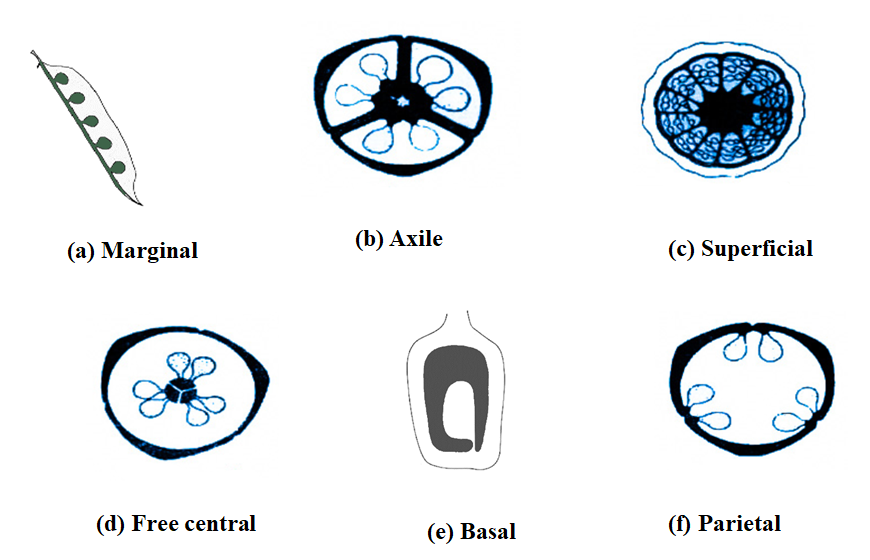
In free central placentation, the ovules are borne on the central axis without septa.
Therefore, the type of placentation in dianthus is free central.
Additional Information: There are different types of placentation namely,
-Marginal type of placentation, wherein the placenta forms a ridge seen at the ventral suture of the ovary. The ovules are attached to this ridge in two rows.
-Axile placentation, where the placenta is present at the center with ovules attached to it and the ovary is multilocular.
-Parietal placentation, where the ovules are attached to the wall of the ovary that is parietally. The ovary is originally unilocular but due to the formation of a false septum becomes two-chambered.
-Free central placentation wherein the ovules are present at the center and the ovary is unilocular.
-Basal type of placentation where as the name suggests a single ovule is present at the basal part of the unilocular ovary.
Examples of different types of placentation are
Marginal: pea
Axile: rose,tomato,lemon
Parietal: mustard, agremone
Free central: dianthus, primrose
Basal: sunflower, marigold
So, the correct answer is ‘free central’.
Note: Placentation is referred to as the arrangement of ovules inside the ovary.
Another type of placentation that is lesser known is the superficial placentation as seen in a multicarpellary ovary. Here the ovules are seen developing on the inner surface of the carpels. Ex: Nymphaeaceae.
Complete answer:
A plant ovary contains one or more ovules attached to a flattened,cushion-like structure called the placenta.
In free central placentation, the ovules are borne on the central axis without septa.
Therefore, the type of placentation in dianthus is free central.
Additional Information: There are different types of placentation namely,
-Marginal type of placentation, wherein the placenta forms a ridge seen at the ventral suture of the ovary. The ovules are attached to this ridge in two rows.
-Axile placentation, where the placenta is present at the center with ovules attached to it and the ovary is multilocular.
-Parietal placentation, where the ovules are attached to the wall of the ovary that is parietally. The ovary is originally unilocular but due to the formation of a false septum becomes two-chambered.
-Free central placentation wherein the ovules are present at the center and the ovary is unilocular.
-Basal type of placentation where as the name suggests a single ovule is present at the basal part of the unilocular ovary.
Examples of different types of placentation are
Marginal: pea
Axile: rose,tomato,lemon
Parietal: mustard, agremone
Free central: dianthus, primrose
Basal: sunflower, marigold
So, the correct answer is ‘free central’.
Note: Placentation is referred to as the arrangement of ovules inside the ovary.
Another type of placentation that is lesser known is the superficial placentation as seen in a multicarpellary ovary. Here the ovules are seen developing on the inner surface of the carpels. Ex: Nymphaeaceae.
Recently Updated Pages
Master Class 12 Economics: Engaging Questions & Answers for Success

Master Class 12 English: Engaging Questions & Answers for Success
Master Class 12 Social Science: Engaging Questions & Answers for Success
Master Class 12 Maths: Engaging Questions & Answers for Success
Master Class 12 Physics: Engaging Questions & Answers for Success
Master Class 11 Social Science: Engaging Questions & Answers for Success
Trending doubts
One Metric ton is equal to kg A 10000 B 1000 C 100 class 11 physics CBSE
Difference Between Prokaryotic Cells and Eukaryotic Cells
Find the value of the expression given below sin 30circ class 11 maths CBSE
Two of the body parts which do not appear in MRI are class 11 biology CBSE
Draw a diagram of nephron and explain its structur class 11 biology CBSE
10 examples of friction in our daily life