




In $\Delta OPQ$, right-angled at P, OQ-PQ = 1 cm and OP = 7 cm. Determine the values of sinQ and cosQ .
Answer
 Verified
617.7k+ views
Hint: Sine function of an angle is the ratio between the opposite side length to that of the hypotenuse. The cosine function of an angle is the ratio of the length of the adjacent side to the length of the hypotenuse.
Complete step-by-step answer:
It is given that
OQ-PQ = 1 cm and OP = 7 cm
Let us assume that PQ = x
OQ-PQ = 1
OQ = 1+PQ
OQ = 1 + x
In right triangle OPQ, Using Pythagoras Theorem
\[{{\left( \text{Hypotenuse} \right)}^{2}}={{\left( \text{Height} \right)}^{2}}+{{\left( \text{Base} \right)}^{2}}\]
${{\left( OQ \right)}^{2}}={{\left( OP \right)}^{2}}+{{\left( PQ \right)}^{2}}$
Now put all the values in the above equation, we get
${{\left( 1+x \right)}^{2}}={{7}^{2}}+{{x}^{2}}$
Expanding the term on the left side by using ${{\left( a+b \right)}^{2}}={{a}^{2}}+2ab+{{b}^{2}}$ , we get
${{1}^{2}}+{{x}^{2}}+2\times 1\times x=49+{{x}^{2}}$
Rearranging the terms, we get
$1+{{x}^{2}}+2x=49+{{x}^{2}}$
$1+{{x}^{2}}+2x-49-{{x}^{2}}=0$
Cancelling the term ${{x}^{2}}$ on the left side, we get
$2x-48=0$
$2x=48$
Dividing both sides by 2, we get
$x=\dfrac{48}{2}=24$
Hence the required length of side PQ $=x=24$cm
Therefore the length of side OQ $=1+x=1+24=25$cm
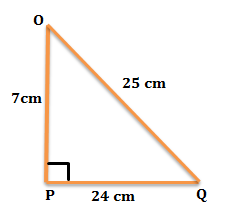
The basic definitions of the trigonometric functions are
The sine function of an angle is the ratio between the opposite side length to that of the hypotenuse.
$\sin Q=\dfrac{\text{side opposite to angle Q}}{\text{Hypotenuse}}=\dfrac{OP}{OQ}=\dfrac{7}{25}$
The cosine function of an angle is the ratio of the length of the adjacent side to the length of the hypotenuse.
$\cos Q=\dfrac{\text{side adjacent to angle Q}}{\text{Hypotenuse}}=\dfrac{PQ}{OQ}=\dfrac{24}{25}$
Note: It should be noted that the $\cos Q$ can also be represented in terms of sine that is $\cos Q=\sqrt{1-{{\sin }^{2}}Q}$ .
Hence $\cos Q=\sqrt{1-{{\left( \dfrac{7}{25} \right)}^{2}}}=\sqrt{1-\dfrac{49}{625}}=\sqrt{\dfrac{625-49}{625}}=\sqrt{\dfrac{576}{625}}=\sqrt{{{\left( \dfrac{24}{25} \right)}^{2}}}=\dfrac{24}{25}$
Complete step-by-step answer:
It is given that
OQ-PQ = 1 cm and OP = 7 cm
Let us assume that PQ = x
OQ-PQ = 1
OQ = 1+PQ
OQ = 1 + x
In right triangle OPQ, Using Pythagoras Theorem
\[{{\left( \text{Hypotenuse} \right)}^{2}}={{\left( \text{Height} \right)}^{2}}+{{\left( \text{Base} \right)}^{2}}\]
${{\left( OQ \right)}^{2}}={{\left( OP \right)}^{2}}+{{\left( PQ \right)}^{2}}$
Now put all the values in the above equation, we get
${{\left( 1+x \right)}^{2}}={{7}^{2}}+{{x}^{2}}$
Expanding the term on the left side by using ${{\left( a+b \right)}^{2}}={{a}^{2}}+2ab+{{b}^{2}}$ , we get
${{1}^{2}}+{{x}^{2}}+2\times 1\times x=49+{{x}^{2}}$
Rearranging the terms, we get
$1+{{x}^{2}}+2x=49+{{x}^{2}}$
$1+{{x}^{2}}+2x-49-{{x}^{2}}=0$
Cancelling the term ${{x}^{2}}$ on the left side, we get
$2x-48=0$
$2x=48$
Dividing both sides by 2, we get
$x=\dfrac{48}{2}=24$
Hence the required length of side PQ $=x=24$cm
Therefore the length of side OQ $=1+x=1+24=25$cm
The basic definitions of the trigonometric functions are
The sine function of an angle is the ratio between the opposite side length to that of the hypotenuse.
$\sin Q=\dfrac{\text{side opposite to angle Q}}{\text{Hypotenuse}}=\dfrac{OP}{OQ}=\dfrac{7}{25}$
The cosine function of an angle is the ratio of the length of the adjacent side to the length of the hypotenuse.
$\cos Q=\dfrac{\text{side adjacent to angle Q}}{\text{Hypotenuse}}=\dfrac{PQ}{OQ}=\dfrac{24}{25}$
Note: It should be noted that the $\cos Q$ can also be represented in terms of sine that is $\cos Q=\sqrt{1-{{\sin }^{2}}Q}$ .
Hence $\cos Q=\sqrt{1-{{\left( \dfrac{7}{25} \right)}^{2}}}=\sqrt{1-\dfrac{49}{625}}=\sqrt{\dfrac{625-49}{625}}=\sqrt{\dfrac{576}{625}}=\sqrt{{{\left( \dfrac{24}{25} \right)}^{2}}}=\dfrac{24}{25}$
Recently Updated Pages
Basicity of sulphurous acid and sulphuric acid are

Master Class 10 English: Engaging Questions & Answers for Success
Master Class 10 Social Science: Engaging Questions & Answers for Success
Master Class 10 Computer Science: Engaging Questions & Answers for Success
Class 10 Question and Answer - Your Ultimate Solutions Guide
Master Class 10 General Knowledge: Engaging Questions & Answers for Success
Trending doubts
Which country won the ICC Men's ODI World Cup in 2023?
In cricket, how many legal balls are there in a standard over?
Explain the Treaty of Vienna of 1815 class 10 social science CBSE
A boat goes 24 km upstream and 28 km downstream in class 10 maths CBSE
What does "powerplay" mean in limited-overs cricket?
What is the "Powerplay" in T20 cricket?