




In $\Delta ABC$, $\angle ABC = 135^\circ $,
Prove that $A{C^2} = A{B^2} + B{C^2} + 4\left( {\Delta ABC} \right)$.
Answer
 Verified
596.1k+ views
Hint:
Draw a triangle having $\angle ABC = 135^\circ $ and name the triangle as $ABC$, extend the side $BC$ and draw a perpendicular on it from point $A$ and use Pythagoras theorem on triangle $ADB$ and $ADC$
Complete step-by-step answer:
Given:\[\Delta ABC\] and \[\angle ABC = 135^\circ \]
To prove:\[{(AC)^2} = {(AB)^2} + {(BC)^2} + 4ar(\Delta ABC)\]
Construction: Draw a triangle $ABC$ and produce BC to D and draw AD perpendicular to DC.
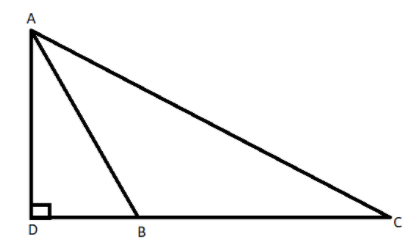
Proof: Consider the triangle $ADB$ and apply Pythagoras theorem on \[\Delta ADB\].
\[{(AB)^2} = {(AD)^2} + {(DB)^2}\]
Now, consider the triangle $ADC$ and again, applying Pythagoras theorem on \[\Delta ADC\].
\[{(AC)^2} = {(AD)^2} + {(DC)^2}\] (1)
As, side $DC$ is equal to the sum of sides $DB$ and $BC$, that is, \[DC = DB + BC\].
So, simplify the obtained equation (2) by substituting \[DC = DB + BC\].
\[{(AC)^2} = {(AD)^2} + {(DB + BC)^2}\]
Now, apply the algebraic identity \[{(a + b)^2} = {a^2} + {b^2} + 2a.b\] and simplify the obtained equation further.
\[{(AC)^2} = {(AD)^2} + {(DB)^2} + {(BC)^2} + 2 \cdot DB \cdot BC\]
It is observed that \[\angle ADB = 90^\circ \], because $AD$ is perpendicular to $BC$ or $DB$.
Now, find the angle $\angle ABD$.
As given $\angle ABC = 135^\circ $.
$\angle DBC$ is a straight line angle, which is equal to $180^\circ $.
So sum of the angles $\angle ABD$ and $\angle ABC$ will be equal to $180^\circ $.
That is $\angle ABD + \angle ABC = 180^\circ $
Now, find $\angle ABD$ by using $\angle ABC = 135^\circ $.
$
\angle ABD + 135^\circ = 180^\circ \\
\Rightarrow \angle ABD = 180^\circ - 135^\circ \\
\Rightarrow \angle ABD = 45^\circ \\
$
Now find the angle $DAB$ with the help of the obtained angle and \[\angle ADB = 90^\circ \].
as the sum of all angles of a triangle is $180^\circ $.
Then,
\[\angle ADB + \angle DAB + \angle ABD = 180^\circ \]
Now simplify the obtained equation for angle $DAB$,
\[
90^\circ + \angle DAB + 45^\circ = 180^\circ \\
135^\circ + \angle DAB = 180^\circ \\
\angle DAB = 180^\circ - 135^\circ \\
= 45^\circ \\
\]
As a result, \[ \Rightarrow \angle ABD = \angle DAB = 45^\circ \]
This implies, \[AD = DB\](Sides opposite to equal angles are equal) (2)
From equation (1) and (2)
\[
{(AC)^2} = {\left( {AD} \right)^2} + {\left( {DC} \right)^2} \\
{(AC)^2} = {\left( {AD} \right)^2} + {\left( {DB + BC} \right)^2}{\text{ As}}\left( {DC = DB + BC} \right) \\
{(AC)^2} = {(AD)^2} + {(DB)^2} + {\left( {BC} \right)^2} + 2 \cdot DB \cdot BC{\text{ As}}\left[ {{{\left( {DB + BC} \right)}^2} = D{B^2} + B{C^2} + 2.DB.BC} \right]{\text{ }} \\
{\left( {AC} \right)^2} = {\left( {AB} \right)^2} + {\left( {BC} \right)^2} + 2.AD.BC{\text{ As}}\left( {A{C^2} = A{B^2} + B{C^2}} \right){\text{ and }}\left( {AD = DB} \right) \\
\]
Multiply and divide by 2 in the term \[2 \cdot AD \cdot BC\] of the obtained expression.
\[
{(AC)^2} = {(AB)^2} + {(BC)^2} + \dfrac{2}{2}(2 \cdot AD \cdot BC) \\
{(AC)^2} = {(AB)^2} + {(BC)^2} + 4\left( {\dfrac{1}{2} \cdot AD \cdot BC} \right) \\
{(AC)^2} = {(AB)^2} + {(BC)^2} + 4ar\left( {\Delta ABC} \right) \\
\]
Hence proved that \[{(AC)^2} = {(AB)^2} + {(BC)^2} + 4ar(\Delta ABC)\].
Note:
Use the Pythagoras Theorem\[{(hypotenuse)^2} = {(base)^2} + {(perpendicular)^2}\] and use the fact that Theorem based on opposite sides triangles, also use the formula of area of area of triangle.
Draw a triangle having $\angle ABC = 135^\circ $ and name the triangle as $ABC$, extend the side $BC$ and draw a perpendicular on it from point $A$ and use Pythagoras theorem on triangle $ADB$ and $ADC$
Complete step-by-step answer:
Given:\[\Delta ABC\] and \[\angle ABC = 135^\circ \]
To prove:\[{(AC)^2} = {(AB)^2} + {(BC)^2} + 4ar(\Delta ABC)\]
Construction: Draw a triangle $ABC$ and produce BC to D and draw AD perpendicular to DC.
Proof: Consider the triangle $ADB$ and apply Pythagoras theorem on \[\Delta ADB\].
\[{(AB)^2} = {(AD)^2} + {(DB)^2}\]
Now, consider the triangle $ADC$ and again, applying Pythagoras theorem on \[\Delta ADC\].
\[{(AC)^2} = {(AD)^2} + {(DC)^2}\] (1)
As, side $DC$ is equal to the sum of sides $DB$ and $BC$, that is, \[DC = DB + BC\].
So, simplify the obtained equation (2) by substituting \[DC = DB + BC\].
\[{(AC)^2} = {(AD)^2} + {(DB + BC)^2}\]
Now, apply the algebraic identity \[{(a + b)^2} = {a^2} + {b^2} + 2a.b\] and simplify the obtained equation further.
\[{(AC)^2} = {(AD)^2} + {(DB)^2} + {(BC)^2} + 2 \cdot DB \cdot BC\]
It is observed that \[\angle ADB = 90^\circ \], because $AD$ is perpendicular to $BC$ or $DB$.
Now, find the angle $\angle ABD$.
As given $\angle ABC = 135^\circ $.
$\angle DBC$ is a straight line angle, which is equal to $180^\circ $.
So sum of the angles $\angle ABD$ and $\angle ABC$ will be equal to $180^\circ $.
That is $\angle ABD + \angle ABC = 180^\circ $
Now, find $\angle ABD$ by using $\angle ABC = 135^\circ $.
$
\angle ABD + 135^\circ = 180^\circ \\
\Rightarrow \angle ABD = 180^\circ - 135^\circ \\
\Rightarrow \angle ABD = 45^\circ \\
$
Now find the angle $DAB$ with the help of the obtained angle and \[\angle ADB = 90^\circ \].
as the sum of all angles of a triangle is $180^\circ $.
Then,
\[\angle ADB + \angle DAB + \angle ABD = 180^\circ \]
Now simplify the obtained equation for angle $DAB$,
\[
90^\circ + \angle DAB + 45^\circ = 180^\circ \\
135^\circ + \angle DAB = 180^\circ \\
\angle DAB = 180^\circ - 135^\circ \\
= 45^\circ \\
\]
As a result, \[ \Rightarrow \angle ABD = \angle DAB = 45^\circ \]
This implies, \[AD = DB\](Sides opposite to equal angles are equal) (2)
From equation (1) and (2)
\[
{(AC)^2} = {\left( {AD} \right)^2} + {\left( {DC} \right)^2} \\
{(AC)^2} = {\left( {AD} \right)^2} + {\left( {DB + BC} \right)^2}{\text{ As}}\left( {DC = DB + BC} \right) \\
{(AC)^2} = {(AD)^2} + {(DB)^2} + {\left( {BC} \right)^2} + 2 \cdot DB \cdot BC{\text{ As}}\left[ {{{\left( {DB + BC} \right)}^2} = D{B^2} + B{C^2} + 2.DB.BC} \right]{\text{ }} \\
{\left( {AC} \right)^2} = {\left( {AB} \right)^2} + {\left( {BC} \right)^2} + 2.AD.BC{\text{ As}}\left( {A{C^2} = A{B^2} + B{C^2}} \right){\text{ and }}\left( {AD = DB} \right) \\
\]
Multiply and divide by 2 in the term \[2 \cdot AD \cdot BC\] of the obtained expression.
\[
{(AC)^2} = {(AB)^2} + {(BC)^2} + \dfrac{2}{2}(2 \cdot AD \cdot BC) \\
{(AC)^2} = {(AB)^2} + {(BC)^2} + 4\left( {\dfrac{1}{2} \cdot AD \cdot BC} \right) \\
{(AC)^2} = {(AB)^2} + {(BC)^2} + 4ar\left( {\Delta ABC} \right) \\
\]
Hence proved that \[{(AC)^2} = {(AB)^2} + {(BC)^2} + 4ar(\Delta ABC)\].
Note:
Use the Pythagoras Theorem\[{(hypotenuse)^2} = {(base)^2} + {(perpendicular)^2}\] and use the fact that Theorem based on opposite sides triangles, also use the formula of area of area of triangle.
Recently Updated Pages
Master Class 10 Computer Science: Engaging Questions & Answers for Success

Master Class 10 General Knowledge: Engaging Questions & Answers for Success
Master Class 10 English: Engaging Questions & Answers for Success
Master Class 10 Social Science: Engaging Questions & Answers for Success
Master Class 10 Maths: Engaging Questions & Answers for Success
Master Class 10 Science: Engaging Questions & Answers for Success
Trending doubts
What is the median of the first 10 natural numbers class 10 maths CBSE
Which women's tennis player has 24 Grand Slam singles titles?
Who is the Brand Ambassador of Incredible India?
Why is there a time difference of about 5 hours between class 10 social science CBSE
Write a letter to the principal requesting him to grant class 10 english CBSE
State and prove converse of BPT Basic Proportionality class 10 maths CBSE