




In $\Delta ABC$, $AB=8cm$, $AC=5cm$ and $\angle A=50{}^\circ $. Then
(a) What is the length of the perpendicular from $C$ to $AB$?
(b) Find the length of $BC$.
$[\sin 50{}^\circ =0.7660,\cos 50{}^\circ =0.6428,\tan 50{}^\circ =1.1918]$
Answer
 Verified
618k+ views
Hint: We have to find the length of $CD$ and $BC$. For that consider $\Delta ACD$ and take $\sin A$. Then substitute the values, you will get $CD$. Now, for $BC$consider $\cos A$and find the value of $AD$. Prove the $\Delta ACD$ and $\Delta CDB$ congruent and then from that $AD=BD$. After that, consider $\Delta CDB$ and use Pythagora's theorem to find length of $BC$. Try it and you will get the answer.
Complete step-by-step answer:
A triangle is a polygon with three edges and three vertices. It is one of the basic shapes in geometry. A triangle with vertices $A$, $B$, and $C$ is denoted $\Delta ABC$.
In Euclidean geometry, any three points, when non-collinear, determine a unique triangle and simultaneously, a unique plane (i.e. a two-dimensional Euclidean space). In other words, there is only one plane that contains the triangle, and every triangle is contained in some plane. If the entire geometry is only the Euclidean plane, there is only one plane and all triangles are contained in it; however, in higher-dimensional Euclidean spaces, this is no longer true. This article is about triangles in Euclidean geometry, and in particular, the Euclidean plane, except where otherwise noted.
The sum of the measures of the interior angles of a triangle in Euclidean space is always $180{}^\circ $. This fact is equivalent to Euclid's parallel postulate. This allows determination of the measure of the third angle of any triangle given the measure of two angles. An exterior angle of a triangle is an angle that is a linear pair (and hence supplementary) to an interior angle. The measure of an exterior angle of a triangle is equal to the sum of the measures of the two interior angles that are not adjacent to it; this is the exterior angle theorem. The sum of the measures of the three exterior angles (one for each vertex) of any triangle is $360{}^\circ $.
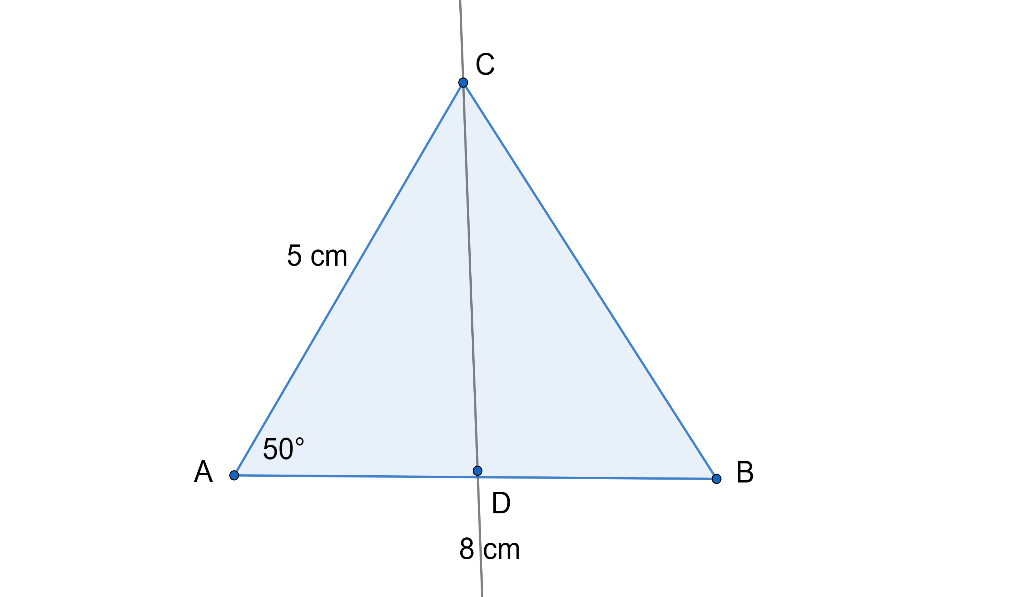
In the above figure, let $CD$ perpendicular to $AB$.
Now in $\Delta ACD$,
$\sin A=\dfrac{CD}{AC}$
Now, substituting the values we get,
$\sin 50{}^\circ =\dfrac{CD}{5}$
$\begin{align}
& CD=\sin 50{}^\circ \times 5 \\
& CD=0.7660\times 5 \\
\end{align}$
$CD=3.83cm$
Also,
$\cos A=\dfrac{AD}{AC}$
Now, substituting the values we get,
$\begin{align}
& \cos 50{}^\circ =\dfrac{AD}{5} \\
& \cos 50{}^\circ \times 5=AD \\
& AD=0.6428\times 5 \\
\end{align}$
$AD=3.214cm$
Now we will apply cosine rule. As per cosine rule, we can say that,
$B{{C}^{2}}=A{{C}^{2}}+A{{B}^{2}}-2(AC)(AB)\cos (A)$
Now substituting the corresponding values, we get
$\begin{align}
& B{{C}^{2}}={{5}^{2}}+{{8}^{2}}-2(5)(8)\cos (50{}^\circ ) \\
& \Rightarrow B{{C}^{2}}=25+64-80\times 0.6428 \\
& \Rightarrow B{{C}^{2}}=89-51.424=37.576 \\
\end{align}$
Taking square root on both sides, we get
BC = 6.12cm
Therefore, we get the length of perpendicular $CD$ and length of $BC$as $3.83cm$ and 6.12cm respectively.
Note: Read the question in a careful manner. Also you must know the basic concepts related to triangles and its properties. Do not make any silly mistakes. Also, take care that while simplifying no confusion occurs. Don’t jumble yourself while simplifying the problem.
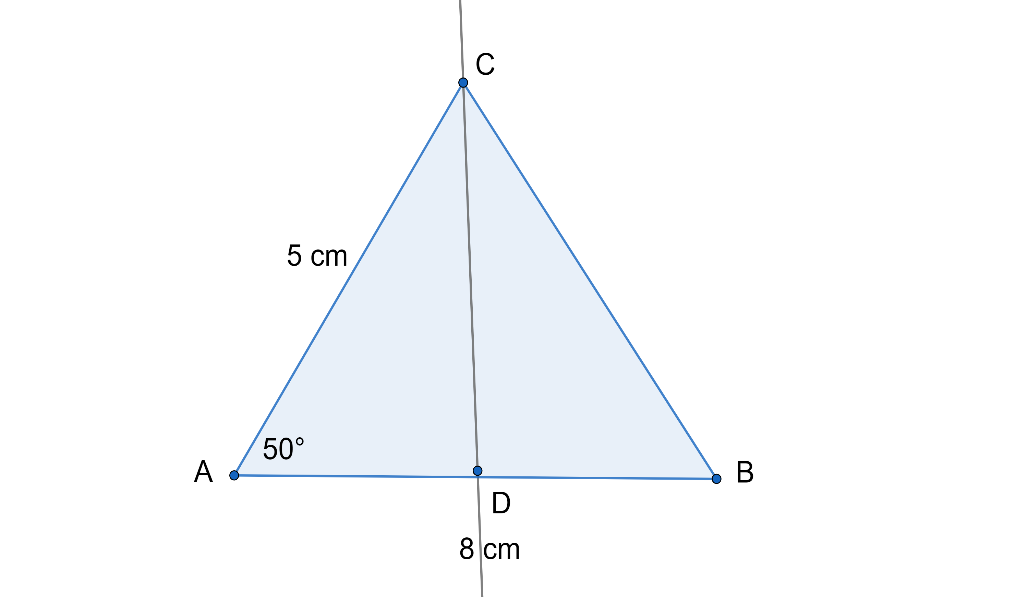
Another approach is after finding the value of AD we can consider right angled $\Delta CDB$, and applying Pythagora's theorem.
Complete step-by-step answer:
A triangle is a polygon with three edges and three vertices. It is one of the basic shapes in geometry. A triangle with vertices $A$, $B$, and $C$ is denoted $\Delta ABC$.
In Euclidean geometry, any three points, when non-collinear, determine a unique triangle and simultaneously, a unique plane (i.e. a two-dimensional Euclidean space). In other words, there is only one plane that contains the triangle, and every triangle is contained in some plane. If the entire geometry is only the Euclidean plane, there is only one plane and all triangles are contained in it; however, in higher-dimensional Euclidean spaces, this is no longer true. This article is about triangles in Euclidean geometry, and in particular, the Euclidean plane, except where otherwise noted.
The sum of the measures of the interior angles of a triangle in Euclidean space is always $180{}^\circ $. This fact is equivalent to Euclid's parallel postulate. This allows determination of the measure of the third angle of any triangle given the measure of two angles. An exterior angle of a triangle is an angle that is a linear pair (and hence supplementary) to an interior angle. The measure of an exterior angle of a triangle is equal to the sum of the measures of the two interior angles that are not adjacent to it; this is the exterior angle theorem. The sum of the measures of the three exterior angles (one for each vertex) of any triangle is $360{}^\circ $.
In the above figure, let $CD$ perpendicular to $AB$.
Now in $\Delta ACD$,
$\sin A=\dfrac{CD}{AC}$
Now, substituting the values we get,
$\sin 50{}^\circ =\dfrac{CD}{5}$
$\begin{align}
& CD=\sin 50{}^\circ \times 5 \\
& CD=0.7660\times 5 \\
\end{align}$
$CD=3.83cm$
Also,
$\cos A=\dfrac{AD}{AC}$
Now, substituting the values we get,
$\begin{align}
& \cos 50{}^\circ =\dfrac{AD}{5} \\
& \cos 50{}^\circ \times 5=AD \\
& AD=0.6428\times 5 \\
\end{align}$
$AD=3.214cm$
Now we will apply cosine rule. As per cosine rule, we can say that,
$B{{C}^{2}}=A{{C}^{2}}+A{{B}^{2}}-2(AC)(AB)\cos (A)$
Now substituting the corresponding values, we get
$\begin{align}
& B{{C}^{2}}={{5}^{2}}+{{8}^{2}}-2(5)(8)\cos (50{}^\circ ) \\
& \Rightarrow B{{C}^{2}}=25+64-80\times 0.6428 \\
& \Rightarrow B{{C}^{2}}=89-51.424=37.576 \\
\end{align}$
Taking square root on both sides, we get
BC = 6.12cm
Therefore, we get the length of perpendicular $CD$ and length of $BC$as $3.83cm$ and 6.12cm respectively.
Note: Read the question in a careful manner. Also you must know the basic concepts related to triangles and its properties. Do not make any silly mistakes. Also, take care that while simplifying no confusion occurs. Don’t jumble yourself while simplifying the problem.
Another approach is after finding the value of AD we can consider right angled $\Delta CDB$, and applying Pythagora's theorem.
Recently Updated Pages
Basicity of sulphurous acid and sulphuric acid are

Master Class 10 English: Engaging Questions & Answers for Success
Master Class 10 Social Science: Engaging Questions & Answers for Success
Master Class 10 Computer Science: Engaging Questions & Answers for Success
Class 10 Question and Answer - Your Ultimate Solutions Guide
Master Class 10 General Knowledge: Engaging Questions & Answers for Success
Trending doubts
Which country won the ICC Men's ODI World Cup in 2023?
In cricket, how many legal balls are there in a standard over?
Explain the Treaty of Vienna of 1815 class 10 social science CBSE
A boat goes 24 km upstream and 28 km downstream in class 10 maths CBSE
What does "powerplay" mean in limited-overs cricket?
What is the "Powerplay" in T20 cricket?