




In cockroach sclerites are joined by
(a) Terga
(b) Sterna
(c) Pleura
(d) Arthrodial membrane
Answer
 Verified
666.9k+ views
Hint: A thin flexible membrane known as the Articular Membrane is fused in cockroach sclerites. The articular membrane is an arthropod specialty. It is a flexible membrane that is, in essence, non-sclerotic and present between the sclerites of the arthropod segmented body.
Complete answer:
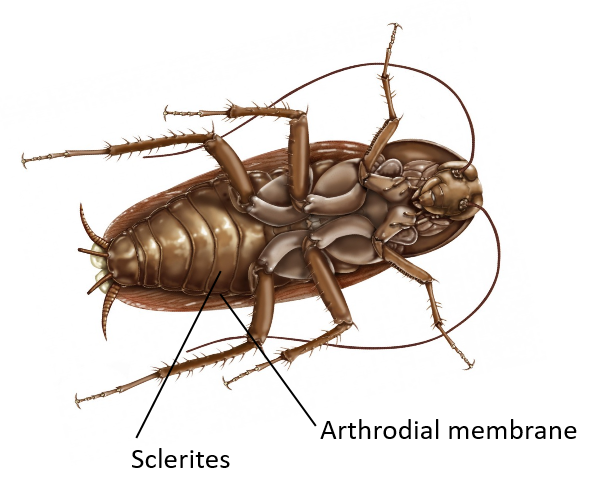
The cockroach's whole body is enclosed by a chitinous, rigid exoskeleton. The exoskeleton has hardened plates in each segment, called sclerites, which are joined by a thin and flexible articular membrane known as the arthrodial membrane.
So, the correct answer is, ‘Arthrodial membrane’.
Additional Information:
Sclerite, a hard exoskeleton, brown, is made up of chitin.
In Arthropoda, the hardening that creates sclerites is achieved either by cross-linking protein chains in the exocuticle, a process called sclerotization, or by adding minerals such as calcium carbonate into the exoskeleton regions, or both. The exoskeleton of an arthropod is divided into various sclerites, joined by regions or sutures that are less sclerotic and membranous.
A body section of dorsal sclerites, sometimes platelike, is known as tergites. Equally, a body segment's ventral sclerites are referred to as sternites. Separate sclerites are called pleurites for the lateral parts of body segments, the pleura.
Note: The body is covered/supported by a chitinous exoskeleton in a cockroach, it is secreted by the hypodermis' underlying cells. This exoskeleton is divided into smaller parts called sclerites, connected by a soft and flexible layer called the arthrodial membrane that lacks exocuticle so that the body can move flexibly.
Complete answer:
The cockroach's whole body is enclosed by a chitinous, rigid exoskeleton. The exoskeleton has hardened plates in each segment, called sclerites, which are joined by a thin and flexible articular membrane known as the arthrodial membrane.
So, the correct answer is, ‘Arthrodial membrane’.
Additional Information:
Sclerite, a hard exoskeleton, brown, is made up of chitin.
In Arthropoda, the hardening that creates sclerites is achieved either by cross-linking protein chains in the exocuticle, a process called sclerotization, or by adding minerals such as calcium carbonate into the exoskeleton regions, or both. The exoskeleton of an arthropod is divided into various sclerites, joined by regions or sutures that are less sclerotic and membranous.
A body section of dorsal sclerites, sometimes platelike, is known as tergites. Equally, a body segment's ventral sclerites are referred to as sternites. Separate sclerites are called pleurites for the lateral parts of body segments, the pleura.
Note: The body is covered/supported by a chitinous exoskeleton in a cockroach, it is secreted by the hypodermis' underlying cells. This exoskeleton is divided into smaller parts called sclerites, connected by a soft and flexible layer called the arthrodial membrane that lacks exocuticle so that the body can move flexibly.
Recently Updated Pages
Which will be the least stable resonating structure class 11 chemistry CBSE

How many 5 digit telephone numbers can be construc-class-11-maths-CBSE
How do you find the angle of the resultant vector class 11 physics CBSE
Draw labelled diagram of the following i Gram seed class 11 biology CBSE
1 Quintal is equal to a 110 kg b 10 kg c 100kg d 1000 class 11 physics CBSE
What is the need and importance of classification class 11 biology CBSE
Trending doubts
Find the value of the expression given below sin 30circ class 11 maths CBSE
One Metric ton is equal to kg A 10000 B 1000 C 100 class 11 physics CBSE
10 examples of friction in our daily life
Draw a diagram of a plant cell and label at least eight class 11 biology CBSE
Difference between physical and chemical change class 11 chemistry CBSE
Proton was discovered by A Thomson B Rutherford C Chadwick class 11 chemistry CBSE