




In canal system of porifera, the pathway of water flow is
(a)${ Ostia }\rightarrow { Spongocoel }\rightarrow { Osculum }\rightarrow { Exterior }$
(b)${ Spongocoel}\rightarrow { Ostia}\rightarrow { Osculum }\rightarrow { Exterior }$
(c)${ Osculum}\rightarrow { Spongocoel}\rightarrow { Ostia}\rightarrow { Exterior }$
(d)${ Osculum}\rightarrow { Ostia}\rightarrow { Spongocoel}\rightarrow { Exterior }$
Answer
 Verified
619.2k+ views
Hint: In Porifera, the water enters through the mouth region containing several small pores that are present in the central cavity and then are then excreted out of the body from these small pores along with the body wastes.
Complete answer:
In the canal system of Porifera, the water flow starts from the small pores called Ostia from there it goes to the large central cavity called osculum where these Ostia are present and then it is excreted out from the osculum to the outside.
Additional Information: -Canal system in the sponge body may be a system of characteristic crisscrossing canals (water channels) for water flow that communicates to the exterior through numerous apertures, the Ostia, and osculum.
-In sponges, the body wall is folded. In the midst of two folds, an incurrent canal is present. The opening of the incurrent canal shows a pore membrane. This may show one or two Ostia, through which water enters into the incurrent canals.
-Through this water current the food and oxygen are brought in while excreta and reproductive bodies are excreted out. Pinacoderm consists of porocytes cells that bear openings called Ostia
-The water is then excreted out through the osculum via spongocoel with the help of a water current carrying away all the waste material of the body.
So, the correct answer is ‘${ Ostia }\rightarrow { Spongocoel }\rightarrow { Osculum }\rightarrow { Exterior }$’.
Note: The term Porifera is derived from the Greek word meaning sponges. The organisms lack true tissues and organs. They are found in ocean habitats, and rocks. The water system and the lining of choanocytes cells are observed to be lost in a few carnivorous sponges. The spongocoel varies in its simplicity and complexity depending upon its body plant which can be; Asconoid (simplest body organization having pores for passage of water), syconoid (tubular body having thicker lining of choanocytes), and leuconoid (branched canal system and complex body organization).
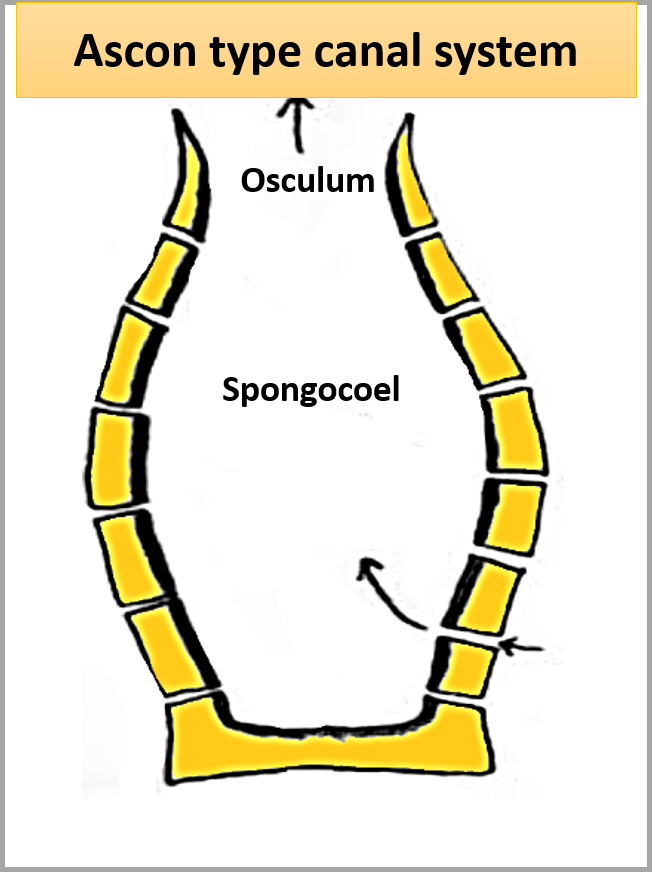
Complete answer:
In the canal system of Porifera, the water flow starts from the small pores called Ostia from there it goes to the large central cavity called osculum where these Ostia are present and then it is excreted out from the osculum to the outside.
Additional Information: -Canal system in the sponge body may be a system of characteristic crisscrossing canals (water channels) for water flow that communicates to the exterior through numerous apertures, the Ostia, and osculum.
-In sponges, the body wall is folded. In the midst of two folds, an incurrent canal is present. The opening of the incurrent canal shows a pore membrane. This may show one or two Ostia, through which water enters into the incurrent canals.
-Through this water current the food and oxygen are brought in while excreta and reproductive bodies are excreted out. Pinacoderm consists of porocytes cells that bear openings called Ostia
-The water is then excreted out through the osculum via spongocoel with the help of a water current carrying away all the waste material of the body.
So, the correct answer is ‘${ Ostia }\rightarrow { Spongocoel }\rightarrow { Osculum }\rightarrow { Exterior }$’.
Note: The term Porifera is derived from the Greek word meaning sponges. The organisms lack true tissues and organs. They are found in ocean habitats, and rocks. The water system and the lining of choanocytes cells are observed to be lost in a few carnivorous sponges. The spongocoel varies in its simplicity and complexity depending upon its body plant which can be; Asconoid (simplest body organization having pores for passage of water), syconoid (tubular body having thicker lining of choanocytes), and leuconoid (branched canal system and complex body organization).
Recently Updated Pages
Master Class 12 Economics: Engaging Questions & Answers for Success

Master Class 12 English: Engaging Questions & Answers for Success
Master Class 12 Social Science: Engaging Questions & Answers for Success
Master Class 12 Maths: Engaging Questions & Answers for Success
Master Class 12 Physics: Engaging Questions & Answers for Success
Master Class 9 General Knowledge: Engaging Questions & Answers for Success
Trending doubts
One Metric ton is equal to kg A 10000 B 1000 C 100 class 11 physics CBSE
Difference Between Prokaryotic Cells and Eukaryotic Cells
Find the value of the expression given below sin 30circ class 11 maths CBSE
Two of the body parts which do not appear in MRI are class 11 biology CBSE
1 ton equals to A 100 kg B 1000 kg C 10 kg D 10000 class 11 physics CBSE
Draw a diagram of nephron and explain its structur class 11 biology CBSE