




In ${C}_{3}$ plants, the first carbon dioxide acceptor enzyme is
(a)PEPCO
(b)RuBP carboxylase/Rubisco
(c)RuBP oxygenase
(d)Oxidase
Answer
 Verified
595.2k+ views
Hint: ${C}_{3}$ cycle is also known as the Calvin cycle. Calvin cycle occurs in all photosynthetic plants whether they are ${C}_{3}$ or ${C}_{4}$ pathways. The first carbon dioxide acceptor facilitates the attack of ${C}{O}_{2}$ and forms two molecules of glycerate-3-phosphate.
Complete step-by-step answer:
The products of light reaction i.e. ATP and NADPH are essential for the assimilation of carbon dioxide to Carbohydrates. This is the biosynthetic phase of photosynthesis. These reactions take in the stroma of chloroplasts where all the enzymes required are present. This process does not depend directly on the presence of light but is dependent on the products of light reaction i.e. ATP and NADPH. The reaction occurs through the Calvin cycle. The Calvin cycle may be supported by the ${C}_{4}$ cycle in certain plants.
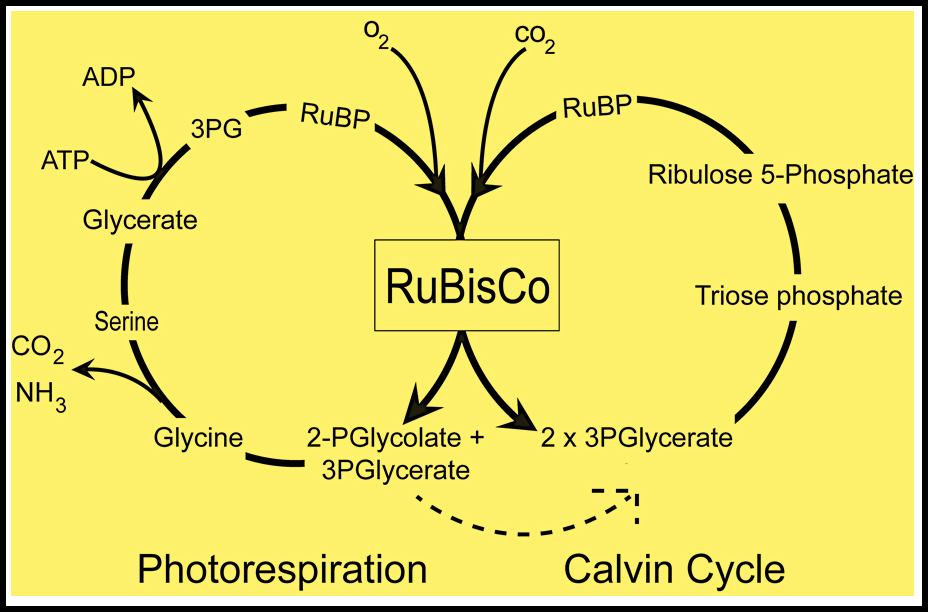
The primary acceptor molecule during the ${C}_{3}$ cycle is 5-Carbon Ketose Sugar-Ribulose Bisphosphate (RuBP) The enzyme for carbon dioxide fixation is Rubisco (Ribulose Bisphosphate carboxylase oxygenase). It is characterized by the fact that its active site can bind to both carbon dioxide and oxygen, hence the name.
Additional Information:
Carboxylation: It is the fixation of carbon dioxide. This carbon dioxide is utilized for the carboxylation of RuBP. This reaction is catalyzed by the enzyme Rubisco and it results in the formation of 2-molecules of 3-Phosphoglyceric acid.
Reduction: This reaction leads to the formation of glucose. The steps involve the utilization of two molecules of ATP for phosphorylation and 2 NADPH for reduction.
Regeneration: For the cycle to continue uninterrupted, regeneration of the carbon dioxide acceptor molecule is crucial. This step requires 1 ATP for phosphorylation to form RuBP. To make one molecule of glucose, six turns of cycle are required. 18 ATP and 12 NADPH are used to make a molecule of glucose. Hence, for every carbon dioxide molecule entering the ${C}_{3}$ cycle, 3 molecules of ATP and 2 molecules of NADPH are required.
Hence, the correct answer is, “RuBP carboxylase/Rubisco”.
Note: -The Calvin cycle is also known as a dark reaction or ${C}_{3}$ cycle. This reaction takes place even in the presence of light and even in the absence of light. Thus, the Dark reaction is a misnomer.
-In ${C}_{4}$ plants where the light and dark reactions are separated, carbon dioxide is first fixed by PEP Carboxylase of PEPCO in the mesophyll cells where light reactions take place to form Oxaloacetate which is later converted to Malate and transferred to Bundle Sheath Cells.
-Inside the Bundle sheath cells, Malate is converted to Pyruvate with the release of one carbon dioxide molecule which ultimately enters the ${C}_{3}$ cycle. Thus, the ${C}_{3}$ cycle is the central pathway for photosynthesis.
Complete step-by-step answer:
The products of light reaction i.e. ATP and NADPH are essential for the assimilation of carbon dioxide to Carbohydrates. This is the biosynthetic phase of photosynthesis. These reactions take in the stroma of chloroplasts where all the enzymes required are present. This process does not depend directly on the presence of light but is dependent on the products of light reaction i.e. ATP and NADPH. The reaction occurs through the Calvin cycle. The Calvin cycle may be supported by the ${C}_{4}$ cycle in certain plants.
The primary acceptor molecule during the ${C}_{3}$ cycle is 5-Carbon Ketose Sugar-Ribulose Bisphosphate (RuBP) The enzyme for carbon dioxide fixation is Rubisco (Ribulose Bisphosphate carboxylase oxygenase). It is characterized by the fact that its active site can bind to both carbon dioxide and oxygen, hence the name.
Additional Information:
Carboxylation: It is the fixation of carbon dioxide. This carbon dioxide is utilized for the carboxylation of RuBP. This reaction is catalyzed by the enzyme Rubisco and it results in the formation of 2-molecules of 3-Phosphoglyceric acid.
Reduction: This reaction leads to the formation of glucose. The steps involve the utilization of two molecules of ATP for phosphorylation and 2 NADPH for reduction.
Regeneration: For the cycle to continue uninterrupted, regeneration of the carbon dioxide acceptor molecule is crucial. This step requires 1 ATP for phosphorylation to form RuBP. To make one molecule of glucose, six turns of cycle are required. 18 ATP and 12 NADPH are used to make a molecule of glucose. Hence, for every carbon dioxide molecule entering the ${C}_{3}$ cycle, 3 molecules of ATP and 2 molecules of NADPH are required.
Hence, the correct answer is, “RuBP carboxylase/Rubisco”.
Note: -The Calvin cycle is also known as a dark reaction or ${C}_{3}$ cycle. This reaction takes place even in the presence of light and even in the absence of light. Thus, the Dark reaction is a misnomer.
-In ${C}_{4}$ plants where the light and dark reactions are separated, carbon dioxide is first fixed by PEP Carboxylase of PEPCO in the mesophyll cells where light reactions take place to form Oxaloacetate which is later converted to Malate and transferred to Bundle Sheath Cells.
-Inside the Bundle sheath cells, Malate is converted to Pyruvate with the release of one carbon dioxide molecule which ultimately enters the ${C}_{3}$ cycle. Thus, the ${C}_{3}$ cycle is the central pathway for photosynthesis.
Recently Updated Pages
Master Class 11 Social Science: Engaging Questions & Answers for Success

Master Class 11 Physics: Engaging Questions & Answers for Success
Master Class 11 Maths: Engaging Questions & Answers for Success
Master Class 11 Economics: Engaging Questions & Answers for Success
Master Class 11 Computer Science: Engaging Questions & Answers for Success
Master Class 11 Chemistry: Engaging Questions & Answers for Success
Trending doubts
One Metric ton is equal to kg A 10000 B 1000 C 100 class 11 physics CBSE
There are 720 permutations of the digits 1 2 3 4 5 class 11 maths CBSE
1 Quintal is equal to a 110 kg b 10 kg c 100kg d 1000 class 11 physics CBSE
State and prove Bernoullis theorem class 11 physics CBSE
Difference Between Prokaryotic Cells and Eukaryotic Cells
Which among the following are examples of coming together class 11 social science CBSE