




In any $\Delta ABC$, prove that $2\left( bc\cos A+ca\cos B+ab\cos C \right)=\left( {{a}^{2}}+{{b}^{2}}+{{c}^{2}} \right)$.
Answer
 Verified
648.6k+ views
Hint: We will be using the concept of solution of triangles to solve the given problem. We will be using cosine rules to relate the side a, b and c of the triangle with the angles of the triangle then we will substitute the side of the triangle with the cosine of the angles of the triangle to further simplify the left hand side of the equation.
Complete Step-by-Step solution:
We have been given a$\Delta ABC$ and we have to prove that,$2\left( bc\cos A+ca\cos B+ab\cos C \right)=\left( {{a}^{2}}+{{b}^{2}}+{{c}^{2}} \right)$.
We will first draw a $\Delta ABC$ and label its sides as a, b, c.
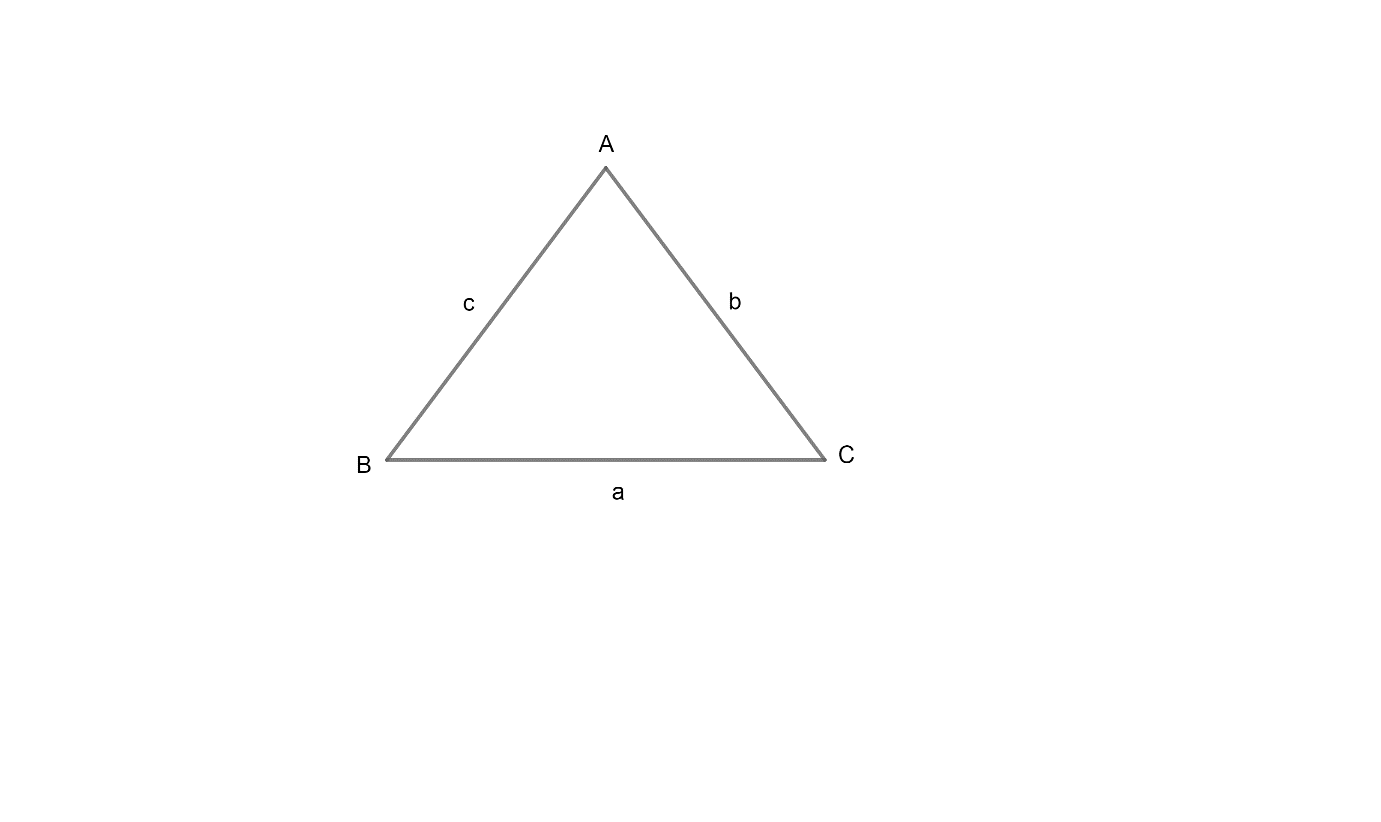
Now, we know that according to projection formula, we have in $\Delta ABC$,
$\begin{align}
& \cos A=\dfrac{{{b}^{2}}+{{c}^{2}}-{{a}^{2}}}{2bc}..........\left( 1 \right) \\
& \cos B=\dfrac{{{a}^{2}}+{{c}^{2}}-{{b}^{2}}}{2ac}..........\left( 2 \right) \\
& \cos C=\dfrac{{{a}^{2}}+{{b}^{2}}-{{c}^{2}}}{2ab}..........\left( 3 \right) \\
\end{align}$
Now, we will take the left – hand side and prove it to be equal to the right hand side. In L.H.S we have,
$2\left( bc\cos A+ca\cos B+ab\cos C \right)$
Now, we will substitute the value of $\cos A,\cos B,\cos C$from (1), (2) and (3) in L.H.S,
\[\begin{align}
& 2\left( bc\cos A+ca\cos B+ab\cos C \right)=2\left( bc\dfrac{\left( {{b}^{2}}+{{c}^{2}}-{{a}^{2}} \right)}{2bc}+ca\dfrac{\left( {{a}^{2}}+{{c}^{2}}-{{b}^{2}} \right)}{2ac}+ab\dfrac{\left( {{a}^{2}}+{{b}^{2}}-{{c}^{2}} \right)}{2ab} \right) \\
& =2\left( \dfrac{{{b}^{2}}+{{c}^{2}}-{{a}^{2}}}{2}+\dfrac{{{a}^{2}}+{{c}^{2}}-{{b}^{2}}}{2}+\dfrac{{{a}^{2}}+{{b}^{2}}-{{c}^{2}}}{2} \right) \\
\end{align}\]
Now, we will take 2 as L.C.M inside the bracket,
\[=2\left( \dfrac{{{b}^{2}}+{{c}^{2}}-{{a}^{2}}+{{a}^{2}}+{{c}^{2}}-{{b}^{2}}+{{a}^{2}}+{{b}^{2}}-{{c}^{2}}}{2} \right)\]
Now, we have a pair of ${{a}^{2}},{{b}^{2}},{{c}^{2}}$ cancelling with each in both numerator, on solving this we have,
$\begin{align}
& ={{a}^{2}}+{{b}^{2}}+{{c}^{2}} \\
& 2\left( bc\cos A+ca\cos B+ab\cos C \right)={{a}^{2}}+{{b}^{2}}+{{c}^{2}} \\
\end{align}$
Now, since, L.H.S = R.H.S. We have proved that,
$2\left( bc\cos A+ca\cos B+ab\cos C \right)={{a}^{2}}+{{b}^{2}}+{{c}^{2}}$.
Note: To solve these type of the problems it is important to note that we have used the cosine rule to relate the cosine of the angle of the triangle with the sides of the triangle and used this value to substitute the value of the side of the triangle in the left hand side of the equation because the right hand side of the equation have only sides of the triangles. Also it is important to note that the sine rule is
$\dfrac{\sin A}{a}=\dfrac{\sin B}{b}=\dfrac{\sin C}{c}=k$
Complete Step-by-Step solution:
We have been given a$\Delta ABC$ and we have to prove that,$2\left( bc\cos A+ca\cos B+ab\cos C \right)=\left( {{a}^{2}}+{{b}^{2}}+{{c}^{2}} \right)$.
We will first draw a $\Delta ABC$ and label its sides as a, b, c.
Now, we know that according to projection formula, we have in $\Delta ABC$,
$\begin{align}
& \cos A=\dfrac{{{b}^{2}}+{{c}^{2}}-{{a}^{2}}}{2bc}..........\left( 1 \right) \\
& \cos B=\dfrac{{{a}^{2}}+{{c}^{2}}-{{b}^{2}}}{2ac}..........\left( 2 \right) \\
& \cos C=\dfrac{{{a}^{2}}+{{b}^{2}}-{{c}^{2}}}{2ab}..........\left( 3 \right) \\
\end{align}$
Now, we will take the left – hand side and prove it to be equal to the right hand side. In L.H.S we have,
$2\left( bc\cos A+ca\cos B+ab\cos C \right)$
Now, we will substitute the value of $\cos A,\cos B,\cos C$from (1), (2) and (3) in L.H.S,
\[\begin{align}
& 2\left( bc\cos A+ca\cos B+ab\cos C \right)=2\left( bc\dfrac{\left( {{b}^{2}}+{{c}^{2}}-{{a}^{2}} \right)}{2bc}+ca\dfrac{\left( {{a}^{2}}+{{c}^{2}}-{{b}^{2}} \right)}{2ac}+ab\dfrac{\left( {{a}^{2}}+{{b}^{2}}-{{c}^{2}} \right)}{2ab} \right) \\
& =2\left( \dfrac{{{b}^{2}}+{{c}^{2}}-{{a}^{2}}}{2}+\dfrac{{{a}^{2}}+{{c}^{2}}-{{b}^{2}}}{2}+\dfrac{{{a}^{2}}+{{b}^{2}}-{{c}^{2}}}{2} \right) \\
\end{align}\]
Now, we will take 2 as L.C.M inside the bracket,
\[=2\left( \dfrac{{{b}^{2}}+{{c}^{2}}-{{a}^{2}}+{{a}^{2}}+{{c}^{2}}-{{b}^{2}}+{{a}^{2}}+{{b}^{2}}-{{c}^{2}}}{2} \right)\]
Now, we have a pair of ${{a}^{2}},{{b}^{2}},{{c}^{2}}$ cancelling with each in both numerator, on solving this we have,
$\begin{align}
& ={{a}^{2}}+{{b}^{2}}+{{c}^{2}} \\
& 2\left( bc\cos A+ca\cos B+ab\cos C \right)={{a}^{2}}+{{b}^{2}}+{{c}^{2}} \\
\end{align}$
Now, since, L.H.S = R.H.S. We have proved that,
$2\left( bc\cos A+ca\cos B+ab\cos C \right)={{a}^{2}}+{{b}^{2}}+{{c}^{2}}$.
Note: To solve these type of the problems it is important to note that we have used the cosine rule to relate the cosine of the angle of the triangle with the sides of the triangle and used this value to substitute the value of the side of the triangle in the left hand side of the equation because the right hand side of the equation have only sides of the triangles. Also it is important to note that the sine rule is
$\dfrac{\sin A}{a}=\dfrac{\sin B}{b}=\dfrac{\sin C}{c}=k$
Recently Updated Pages
Master Class 11 English: Engaging Questions & Answers for Success

Master Class 11 Social Science: Engaging Questions & Answers for Success
Master Class 11 Maths: Engaging Questions & Answers for Success
Master Class 11 Biology: Engaging Questions & Answers for Success
Master Class 11 Physics: Engaging Questions & Answers for Success
Master Class 11 Chemistry: Engaging Questions & Answers for Success
Trending doubts
Explain the Treaty of Vienna of 1815 class 10 social science CBSE
What is the Total Duration of Football Match?
The shortest day of the year in India
In which year voting age was reduced from 21 to 18?
10 examples of evaporation in daily life with explanations
What planets have no moons Which one has only one moon class 10 physics CBSE