




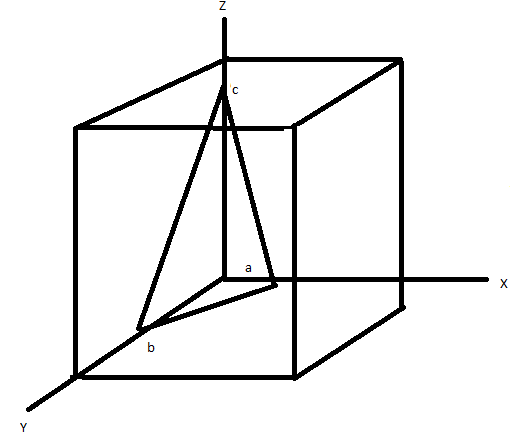
In an orthorhombic crystal, a lattice plane cuts intercepts in the ratio 1:2:3 along a,b and c axes. Find the miller indices of the plane. Sketch the plane and calculate the interplanar spacing, given that a=1A, b=2A and c=3A.
Answer
 Verified
622.8k+ views
Hint: We have to calculate Miller indices by taking the reciprocals of intercepts and for calculating the interplanar spacing, we have to use the formula,
$\dfrac{1}{{{d_{hkl}}^2}} = \dfrac{4}{3}\left( {\dfrac{{{h^ + } + hk + {k^2}}}{{{a^2}}}} \right) + \left( {\dfrac{{{l^2}}}{{{c^2}}}} \right)$
Here, h, k, and l are miller indices.
Complete step by step answer:
We know that the orthorhombic crystal system is one of the 7 crystal systems.
Orthorhombic lattices comes from enlarging a cubic lattice along two of its orthogonal pairs by two factors, that leads in a rectangular prism with a rectangular base (a by b) and height (c), such that a, b, and c are different.
The intersection of all three bases at 90° angles, so the three lattice vectors remain mutually orthogonal.
We know that Miller indices of a plane are the reciprocals of the intercepts of that corresponding to unit length.
Thus, intercepts are a:b:c=1:2:3.
So let us now take the reciprocals:
$\dfrac{1}{a}:\dfrac{1}{b}:\dfrac{1}{c} = \dfrac{1}{1}:\dfrac{1}{2}:\dfrac{1}{3}$
(or) We can take L.C.M and by taking L.C.M, we get the value of miller indices as 6,3,2.
The value of h is 6.
The value of k is 3.
The value of l is 2.
We can represent the miller indices as $\left( {hkl} \right) = \left( {632} \right)$
Let us now calculate the interplanar spacing for orthorhombic crystals.
$\dfrac{1}{{{d_{hkl}}^2}} = \dfrac{4}{3}\left( {\dfrac{{{h^ + } + hk + {k^2}}}{{{a^2}}}} \right) + \left( {\dfrac{{{l^2}}}{{{c^2}}}} \right)$
Let us now substitute the values of a, c, h, k, and l to calculate the interplanar spacing.
$\dfrac{1}{{{d_{hkl}}^2}} = \dfrac{4}{3}\left( {\dfrac{{{{\left( 6 \right)}^2} + \left( 6 \right)\left( 2 \right) + {{\left( 2 \right)}^2}}}{{{{\left( 1 \right)}^2}}}} \right) + \left( {\dfrac{{{{\left( 2 \right)}^2}}}{{{{\left( 3 \right)}^2}}}} \right)$
$ \Rightarrow $$\dfrac{1}{{{d_{hkl}}^2}} = \dfrac{{760}}{9}$
$ \Rightarrow $${d_{hkl}}^2 = \dfrac{9}{{760}}$
$ \Rightarrow $${d_{hkl}} = \dfrac{3}{{\sqrt {760} }}$
The inter-planar spacing is $\dfrac{3}{{\sqrt {760} }}$.
The plane is sketched as,
Note:
We have to know that in two dimensions there are two orthorhombic Bravais lattices: primitive rectangular and centered rectangular. In three dimensions, primitive orthorhombic, base-centered orthorhombic, body-centered orthorhombic, and face-centered orthorhombic are the four orthorhombic Bravais lattices.
$\dfrac{1}{{{d_{hkl}}^2}} = \dfrac{4}{3}\left( {\dfrac{{{h^ + } + hk + {k^2}}}{{{a^2}}}} \right) + \left( {\dfrac{{{l^2}}}{{{c^2}}}} \right)$
Here, h, k, and l are miller indices.
Complete step by step answer:
We know that the orthorhombic crystal system is one of the 7 crystal systems.
Orthorhombic lattices comes from enlarging a cubic lattice along two of its orthogonal pairs by two factors, that leads in a rectangular prism with a rectangular base (a by b) and height (c), such that a, b, and c are different.
The intersection of all three bases at 90° angles, so the three lattice vectors remain mutually orthogonal.
We know that Miller indices of a plane are the reciprocals of the intercepts of that corresponding to unit length.
Thus, intercepts are a:b:c=1:2:3.
So let us now take the reciprocals:
$\dfrac{1}{a}:\dfrac{1}{b}:\dfrac{1}{c} = \dfrac{1}{1}:\dfrac{1}{2}:\dfrac{1}{3}$
(or) We can take L.C.M and by taking L.C.M, we get the value of miller indices as 6,3,2.
The value of h is 6.
The value of k is 3.
The value of l is 2.
We can represent the miller indices as $\left( {hkl} \right) = \left( {632} \right)$
Let us now calculate the interplanar spacing for orthorhombic crystals.
$\dfrac{1}{{{d_{hkl}}^2}} = \dfrac{4}{3}\left( {\dfrac{{{h^ + } + hk + {k^2}}}{{{a^2}}}} \right) + \left( {\dfrac{{{l^2}}}{{{c^2}}}} \right)$
Let us now substitute the values of a, c, h, k, and l to calculate the interplanar spacing.
$\dfrac{1}{{{d_{hkl}}^2}} = \dfrac{4}{3}\left( {\dfrac{{{{\left( 6 \right)}^2} + \left( 6 \right)\left( 2 \right) + {{\left( 2 \right)}^2}}}{{{{\left( 1 \right)}^2}}}} \right) + \left( {\dfrac{{{{\left( 2 \right)}^2}}}{{{{\left( 3 \right)}^2}}}} \right)$
$ \Rightarrow $$\dfrac{1}{{{d_{hkl}}^2}} = \dfrac{{760}}{9}$
$ \Rightarrow $${d_{hkl}}^2 = \dfrac{9}{{760}}$
$ \Rightarrow $${d_{hkl}} = \dfrac{3}{{\sqrt {760} }}$
The inter-planar spacing is $\dfrac{3}{{\sqrt {760} }}$.
The plane is sketched as,
Note:
We have to know that in two dimensions there are two orthorhombic Bravais lattices: primitive rectangular and centered rectangular. In three dimensions, primitive orthorhombic, base-centered orthorhombic, body-centered orthorhombic, and face-centered orthorhombic are the four orthorhombic Bravais lattices.
Recently Updated Pages
The given figure shows two endocrine glands marked class 11 biology NEET_UG

Match columnI with columnII and select the correct class 11 biology NEET
Match column I with column II and select the correct class 11 biology NEET_UG
Which floral family has left 9 right + 1 arrangement class 11 biology NEET_UG
Which is not a variety of sheep A Lohi B Beetal C Nellore class 11 biology NEET_UG
Match column I with column II and select the correct class 11 biology NEET_UG
Trending doubts
One Metric ton is equal to kg A 10000 B 1000 C 100 class 11 physics CBSE
What is cell theory Who formulated it class 11 biology CBSE
Phyllotaxy is the arrangement of ALeaflets BLeaves class 11 biology CBSE
Difference Between Prokaryotic Cells and Eukaryotic Cells
The symbiotic association of fungi and algae is called class 11 biology CBSE
Cell theory was formulated by A Schleiden and Schwann class 11 biology CBSE