




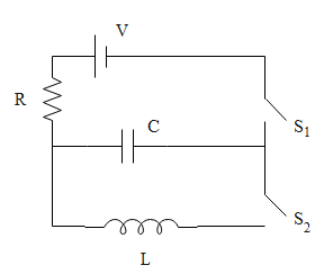
In an LCR circuit as shown below both switches are open initially. Now switch ${S_1}$ is closed, ${S_2}$ kept open. (q is charged on the capacitor and $\tau = RC$ is a capacitive time constant). Which of the following statements is correct?
A. At $t = \tau ,{\text{ }}q = \dfrac{{CV}}{2}$
B. At $t = 2\tau ,{\text{ }}q = CV\left( {1 - {e^{ - 2}}} \right)$
C. At $t = \dfrac{\tau }{2},{\text{ }}q = CV\left( {1 - {e^{ - 1}}} \right)$
D. Work done by the battery is half of the energy dissipated in the resistor.
Answer
 Verified
586.5k+ views
Hint: When the switch \[{S_1}\] is closed, then current flows through the capacitor. By using the expression for charge on a capacitor as a function of time and inserting different values of time as given in options, we can check which option is correct.
Formula used:
The expression for charge on a capacitor at a given time t is given as
$q = CV\left( {1 - {e^{ - t/\tau }}} \right)$
Complete answer:
We are given an LCR circuit which has two switches. Initially the switches are open but then switch ${S_1}$ is closed, ${S_2}$ kept open. On the closing switch ${S_1}$, the current flows through the circuit containing the capacitor.
As the switch is turned on, the capacitor will start charging and slowing the charge will start building up in the capacitor. The expression which gives us charge on the capacitor at any time t is given as
$q = CV\left( {1 - {e^{ - t/\tau }}} \right)$
Here C is the capacitance of the capacitor, V represents the voltage on the capacitor and $\tau = RC$ is a capacitive time constant.
Now let us check the charge on the capacitor at different values of t.
At $t = \tau ,{\text{ }}q = CV\left( {1 - {e^{ - \tau /\tau }}} \right) = CV\left( {1 - {e^{ - 1}}} \right)$
At $t = 2\tau ,{\text{ }}q = CV\left( {1 - {e^{ - 2\tau /\tau }}} \right) = CV\left( {1 - {e^{ - 2}}} \right)$
At $t = \dfrac{\tau }{2},{\text{ }}q = CV\left( {1 - {e^{ - \dfrac{1}{2}}}} \right)$
The work done by a capacitor is $U = \dfrac{1}{2}C{V^2}$ while the work done by a resistor is $W = {I^2}Rt = VIt$. These two are not equal so the total work done by battery is not equal to half of the energy dissipated in the resistor.
Hence, we can say that the correct answer is option B.
Note:
When we turn only switch ${S_1}$ on, then the inductor does not get involved in the circuit and we are left with only an RC circuit. In case if we turn switch ${S_2}$ also on, then we will need to take the inductor in consideration for calculating charge on the capacitor.
Formula used:
The expression for charge on a capacitor at a given time t is given as
$q = CV\left( {1 - {e^{ - t/\tau }}} \right)$
Complete answer:
We are given an LCR circuit which has two switches. Initially the switches are open but then switch ${S_1}$ is closed, ${S_2}$ kept open. On the closing switch ${S_1}$, the current flows through the circuit containing the capacitor.
As the switch is turned on, the capacitor will start charging and slowing the charge will start building up in the capacitor. The expression which gives us charge on the capacitor at any time t is given as
$q = CV\left( {1 - {e^{ - t/\tau }}} \right)$
Here C is the capacitance of the capacitor, V represents the voltage on the capacitor and $\tau = RC$ is a capacitive time constant.
Now let us check the charge on the capacitor at different values of t.
At $t = \tau ,{\text{ }}q = CV\left( {1 - {e^{ - \tau /\tau }}} \right) = CV\left( {1 - {e^{ - 1}}} \right)$
At $t = 2\tau ,{\text{ }}q = CV\left( {1 - {e^{ - 2\tau /\tau }}} \right) = CV\left( {1 - {e^{ - 2}}} \right)$
At $t = \dfrac{\tau }{2},{\text{ }}q = CV\left( {1 - {e^{ - \dfrac{1}{2}}}} \right)$
The work done by a capacitor is $U = \dfrac{1}{2}C{V^2}$ while the work done by a resistor is $W = {I^2}Rt = VIt$. These two are not equal so the total work done by battery is not equal to half of the energy dissipated in the resistor.
Hence, we can say that the correct answer is option B.
Note:
When we turn only switch ${S_1}$ on, then the inductor does not get involved in the circuit and we are left with only an RC circuit. In case if we turn switch ${S_2}$ also on, then we will need to take the inductor in consideration for calculating charge on the capacitor.
Recently Updated Pages
Basicity of sulphurous acid and sulphuric acid are

Master Class 12 English: Engaging Questions & Answers for Success
Master Class 12 Social Science: Engaging Questions & Answers for Success
Master Class 12 Maths: Engaging Questions & Answers for Success
Master Class 12 Economics: Engaging Questions & Answers for Success
Master Class 12 Physics: Engaging Questions & Answers for Success
Trending doubts
Draw a labelled sketch of the human eye class 12 physics CBSE
Which are the Top 10 Largest Countries of the World?
Draw ray diagrams each showing i myopic eye and ii class 12 physics CBSE
Giving reasons state the signs positive or negative class 12 physics CBSE
Explain esterification reaction with the help of a class 12 chemistry CBSE
What is defined as a solenoid Depict a diagram with class 12 physics CBSE