




In an isothermal change of an ideal gas, $\Delta {\text{U = 0}}$. The change in the heat energy $\Delta {\text{Q}}$is equal to
A) \[0.5{\text{ }}W\]
B) $W$
C) $1.5W$
D) $2W$
Answer
 Verified
664.2k+ views
Hint-Ideal gas It is a theoretical gas that obeys ideal gas law. It comprises randomly moving point particles which are not participating in interparticle interactions. Ideal gas models fail at lower temperatures and high pressure. It also fails for heavy gases.
Formula used:
${\text{dQ = dU + W}}$ where,
${\text{dQ = }}$Heat supplied to the system by the surroundings,
${\text{dU = }}$Change in internal energy,
$W$= system’s work done on the surroundings
Complete step by step solution:
According to the First law of thermodynamics, if some heat is supplied to the system, then the quantity of heat absorbed by the system will be equal to the sum of the increase in its internal energy and the external work done by the system on the surroundings.
Ideal gas explores both in classical mechanics and quantum mechanics.
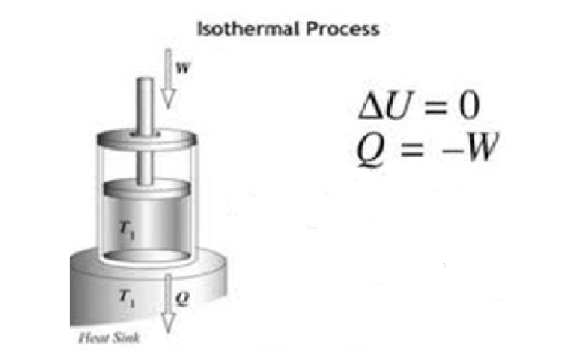
An isothermal process is one in which the pressure and volume of the system change but the temperature remains the same. Therefore, using the formula
${\text{dQ = dU + W}}$,
for an isothermal condition,${\text{dU = 0}}$
Substituting the values, we get, ${\text{dQ = W}}$
Hence the heat supplied to the system by the surroundings is equal to the system’s work done on the surroundings.
Hence, the correct answer is (B).
Note: The essential conditions for an isothermal process:
-The walls of the container are perfectly conducting to allow the free exchange of heat between the system and the surroundings.
-The process of compression and expansion should be very slow, to provide sufficient time for the exchange of heat energy.
-The internal energy of the isothermal process remains constant. The transfer of heat in or out of the system happens very slowly that the system maintains equilibrium.
Formula used:
${\text{dQ = dU + W}}$ where,
${\text{dQ = }}$Heat supplied to the system by the surroundings,
${\text{dU = }}$Change in internal energy,
$W$= system’s work done on the surroundings
Complete step by step solution:
According to the First law of thermodynamics, if some heat is supplied to the system, then the quantity of heat absorbed by the system will be equal to the sum of the increase in its internal energy and the external work done by the system on the surroundings.
Ideal gas explores both in classical mechanics and quantum mechanics.
An isothermal process is one in which the pressure and volume of the system change but the temperature remains the same. Therefore, using the formula
${\text{dQ = dU + W}}$,
for an isothermal condition,${\text{dU = 0}}$
Substituting the values, we get, ${\text{dQ = W}}$
Hence the heat supplied to the system by the surroundings is equal to the system’s work done on the surroundings.
Hence, the correct answer is (B).
Note: The essential conditions for an isothermal process:
-The walls of the container are perfectly conducting to allow the free exchange of heat between the system and the surroundings.
-The process of compression and expansion should be very slow, to provide sufficient time for the exchange of heat energy.
-The internal energy of the isothermal process remains constant. The transfer of heat in or out of the system happens very slowly that the system maintains equilibrium.
Recently Updated Pages
Which will be the least stable resonating structure class 11 chemistry CBSE

How many 5 digit telephone numbers can be construc-class-11-maths-CBSE
How do you find the angle of the resultant vector class 11 physics CBSE
Draw labelled diagram of the following i Gram seed class 11 biology CBSE
1 Quintal is equal to a 110 kg b 10 kg c 100kg d 1000 class 11 physics CBSE
What is the need and importance of classification class 11 biology CBSE
Trending doubts
Find the value of the expression given below sin 30circ class 11 maths CBSE
One Metric ton is equal to kg A 10000 B 1000 C 100 class 11 physics CBSE
10 examples of friction in our daily life
Draw a diagram of a plant cell and label at least eight class 11 biology CBSE
Difference between physical and chemical change class 11 chemistry CBSE
Proton was discovered by A Thomson B Rutherford C Chadwick class 11 chemistry CBSE