




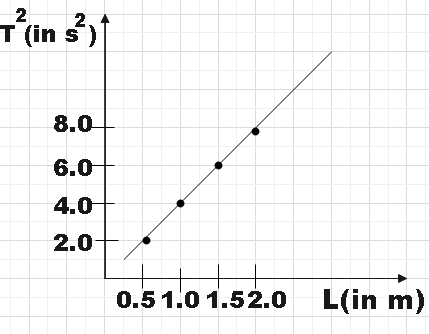
In an experiment for determining the gravitational acceleration g of a place with the help of a simple pendulum, the measured time period square is plotted against the string length of the pendulum in the figure. What is the value of g at the place?
A. $9.81m/{{s}^{2}}$
B. $9.87m/{{s}^{2}}$
C. $9.91m/{{s}^{2}}$
D. $10.0m/{{s}^{2}}$
Answer
 Verified
558.9k+ views
Hint: As a very first step, you could find the slope of the given graph. Then you could recall the expression for a time period of simple pendulum and then by squaring on both sides we will get an expression which when compared with a straight line equation will give the slope. Equating this to the above found slope, you will get the answer.
Formula used:
Time period of simple pendulum,
$T=2\pi \sqrt{\dfrac{l}{g}}$
Complete step by step answer:
In an experiment for determining the gravitational acceleration g of a place with the help of a simple pendulum, the measured time period square is plotted against the string length of the pendulum in the figure. What is the value of g at the place?
In the question, we are discussing an experiment that is conducted to determine the gravitational acceleration g of that place using a simple pendulum. We are provided with a graph in which the square of the time period is plotted against the length of the string. Using all this information, we are supposed to find the gravitational acceleration of that place.
From the graph we could find the slope m.
$m=\dfrac{8-4}{2-1}$
$\Rightarrow m=4$ ………………………………………… (1)
Now, let us recall the expression for the time period of a simple pendulum,
$T=2\pi \sqrt{\dfrac{l}{g}}$
Squaring on both sides we get,
${{T}^{2}}=\dfrac{4{{\pi }^{2}}}{g}l$
Here, it is very clear that, when ${{T}^{2}}$ and l are plotted against each other, the slope would be,
$m=\dfrac{4{{\pi }^{2}}}{g}$ ……………………………………………. (2)
From (1) and (2), we get,
$\dfrac{4{{\pi }^{2}}}{g}=4$
$\Rightarrow g={{\pi }^{2}}$
$\therefore g=9.87m{{s}^{-2}}$
Therefore, the value of g is found to be $g=9.87m{{s}^{-2}}$
So, the correct answer is “Option B”.
Note: You may recall that the acceleration due earth’s gravity is normally taken as$9.8m{{s}^{-2}}$. However, this value also depends upon the location of the experimental setup as this value shows slight variation with altitude. This is also the most accurate approximation and if you end in a very different value then it must be due to some experimental error.
Formula used:
Time period of simple pendulum,
$T=2\pi \sqrt{\dfrac{l}{g}}$
Complete step by step answer:
In an experiment for determining the gravitational acceleration g of a place with the help of a simple pendulum, the measured time period square is plotted against the string length of the pendulum in the figure. What is the value of g at the place?
In the question, we are discussing an experiment that is conducted to determine the gravitational acceleration g of that place using a simple pendulum. We are provided with a graph in which the square of the time period is plotted against the length of the string. Using all this information, we are supposed to find the gravitational acceleration of that place.
From the graph we could find the slope m.
$m=\dfrac{8-4}{2-1}$
$\Rightarrow m=4$ ………………………………………… (1)
Now, let us recall the expression for the time period of a simple pendulum,
$T=2\pi \sqrt{\dfrac{l}{g}}$
Squaring on both sides we get,
${{T}^{2}}=\dfrac{4{{\pi }^{2}}}{g}l$
Here, it is very clear that, when ${{T}^{2}}$ and l are plotted against each other, the slope would be,
$m=\dfrac{4{{\pi }^{2}}}{g}$ ……………………………………………. (2)
From (1) and (2), we get,
$\dfrac{4{{\pi }^{2}}}{g}=4$
$\Rightarrow g={{\pi }^{2}}$
$\therefore g=9.87m{{s}^{-2}}$
Therefore, the value of g is found to be $g=9.87m{{s}^{-2}}$
So, the correct answer is “Option B”.
Note: You may recall that the acceleration due earth’s gravity is normally taken as$9.8m{{s}^{-2}}$. However, this value also depends upon the location of the experimental setup as this value shows slight variation with altitude. This is also the most accurate approximation and if you end in a very different value then it must be due to some experimental error.
Recently Updated Pages
Master Class 11 Social Science: Engaging Questions & Answers for Success

Master Class 11 Physics: Engaging Questions & Answers for Success
Master Class 11 Maths: Engaging Questions & Answers for Success
Master Class 11 Economics: Engaging Questions & Answers for Success
Master Class 11 Computer Science: Engaging Questions & Answers for Success
Master Class 11 Chemistry: Engaging Questions & Answers for Success
Trending doubts
One Metric ton is equal to kg A 10000 B 1000 C 100 class 11 physics CBSE
There are 720 permutations of the digits 1 2 3 4 5 class 11 maths CBSE
1 Quintal is equal to a 110 kg b 10 kg c 100kg d 1000 class 11 physics CBSE
State and prove Bernoullis theorem class 11 physics CBSE
Difference Between Prokaryotic Cells and Eukaryotic Cells
Which among the following are examples of coming together class 11 social science CBSE