




In a woody dicotyledonous tree, which of the following parts will mainly consists of primary tissues-
A. Stem and root
B. All parts
C. Shoot tips and root tips
D. Flowers, fruits and leaves
Answer
 Verified
603.6k+ views
Hint: Plant tissues are of two types: primary tissue for primary growth and secondary tissue for secondary growth. The primary growth (increase in length) occurs with the help of apical meristem. The secondary growth (increase in diameter and girth) occurs in most of the dicotyledons roots and stems
Complete answer:
Plants tissues are mainly primary or secondary in origin. The primary tissues arise from apical meristems (present at the tip of roots and shoots and are responsible for primary growth). The primary tissues of the plant include:- epidermis (outermost layer of the primary plant body); the primary vascular tissues (xylem and phloem), which conduct water and food, respectively; and the ground tissues (all tissues except epidermis and vascular bundles).
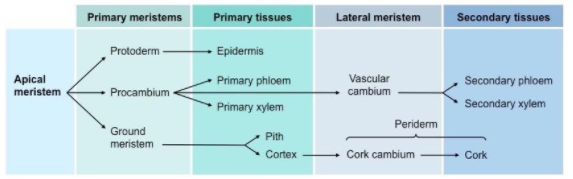
The ground tissues are parenchyma (concerned with manufacture and storage of food), collenchyma and sclerenchyma (both are supporting tissues). Ground tissue may be present in the centre of the pith and on its periphery (pericycle). The ground tissue system enclosing the pith on the outside is the cortex. It may have a hypodermis peripherally and an endodermis next to the pith.
The secondary tissues of plants arise from lateral meristems, and it is mainly responsible for increasing diameter and girth of stems and roots (secondary growth). The tissue responsible for secondary growth consists of two lateral meristems: Vascular cambium and cork cambium. The vascular cambium adds a layer of vascular tissue called secondary xylem and secondary phloem. The cork cambium replaces the epidermis with periderm, which is tough and thick.
Meristematic tissues divide continuously and help in increasing the length and girth of a plant. According to their position in the plant, meristems are of three types:- apical, lateral and intercalary. Apical meristems are present at the tip of roots and shoots.
Dicotyledonous stem and roots have secondary vascular tissues (i.e. secondary xylem and secondary phloem) which are responsible for secondary.
Flowers, fruits and leaves develop from apical meristem (primary tissue) that is responsible for primary growth. They lack lateral meristem which causes secondary growth.
So, from the above discussion, it is clear that the flowers, fruits and leaves of the woody dicotyledonous tree mainly consist of primary tissue.
Hence, the correct answer is option (D).
Note: Angiosperms or flowering plants are divided into two classes, on the basis of types of cotyledons present, they are monocotyledons and dicotyledons. The monocotyledons are characterized by having only one cotyledon in their seeds while dicotyledons have two cotyledons.
Complete answer:
Plants tissues are mainly primary or secondary in origin. The primary tissues arise from apical meristems (present at the tip of roots and shoots and are responsible for primary growth). The primary tissues of the plant include:- epidermis (outermost layer of the primary plant body); the primary vascular tissues (xylem and phloem), which conduct water and food, respectively; and the ground tissues (all tissues except epidermis and vascular bundles).
The ground tissues are parenchyma (concerned with manufacture and storage of food), collenchyma and sclerenchyma (both are supporting tissues). Ground tissue may be present in the centre of the pith and on its periphery (pericycle). The ground tissue system enclosing the pith on the outside is the cortex. It may have a hypodermis peripherally and an endodermis next to the pith.
The secondary tissues of plants arise from lateral meristems, and it is mainly responsible for increasing diameter and girth of stems and roots (secondary growth). The tissue responsible for secondary growth consists of two lateral meristems: Vascular cambium and cork cambium. The vascular cambium adds a layer of vascular tissue called secondary xylem and secondary phloem. The cork cambium replaces the epidermis with periderm, which is tough and thick.
Meristematic tissues divide continuously and help in increasing the length and girth of a plant. According to their position in the plant, meristems are of three types:- apical, lateral and intercalary. Apical meristems are present at the tip of roots and shoots.
Dicotyledonous stem and roots have secondary vascular tissues (i.e. secondary xylem and secondary phloem) which are responsible for secondary.
Flowers, fruits and leaves develop from apical meristem (primary tissue) that is responsible for primary growth. They lack lateral meristem which causes secondary growth.
So, from the above discussion, it is clear that the flowers, fruits and leaves of the woody dicotyledonous tree mainly consist of primary tissue.
Hence, the correct answer is option (D).
Note: Angiosperms or flowering plants are divided into two classes, on the basis of types of cotyledons present, they are monocotyledons and dicotyledons. The monocotyledons are characterized by having only one cotyledon in their seeds while dicotyledons have two cotyledons.
Recently Updated Pages
Master Class 12 Economics: Engaging Questions & Answers for Success

Master Class 12 English: Engaging Questions & Answers for Success
Master Class 12 Social Science: Engaging Questions & Answers for Success
Master Class 12 Maths: Engaging Questions & Answers for Success
Master Class 12 Physics: Engaging Questions & Answers for Success
Master Class 11 Social Science: Engaging Questions & Answers for Success
Trending doubts
One Metric ton is equal to kg A 10000 B 1000 C 100 class 11 physics CBSE
Difference Between Prokaryotic Cells and Eukaryotic Cells
Two of the body parts which do not appear in MRI are class 11 biology CBSE
1 ton equals to A 100 kg B 1000 kg C 10 kg D 10000 class 11 physics CBSE
Draw a diagram of nephron and explain its structur class 11 biology CBSE
10 examples of friction in our daily life