




In a uniform electric field, the equipotential surfaces must be:
This question has multiple correct options
a) be plane surfaces
b) be normal to the direction of the field
c) be placed such that the surfaces having equal differences in potential are separated by equal differences
d) have decreasing potential in the direction of the field
Answer
 Verified
616.2k+ views
Hint: The question is of the type multiple correct options. Hence, eliminate the wrong options using the properties of equipotential surfaces in an electric field. The understanding of the relation between Electric field and potential is essential to choose the right options.
Complete solution:
Let us first define the equipotential potential surfaces, understand the properties and the relation between electric field and electrostatic potential which results in equipotential surfaces.
An equipotential surface is a surface with a constant value of potential at all the points on the surface.
Since, to move a charge q from a region of one potential let us say A to some other potential let us say B work done is give by $\dfrac{W}{q}={{V}_{B}}-{{V}_{A}}J$
Now since we know that on an equipotential surface, potential is the same, work done to move a charge between any two points i.e.
$\dfrac{W}{q}={{V}_{B}}-{{V}_{A}}J$
$\begin{align}
& \dfrac{W}{q}=V-V \\
& W=0J \\
\end{align}$
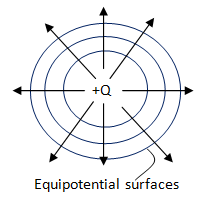
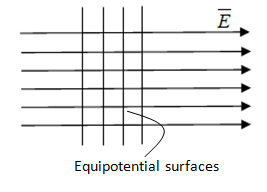
As shown in the above diagram 1 the concentric circles about a charge +Q are the equipotential surfaces. Similarly the normal lines drawn to uniform electric fields also represent equipotential surfaces.
If we observe the above diagram the equipotential surfaces are always normal to the electric field. This is because if the electric field was not perpendicular to the equipotential surface there would have existed some non zero component of along the surface . Hence to move a test charge along the direction of the field work had to be done. But this contradicts the definition of an equipotential surface. Hence the electric field is always perpendicular to the surface.
Let us obtain the relation between electric field and potential.
Work done to move a charge between two points in an electric field is given by,
$\dfrac{W}{q}={{V}_{B}}-{{V}_{A}}J..........(1)$
But by general definition of work done , work done is given as
$W=\overline{F}\times d.......(2)$
Here $\overline{F}$is the electrostatic force and d is the distance through which the charge is moved.
Let us assume that the charge is ,moved through a small distance $dr$ trough a region of potential $dV$
Equating equation 1 and 2 for work done we get,
$({{V}_{B}}-{{V}_{A}})q=-\overline{F}.d$ the minus sign suggests the force and displacement are in opposite directions.
Since we assumed that the charge is ,moved through a small distance $dr$ trough a region of potential $dV$.
The above equation becomes
$dVq=-\overline{F}.dr$
Electrostatic force on a charge is given by, F=Eq, where E is the electric field and q is the charge on which force is acted upon. Hence,
$\begin{align}
& dVq=-\overline{F}.dr \\
& dVq=-\overline{E}qdr \\
\end{align}$
q gets cancelled on both the sides and we get,
$\begin{align}
& dV=\overline{-E}dr \\
& \dfrac{dV}{dr}=-\overline{E} \\
\end{align}$
The minus sign suggested with the electric field is in the direction of decreasing potential .
Hence from all the above results obtained Its not necessary for the equipotential surfaces to be plane surfaces.
Hence the answer to the above question are option b, c and d.
b) be normal to the direction of the field
c) be placed such that the surfaces having equal differences in potential are separated by equal differences since $\dfrac{dV}{dr}=-\overline{E}$ i.e. E is constant and therefore for every change in dV the corresponding dr should be same
d) have decreasing potential in the direction of the field
Note: For a charge q the field is not uniform $\dfrac{dV}{dr}=-\overline{E}$ is not constant for consecutive equipotential surfaces as we move from the centre of the charge but for a uniform field i.e., by a charged plate $\dfrac{dV}{dr}=-\overline{E}$is constant.
Complete solution:
Let us first define the equipotential potential surfaces, understand the properties and the relation between electric field and electrostatic potential which results in equipotential surfaces.
An equipotential surface is a surface with a constant value of potential at all the points on the surface.
Since, to move a charge q from a region of one potential let us say A to some other potential let us say B work done is give by $\dfrac{W}{q}={{V}_{B}}-{{V}_{A}}J$
Now since we know that on an equipotential surface, potential is the same, work done to move a charge between any two points i.e.
$\dfrac{W}{q}={{V}_{B}}-{{V}_{A}}J$
$\begin{align}
& \dfrac{W}{q}=V-V \\
& W=0J \\
\end{align}$
As shown in the above diagram 1 the concentric circles about a charge +Q are the equipotential surfaces. Similarly the normal lines drawn to uniform electric fields also represent equipotential surfaces.
If we observe the above diagram the equipotential surfaces are always normal to the electric field. This is because if the electric field was not perpendicular to the equipotential surface there would have existed some non zero component of along the surface . Hence to move a test charge along the direction of the field work had to be done. But this contradicts the definition of an equipotential surface. Hence the electric field is always perpendicular to the surface.
Let us obtain the relation between electric field and potential.
Work done to move a charge between two points in an electric field is given by,
$\dfrac{W}{q}={{V}_{B}}-{{V}_{A}}J..........(1)$
But by general definition of work done , work done is given as
$W=\overline{F}\times d.......(2)$
Here $\overline{F}$is the electrostatic force and d is the distance through which the charge is moved.
Let us assume that the charge is ,moved through a small distance $dr$ trough a region of potential $dV$
Equating equation 1 and 2 for work done we get,
$({{V}_{B}}-{{V}_{A}})q=-\overline{F}.d$ the minus sign suggests the force and displacement are in opposite directions.
Since we assumed that the charge is ,moved through a small distance $dr$ trough a region of potential $dV$.
The above equation becomes
$dVq=-\overline{F}.dr$
Electrostatic force on a charge is given by, F=Eq, where E is the electric field and q is the charge on which force is acted upon. Hence,
$\begin{align}
& dVq=-\overline{F}.dr \\
& dVq=-\overline{E}qdr \\
\end{align}$
q gets cancelled on both the sides and we get,
$\begin{align}
& dV=\overline{-E}dr \\
& \dfrac{dV}{dr}=-\overline{E} \\
\end{align}$
The minus sign suggested with the electric field is in the direction of decreasing potential .
Hence from all the above results obtained Its not necessary for the equipotential surfaces to be plane surfaces.
Hence the answer to the above question are option b, c and d.
b) be normal to the direction of the field
c) be placed such that the surfaces having equal differences in potential are separated by equal differences since $\dfrac{dV}{dr}=-\overline{E}$ i.e. E is constant and therefore for every change in dV the corresponding dr should be same
d) have decreasing potential in the direction of the field
Note: For a charge q the field is not uniform $\dfrac{dV}{dr}=-\overline{E}$ is not constant for consecutive equipotential surfaces as we move from the centre of the charge but for a uniform field i.e., by a charged plate $\dfrac{dV}{dr}=-\overline{E}$is constant.
Recently Updated Pages
Three beakers labelled as A B and C each containing 25 mL of water were taken A small amount of NaOH anhydrous CuSO4 and NaCl were added to the beakers A B and C respectively It was observed that there was an increase in the temperature of the solutions contained in beakers A and B whereas in case of beaker C the temperature of the solution falls Which one of the following statements isarecorrect i In beakers A and B exothermic process has occurred ii In beakers A and B endothermic process has occurred iii In beaker C exothermic process has occurred iv In beaker C endothermic process has occurred

Master Class 12 Social Science: Engaging Questions & Answers for Success
Master Class 12 Physics: Engaging Questions & Answers for Success
Master Class 12 Maths: Engaging Questions & Answers for Success
Master Class 12 Economics: Engaging Questions & Answers for Success
Master Class 12 Chemistry: Engaging Questions & Answers for Success
Three beakers labelled as A B and C each containing 25 mL of water were taken A small amount of NaOH anhydrous CuSO4 and NaCl were added to the beakers A B and C respectively It was observed that there was an increase in the temperature of the solutions contained in beakers A and B whereas in case of beaker C the temperature of the solution falls Which one of the following statements isarecorrect i In beakers A and B exothermic process has occurred ii In beakers A and B endothermic process has occurred iii In beaker C exothermic process has occurred iv In beaker C endothermic process has occurred
Master Class 12 Social Science: Engaging Questions & Answers for Success
Master Class 12 Physics: Engaging Questions & Answers for Success
Trending doubts
Which are the Top 10 Largest Countries of the World?
Draw a labelled sketch of the human eye class 12 physics CBSE
Differentiate between homogeneous and heterogeneous class 12 chemistry CBSE
What are the major means of transport Explain each class 12 social science CBSE
Sulphuric acid is known as the king of acids State class 12 chemistry CBSE
Why should a magnesium ribbon be cleaned before burning class 12 chemistry CBSE