




In a triangle \[\Delta ABC\], if \[A={{30}^{\circ }},b=2,c=\sqrt{3}+1\], then \[\dfrac{C-B}{2}\] is equal to
(a) \[{{15}^{\circ }}\]
(b) \[{{30}^{\circ }}\]
(c) \[{{45}^{\circ }}\]
(d) None of these
Answer
 Verified
627.6k+ views
Hint: Use cosine formula for angle A which is \[\cos A=\dfrac{{{b}^{2}}+{{c}^{2}}-{{a}^{2}}}{2bc}\] to find the measure of length ‘a’. Use sine formula of triangle, which states that in any triangle \[\Delta ABC\], we have \[\dfrac{a}{\sin A}=\dfrac{b}{\sin B}=\dfrac{c}{\sin C}\] to find the measure of \[\angle B\] and \[\angle C\]. Subtract the value of two angles and divide it by 2 to find the desired value.
Complete step-by-step answer:
We know that in \[\Delta ABC\], we have \[A={{30}^{\circ }},b=2,c=\sqrt{3}+1\]. We have to calculate the value of \[\dfrac{C-B}{2}\].
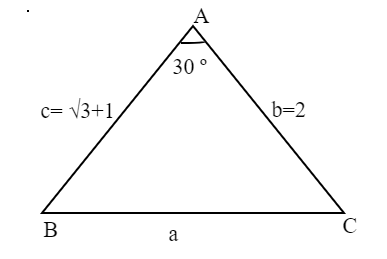
We will use cosine formula for \[\angle A\], which is \[\cos A=\dfrac{{{b}^{2}}+{{c}^{2}}-{{a}^{2}}}{2bc}\]. Substituting \[\angle A={{30}^{\circ }},b=2,c=\sqrt{3}+1\] in the previous equation, we have \[\cos \left( {{30}^{\circ }} \right)=\dfrac{{{2}^{2}}+{{\left( \sqrt{3}+1 \right)}^{2}}-{{a}^{2}}}{2\left( \sqrt{3}+1 \right)\left( 2 \right)}\].
We know that \[\cos \left( {{30}^{\circ }} \right)=\dfrac{\sqrt{3}}{2}\]. Thus, we have \[\cos \left( {{30}^{\circ }} \right)=\dfrac{\sqrt{3}}{2}=\dfrac{{{2}^{2}}+{{\left( \sqrt{3}+1 \right)}^{2}}-{{a}^{2}}}{2\left( \sqrt{3}+1 \right)\left( 2 \right)}\].
Simplifying the above equation, we have \[\dfrac{\sqrt{3}}{2}=\dfrac{4+3+1+2\sqrt{3}-{{a}^{2}}}{4\left( \sqrt{3}+1 \right)}=\dfrac{8+2\sqrt{3}-{{a}^{2}}}{4\left( \sqrt{3}+1 \right)}\].
Cross multiplying the equation, we have \[4\sqrt{3}\left( \sqrt{3}+1 \right)=2\left( 8+2\sqrt{3}-{{a}^{2}} \right)\]. Cancelling out the like terms, we have \[2\sqrt{3}\left( \sqrt{3}+1 \right)=8+2\sqrt{3}-{{a}^{2}}\].
Simplifying the above equation, we have \[6+2\sqrt{3}=8+2\sqrt{3}-{{a}^{2}}\]. Thus, we have \[6=8-{{a}^{2}}\]. Rearranging the terms, we have \[{{a}^{2}}=8-6=2\]. Taking the square root on both sides, we have \[a=\sqrt{2}\].
We will now use a sine formula to calculate the value of \[\angle B\] and \[\angle C\]. We know that the sine formula is \[\dfrac{a}{\sin A}=\dfrac{b}{\sin B}=\dfrac{c}{\sin C}\].
We know that \[a=\sqrt{2},b=2,c=\sqrt{3}+1\] and \[\angle A={{30}^{\circ }}\].
Thus, we have \[\dfrac{\sqrt{2}}{\sin {{30}^{\circ }}}=\dfrac{2}{\sin B}=\dfrac{\sqrt{3}+1}{\sin C}\]. We know that \[\sin {{30}^{\circ }}=\dfrac{1}{2}\].
Thus, we have \[\dfrac{\sqrt{2}}{\dfrac{1}{2}}=\dfrac{2}{\sin B}\] and \[\dfrac{\sqrt{2}}{\dfrac{1}{2}}=\dfrac{\sqrt{3}+1}{\sin C}\].
Rearranging the terms of both the equations, we have \[\sqrt{2}\sin B=2\left( \dfrac{1}{2} \right)\] and \[\sqrt{2}\sin C=\left( \sqrt{3}+1 \right)\left( \dfrac{1}{2} \right)\].
Thus, we have \[\sin B=\dfrac{1}{\sqrt{2}}\] and \[\sin C=\dfrac{\sqrt{3}+1}{2\sqrt{2}}\]. So, we have \[B={{\sin }^{-1}}\left( \dfrac{1}{\sqrt{2}} \right)\] and \[C={{\sin }^{-1}}\left( \dfrac{\sqrt{3}+1}{2\sqrt{2}} \right)\].
Thus, we have \[B={{45}^{\circ }}\] and \[C={{135}^{\circ }}\] as \[\sin \left( {{45}^{\circ }} \right)=\dfrac{1}{\sqrt{2}}\] and \[\sin \left( {{135}^{\circ }} \right)=\dfrac{\sqrt{3}+1}{2\sqrt{2}}\]. we didn’t consider \[C={{15}^{\circ }}\] as the sum of all the three angles must be \[{{180}^{\circ }}\].
We will now calculate the value of \[\dfrac{C-B}{2}\]. Substituting \[\angle C={{135}^{\circ }},\angle B={{45}^{\circ }}\] in the previous expression, we have \[\dfrac{C-B}{2}=\dfrac{{{135}^{\circ }}-{{45}^{\circ }}}{2}=\dfrac{{{90}^{\circ }}}{2}={{45}^{\circ }}\].
Hence, the value of \[\dfrac{C-B}{2}\] is \[{{45}^{\circ }}\], which is option (c).
Note: One must keep in mind that the sum of all the angles must be equal to \[{{180}^{\circ }}\]. Also, we must remember that the length of sides of a triangle is a positive quantity. It’s necessary to use sine and cosine formulas to relate the length and angles of a triangle.
Complete step-by-step answer:
We know that in \[\Delta ABC\], we have \[A={{30}^{\circ }},b=2,c=\sqrt{3}+1\]. We have to calculate the value of \[\dfrac{C-B}{2}\].
We will use cosine formula for \[\angle A\], which is \[\cos A=\dfrac{{{b}^{2}}+{{c}^{2}}-{{a}^{2}}}{2bc}\]. Substituting \[\angle A={{30}^{\circ }},b=2,c=\sqrt{3}+1\] in the previous equation, we have \[\cos \left( {{30}^{\circ }} \right)=\dfrac{{{2}^{2}}+{{\left( \sqrt{3}+1 \right)}^{2}}-{{a}^{2}}}{2\left( \sqrt{3}+1 \right)\left( 2 \right)}\].
We know that \[\cos \left( {{30}^{\circ }} \right)=\dfrac{\sqrt{3}}{2}\]. Thus, we have \[\cos \left( {{30}^{\circ }} \right)=\dfrac{\sqrt{3}}{2}=\dfrac{{{2}^{2}}+{{\left( \sqrt{3}+1 \right)}^{2}}-{{a}^{2}}}{2\left( \sqrt{3}+1 \right)\left( 2 \right)}\].
Simplifying the above equation, we have \[\dfrac{\sqrt{3}}{2}=\dfrac{4+3+1+2\sqrt{3}-{{a}^{2}}}{4\left( \sqrt{3}+1 \right)}=\dfrac{8+2\sqrt{3}-{{a}^{2}}}{4\left( \sqrt{3}+1 \right)}\].
Cross multiplying the equation, we have \[4\sqrt{3}\left( \sqrt{3}+1 \right)=2\left( 8+2\sqrt{3}-{{a}^{2}} \right)\]. Cancelling out the like terms, we have \[2\sqrt{3}\left( \sqrt{3}+1 \right)=8+2\sqrt{3}-{{a}^{2}}\].
Simplifying the above equation, we have \[6+2\sqrt{3}=8+2\sqrt{3}-{{a}^{2}}\]. Thus, we have \[6=8-{{a}^{2}}\]. Rearranging the terms, we have \[{{a}^{2}}=8-6=2\]. Taking the square root on both sides, we have \[a=\sqrt{2}\].
We will now use a sine formula to calculate the value of \[\angle B\] and \[\angle C\]. We know that the sine formula is \[\dfrac{a}{\sin A}=\dfrac{b}{\sin B}=\dfrac{c}{\sin C}\].
We know that \[a=\sqrt{2},b=2,c=\sqrt{3}+1\] and \[\angle A={{30}^{\circ }}\].
Thus, we have \[\dfrac{\sqrt{2}}{\sin {{30}^{\circ }}}=\dfrac{2}{\sin B}=\dfrac{\sqrt{3}+1}{\sin C}\]. We know that \[\sin {{30}^{\circ }}=\dfrac{1}{2}\].
Thus, we have \[\dfrac{\sqrt{2}}{\dfrac{1}{2}}=\dfrac{2}{\sin B}\] and \[\dfrac{\sqrt{2}}{\dfrac{1}{2}}=\dfrac{\sqrt{3}+1}{\sin C}\].
Rearranging the terms of both the equations, we have \[\sqrt{2}\sin B=2\left( \dfrac{1}{2} \right)\] and \[\sqrt{2}\sin C=\left( \sqrt{3}+1 \right)\left( \dfrac{1}{2} \right)\].
Thus, we have \[\sin B=\dfrac{1}{\sqrt{2}}\] and \[\sin C=\dfrac{\sqrt{3}+1}{2\sqrt{2}}\]. So, we have \[B={{\sin }^{-1}}\left( \dfrac{1}{\sqrt{2}} \right)\] and \[C={{\sin }^{-1}}\left( \dfrac{\sqrt{3}+1}{2\sqrt{2}} \right)\].
Thus, we have \[B={{45}^{\circ }}\] and \[C={{135}^{\circ }}\] as \[\sin \left( {{45}^{\circ }} \right)=\dfrac{1}{\sqrt{2}}\] and \[\sin \left( {{135}^{\circ }} \right)=\dfrac{\sqrt{3}+1}{2\sqrt{2}}\]. we didn’t consider \[C={{15}^{\circ }}\] as the sum of all the three angles must be \[{{180}^{\circ }}\].
We will now calculate the value of \[\dfrac{C-B}{2}\]. Substituting \[\angle C={{135}^{\circ }},\angle B={{45}^{\circ }}\] in the previous expression, we have \[\dfrac{C-B}{2}=\dfrac{{{135}^{\circ }}-{{45}^{\circ }}}{2}=\dfrac{{{90}^{\circ }}}{2}={{45}^{\circ }}\].
Hence, the value of \[\dfrac{C-B}{2}\] is \[{{45}^{\circ }}\], which is option (c).
Note: One must keep in mind that the sum of all the angles must be equal to \[{{180}^{\circ }}\]. Also, we must remember that the length of sides of a triangle is a positive quantity. It’s necessary to use sine and cosine formulas to relate the length and angles of a triangle.
Recently Updated Pages
Basicity of sulphurous acid and sulphuric acid are

Master Class 10 English: Engaging Questions & Answers for Success
Master Class 10 Social Science: Engaging Questions & Answers for Success
Master Class 10 Computer Science: Engaging Questions & Answers for Success
Class 10 Question and Answer - Your Ultimate Solutions Guide
Master Class 10 General Knowledge: Engaging Questions & Answers for Success
Trending doubts
Which country won the ICC Men's ODI World Cup in 2023?
In cricket, how many legal balls are there in a standard over?
Explain the Treaty of Vienna of 1815 class 10 social science CBSE
A boat goes 24 km upstream and 28 km downstream in class 10 maths CBSE
What does "powerplay" mean in limited-overs cricket?
What is the "Powerplay" in T20 cricket?