




In a triangle \[\Delta ABC\] and \[\Delta PQR\], the sides AB, BC and median AD are respectively proportional to PQ, QR, and the median PM. Show that \[\Delta ABC\sim \Delta PQR\]
Answer
 Verified
610.5k+ views
Hint: We solve this problem by using the similarity criteria for two triangles.
Let us take the rough figures of the two given triangles.
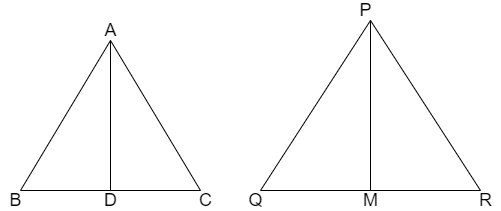
(1) SSS criteria
If three corresponding sides of two triangles are in proportion then we can say that the two triangles are similar
(2) SAS criteria.
If two corresponding sides of two triangles are in proportion and the angle between the sides is equal then we can say that the two triangles are similar.
By using these criteria and the given condition we prove the required result by using the condition that all the corresponding angles of two similar triangles are equal.
Complete step by step answer:
We are given that the sides AB, BC, and median AD are respectively proportional to PQ, QR, and the median PM
By converting the above statement into a mathematical equation we get
\[\Rightarrow \dfrac{AB}{PQ}=\dfrac{BC}{QR}=\dfrac{AD}{PM}.......equation(i)\]
Let us consider the triangles \[\Delta ABD\] and \[\Delta PQM\]
We know that the SSS criteria of similar triangles that are
If three corresponding sides of two triangles are in proportion then we can say that the two triangles are similar
By using this criteria to \[\Delta ABD\] and \[\Delta PQM\]we can say that \[\Delta ABD\sim \Delta PQM\]
We know the condition that all the corresponding angles of two similar triangles are equal.
By using the above condition to similar triangles \[\Delta ABD\sim \Delta PQM\] we can say that
\[\Rightarrow \angle ABD=\angle PQM\]
Here, we can see that BD and BC are collinear lines also QM and QR are collinear lines.
So, we can take the above equation as
\[\Rightarrow \angle ABC=\angle PQR.........equation(ii)\]
Now, let us consider the triangles \[\Delta ABC\] and \[\Delta PQR\]
From equation (i) and equation (ii) we have two conditions for \[\Delta ABC\] and \[\Delta PQR\] as
(1) \[\dfrac{AB}{PQ}=\dfrac{BC}{QR}\]
(2) \[\angle ABC=\angle PQR\]
We know that the SAS criteria of similar triangles that is
If two corresponding sides of two triangles are in proportion and the angle between the sides are equal then we can say that the two triangles are similar.
By using the SAS criteria we can conclude that \[\Delta ABC\sim \Delta PQR\]
Hence the required result has been proved.
Note:
Students may do mistakes in taking the corresponding sides and angles.
If there are two triangles \[\Delta ABC\sim \Delta PQR\] then the corresponding sides and angles says that
(1) \[\dfrac{AB}{PQ}=\dfrac{BC}{QR}=\dfrac{CQ}{RP}\]
(2) \[\angle A=\angle P,\angle B=\angle Q,\angle C=\angle R\]
Here we should not mess with the order or position of angles and sides in the above two conditions.
Let us take the rough figures of the two given triangles.
(1) SSS criteria
If three corresponding sides of two triangles are in proportion then we can say that the two triangles are similar
(2) SAS criteria.
If two corresponding sides of two triangles are in proportion and the angle between the sides is equal then we can say that the two triangles are similar.
By using these criteria and the given condition we prove the required result by using the condition that all the corresponding angles of two similar triangles are equal.
Complete step by step answer:
We are given that the sides AB, BC, and median AD are respectively proportional to PQ, QR, and the median PM
By converting the above statement into a mathematical equation we get
\[\Rightarrow \dfrac{AB}{PQ}=\dfrac{BC}{QR}=\dfrac{AD}{PM}.......equation(i)\]
Let us consider the triangles \[\Delta ABD\] and \[\Delta PQM\]
We know that the SSS criteria of similar triangles that are
If three corresponding sides of two triangles are in proportion then we can say that the two triangles are similar
By using this criteria to \[\Delta ABD\] and \[\Delta PQM\]we can say that \[\Delta ABD\sim \Delta PQM\]
We know the condition that all the corresponding angles of two similar triangles are equal.
By using the above condition to similar triangles \[\Delta ABD\sim \Delta PQM\] we can say that
\[\Rightarrow \angle ABD=\angle PQM\]
Here, we can see that BD and BC are collinear lines also QM and QR are collinear lines.
So, we can take the above equation as
\[\Rightarrow \angle ABC=\angle PQR.........equation(ii)\]
Now, let us consider the triangles \[\Delta ABC\] and \[\Delta PQR\]
From equation (i) and equation (ii) we have two conditions for \[\Delta ABC\] and \[\Delta PQR\] as
(1) \[\dfrac{AB}{PQ}=\dfrac{BC}{QR}\]
(2) \[\angle ABC=\angle PQR\]
We know that the SAS criteria of similar triangles that is
If two corresponding sides of two triangles are in proportion and the angle between the sides are equal then we can say that the two triangles are similar.
By using the SAS criteria we can conclude that \[\Delta ABC\sim \Delta PQR\]
Hence the required result has been proved.
Note:
Students may do mistakes in taking the corresponding sides and angles.
If there are two triangles \[\Delta ABC\sim \Delta PQR\] then the corresponding sides and angles says that
(1) \[\dfrac{AB}{PQ}=\dfrac{BC}{QR}=\dfrac{CQ}{RP}\]
(2) \[\angle A=\angle P,\angle B=\angle Q,\angle C=\angle R\]
Here we should not mess with the order or position of angles and sides in the above two conditions.
Recently Updated Pages
Master Class 11 English: Engaging Questions & Answers for Success

Master Class 11 Social Science: Engaging Questions & Answers for Success
Master Class 11 Maths: Engaging Questions & Answers for Success
Master Class 11 Biology: Engaging Questions & Answers for Success
Master Class 11 Physics: Engaging Questions & Answers for Success
Master Class 11 Chemistry: Engaging Questions & Answers for Success
Trending doubts
Explain the Treaty of Vienna of 1815 class 10 social science CBSE
What is the Total Duration of Football Match?
First Cotton Mill of India
In which year voting age was reduced from 21 to 18?
10 examples of evaporation in daily life with explanations
What planets have no moons Which one has only one moon class 10 physics CBSE