




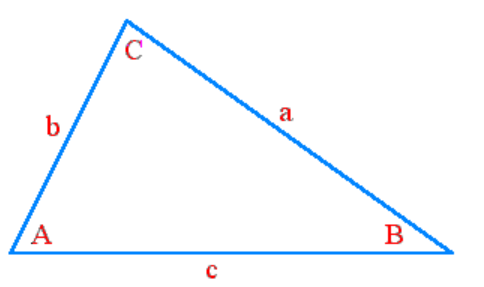
In a triangle ABC with fixed base BC, the vertex A moves such that cos B + cos C = \[4{{\sin }^{2}}\dfrac{A}{2}\]. If a, b, and c denote lengths of the sides of the triangle respectively, then which of the following is true?
(a) b + c = 4a
(b) b + c = 2a
(c) Locus of point A is an ellipse.
(d) Locus of point A is a pair of straight lines.
Answer
 Verified
613.2k+ views
Hint:Use the condition that the sum of all interior angles in a triangle is 180. By basic knowledge of trigonometric transformations you have the following formula of cos B + cos C given, and from basic knowledge of trigonometry relation of sin and cos of any particular angle is also given. Use the following formulae for simplifying the above given expression in the question.
Complete step-by-step answer:
A + B + C = 180.
Cos B + cos C = 2. \[\cos \left( \dfrac{B+C}{2} \right).\cos \left( \dfrac{B-C}{2} \right)\]
cos (90 - X) = sin (X).
First we have relation given in question:
cos B + cos C = \[4{{\sin }^{2}}\dfrac{A}{2}\]…..(1)
By the condition that the sum of all interior angles in a triangle is 180.
A + B + C = 180,we can say:
B + C = 180 – A
Now we should use transformations.
By transformations we can say:
Cos B + cos C = 2. \[\cos \left( \dfrac{B+C}{2} \right).\cos \left( \dfrac{B-C}{2} \right)\]…..(2)
By substituting equation (2) into equation (1), we get:
2. \[\cos \left( \dfrac{B+C}{2} \right).\cos \left( \dfrac{B-C}{2} \right)\] = 4. \[{{\sin }^{2}}\dfrac{A}{2}\]
Dividing both sides with 2, we get:
\[\cos \left( \dfrac{B+C}{2} \right).\cos \left( \dfrac{B-C}{2} \right)\] = 2. \[{{\sin }^{2}}\dfrac{A}{2}\]…..(3)
We know the equation:
B + C = 180 – A. Dividing both sides with 2, we get:
\[\dfrac{B+C}{2}=90-\dfrac{A}{2}\]
Applying cos on both sides on equation, we get:
\[\cos \left( \dfrac{B+C}{2} \right)=\cos \left( 90-\dfrac{A}{2} \right)\]
We know, cos (90 - X) = sin (X).
By applying this above, we get:
\[\cos \left( \dfrac{B+C}{2} \right)=\sin \left( \dfrac{A}{2} \right)\]…..(4)
By substituting equation (4) in the equation (3), we get:
\[\sin \left( \dfrac{A}{2} \right).\cos \left( \dfrac{B-C}{2} \right)=2.{{\sin }^{2}}\left( \dfrac{A}{2} \right)\]
By cancelling common terms, we get:
\[\cos \left( \dfrac{B-C}{2} \right)=2.\sin \left( \dfrac{A}{2} \right)\]
By multiplying with 2 \[\cos \left( \dfrac{A}{2} \right)\]on both sides, we get:
\[2\cos \left( \dfrac{A}{2} \right)\cos \left( \dfrac{B-C}{2} \right)=4\cos \left( \dfrac{A}{2} \right)\sin \left( \dfrac{A}{2} \right)\]…..(5)
We know: 2 sin (A) .cos (A) = sin (2A)…..(6)
By substituting equation (6) in equation (5), we get:
\[2\cos \left( \dfrac{A}{2} \right)\cos \left( \dfrac{B-C}{2} \right)=\] 2 . sin (A)…..(7)
By using equations: B + C = 180 – A
\[\cos \left( \dfrac{A}{2} \right)=\sin \left( \dfrac{B+C}{2} \right)\]
By transformations, we can say:
Sin B + sin C =\[2\sin \left( \dfrac{B+C}{2} \right)\cos \left( \dfrac{B-C}{2} \right)\]…..(8)
By substituting equation (8) in equation (7), we get:
Sin B + sin C = 2 sin A…..(9)
We know sine rule in properties of triangle:
\[\dfrac{\sin A}{a}=\dfrac{\sin B}{b}=\dfrac{\sin C}{c}=k\]
From sine rule we can say:
Sin A = ak, Sin B = bk, Sin C = ck.
Substituting these all into equation (9), we get:
bk + ck = 2ak
(b + c)k = 2ak
By cancelling common terms, we get:
b + c = 2a.
Converting a, b, c into sides BC, AC, AB, we get:
AC + AB = 2.BC
From the above equation we can say, point A moves in such a way that the sum of its distance from points B and C is constant and equal to 2BC.
As it is a proper definition of ellipse.
We can say the locus of point A is ellipse.
So option (b), (c) are correct.
Note: While dealing with a triangle, whenever you see C + B you must get an idea to substitute 180 – A in place of that.Use the transformation formulae carefully if you mess with angles then the whole answer changes.
Complete step-by-step answer:
A + B + C = 180.
Cos B + cos C = 2. \[\cos \left( \dfrac{B+C}{2} \right).\cos \left( \dfrac{B-C}{2} \right)\]
cos (90 - X) = sin (X).
First we have relation given in question:
cos B + cos C = \[4{{\sin }^{2}}\dfrac{A}{2}\]…..(1)
By the condition that the sum of all interior angles in a triangle is 180.
A + B + C = 180,we can say:
B + C = 180 – A
Now we should use transformations.
By transformations we can say:
Cos B + cos C = 2. \[\cos \left( \dfrac{B+C}{2} \right).\cos \left( \dfrac{B-C}{2} \right)\]…..(2)
By substituting equation (2) into equation (1), we get:
2. \[\cos \left( \dfrac{B+C}{2} \right).\cos \left( \dfrac{B-C}{2} \right)\] = 4. \[{{\sin }^{2}}\dfrac{A}{2}\]
Dividing both sides with 2, we get:
\[\cos \left( \dfrac{B+C}{2} \right).\cos \left( \dfrac{B-C}{2} \right)\] = 2. \[{{\sin }^{2}}\dfrac{A}{2}\]…..(3)
We know the equation:
B + C = 180 – A. Dividing both sides with 2, we get:
\[\dfrac{B+C}{2}=90-\dfrac{A}{2}\]
Applying cos on both sides on equation, we get:
\[\cos \left( \dfrac{B+C}{2} \right)=\cos \left( 90-\dfrac{A}{2} \right)\]
We know, cos (90 - X) = sin (X).
By applying this above, we get:
\[\cos \left( \dfrac{B+C}{2} \right)=\sin \left( \dfrac{A}{2} \right)\]…..(4)
By substituting equation (4) in the equation (3), we get:
\[\sin \left( \dfrac{A}{2} \right).\cos \left( \dfrac{B-C}{2} \right)=2.{{\sin }^{2}}\left( \dfrac{A}{2} \right)\]
By cancelling common terms, we get:
\[\cos \left( \dfrac{B-C}{2} \right)=2.\sin \left( \dfrac{A}{2} \right)\]
By multiplying with 2 \[\cos \left( \dfrac{A}{2} \right)\]on both sides, we get:
\[2\cos \left( \dfrac{A}{2} \right)\cos \left( \dfrac{B-C}{2} \right)=4\cos \left( \dfrac{A}{2} \right)\sin \left( \dfrac{A}{2} \right)\]…..(5)
We know: 2 sin (A) .cos (A) = sin (2A)…..(6)
By substituting equation (6) in equation (5), we get:
\[2\cos \left( \dfrac{A}{2} \right)\cos \left( \dfrac{B-C}{2} \right)=\] 2 . sin (A)…..(7)
By using equations: B + C = 180 – A
\[\cos \left( \dfrac{A}{2} \right)=\sin \left( \dfrac{B+C}{2} \right)\]
By transformations, we can say:
Sin B + sin C =\[2\sin \left( \dfrac{B+C}{2} \right)\cos \left( \dfrac{B-C}{2} \right)\]…..(8)
By substituting equation (8) in equation (7), we get:
Sin B + sin C = 2 sin A…..(9)
We know sine rule in properties of triangle:
\[\dfrac{\sin A}{a}=\dfrac{\sin B}{b}=\dfrac{\sin C}{c}=k\]
From sine rule we can say:
Sin A = ak, Sin B = bk, Sin C = ck.
Substituting these all into equation (9), we get:
bk + ck = 2ak
(b + c)k = 2ak
By cancelling common terms, we get:
b + c = 2a.
Converting a, b, c into sides BC, AC, AB, we get:
AC + AB = 2.BC
From the above equation we can say, point A moves in such a way that the sum of its distance from points B and C is constant and equal to 2BC.
As it is a proper definition of ellipse.
We can say the locus of point A is ellipse.
So option (b), (c) are correct.
Note: While dealing with a triangle, whenever you see C + B you must get an idea to substitute 180 – A in place of that.Use the transformation formulae carefully if you mess with angles then the whole answer changes.
Recently Updated Pages
Master Class 11 Business Studies: Engaging Questions & Answers for Success

Master Class 11 Computer Science: Engaging Questions & Answers for Success
Master Class 11 Economics: Engaging Questions & Answers for Success
Master Class 11 Social Science: Engaging Questions & Answers for Success
Master Class 11 English: Engaging Questions & Answers for Success
Master Class 11 Chemistry: Engaging Questions & Answers for Success
Trending doubts
Draw a diagram of nephron and explain its structur class 11 biology CBSE
Explain zero factorial class 11 maths CBSE
Chemical formula of Bleaching powder is A Ca2OCl2 B class 11 chemistry CBSE
Name the part of the brain responsible for the precision class 11 biology CBSE
The growth of tendril in pea plants is due to AEffect class 11 biology CBSE
One Metric ton is equal to kg A 10000 B 1000 C 100 class 11 physics CBSE