




In a triangle ABC, prove that
(a) sin A = sin (B + C)
(b) sin 2A = sin (2B + 2C)
(c) cos A = – cos (A + B)
(d) \[\tan \left( \dfrac{A+B}{2} \right)=\cot \dfrac{C}{2}\]
Answer
 Verified
638.4k+ views
Hint: We know that in a triangle, \[A+B+C={{180}^{o}}\], we can write it as \[A+B={{180}^{o}}-C\] and take the sin on both sides and use \[\sin \left( {{180}^{o}}-\theta \right)=\sin \theta \]. Similarly, take cos on both sides and use \[\cos \left( {{180}^{o}}-\theta \right)=-\cos \theta \]. Now, divide the initial equation by 2 and take tan on both sides and use \[\tan \left( 90-\theta \right)=\cot \theta \] to prove the desired result.
Complete step-by-step answer:
In this question, we are given a triangle ABC, we have to prove that
(a) sin A = sin (B + C)
(b) sin 2A = sin (2B + 2C)
(c) cos A = – cos (A + B)
(d) \[\tan \left( \dfrac{A+B}{2} \right)=\cot \dfrac{C}{2}\]
First of all, let us draw a triangle ABC.
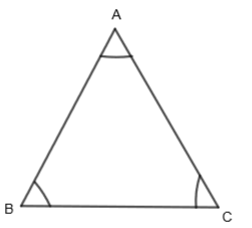
We know that in a triangle, the sum of the interior angles is \[{{180}^{o}}\]. So, we get,
\[A+B+C={{180}^{o}}.....\left( i \right)\]
(a) By subtracting A from both the sides of the above equation, we get,
\[B+C={{180}^{o}}-A.....\left( ii \right)\]
By taking sin on both the sides of the above equation, we get,
\[\sin \left( B+C \right)=\sin \left( {{180}^{o}}-A \right)\]
We know that \[\sin \left( {{180}^{o}}-\theta \right)=\sin \theta \]. By using this, we get,
\[\sin \left( B+C \right)=\sin A\]
Hence proved.
(b) Now by multiplying 2 on both the sides of the equation (ii), we get,
\[B+C={{180}^{o}}-A\]
\[\Rightarrow 2\left( B+C \right)=2\left( {{180}^{o}}-A \right)\]
\[\Rightarrow 2B+2C={{360}^{o}}-2A\]
Now by taking sin on both the sides of the above equation, we get,
\[\sin \left( 2B+2C \right)=\sin \left( {{360}^{o}}-2A \right)\]
We know that \[\sin \left( {{360}^{o}}-\theta \right)=-\sin \theta \]. By using this, we get,
\[\sin \left( 2B+2C \right)=-\sin \left( 2A \right)\]
\[\sin 2A=-\sin \left( 2B+2C \right)\]
Hence proved.
(c) By subtracting C from both the sides of equation (i), we get,
\[A+B={{180}^{o}}-C\]
By taking cos on both the sides of the above equation, we get,
\[\cos \left( A+B \right)=\cos \left( {{180}^{o}}-C \right)\]
We know that \[\cos \left( {{180}^{o}}-\theta \right)=-\cos \theta \]. By using this in the above equation, we get,
\[\cos \left( A+B \right)=-\cos C\]
\[\cos C=-\cos \left( A+B \right)\]
Hence proved.
(d) Now by subtracting C from both the sides of the equation (i), we get,
\[A+B={{180}^{o}}-C\]
By dividing by 2 on both the sides of the above equation, we get,
\[\dfrac{A+B}{2}=\dfrac{{{180}^{o}}-C}{2}\]
\[\Rightarrow \dfrac{A+B}{2}=\dfrac{{{180}^{o}}}{2}-\dfrac{C}{2}\]
\[\Rightarrow \dfrac{A+B}{2}={{90}^{o}}-\dfrac{C}{2}\]
By taking tan on both the sides of the above equation, we get,
\[\tan \left( \dfrac{A+B}{2} \right)=\tan \left( {{90}^{o}}-\dfrac{C}{2} \right)\]
We know that \[\tan \left( {{90}^{o}}-\theta \right)=\cot \theta \]. By using this in the above equation, we get,
\[\tan \left( \dfrac{A+B}{2} \right)=\cot \dfrac{C}{2}\]
Hence proved.
Note: Students must note that sum of the interior angles of the triangle is \[{{180}^{o}}\] and the sum of the interior angles of any n sided polygon is \[\left( n-2 \right){{.180}^{o}}\]. In these types of questions, students should properly read the question and then transpose one angle to another to prove the desired result. Also, students must keep in mind that \[\sin \left( {{180}^{o}}-\theta \right)=\sin \theta \] while \[\cos \left( {{180}^{o}}-\theta \right)=-\cos \theta \] and should not get confused between the two.
Complete step-by-step answer:
In this question, we are given a triangle ABC, we have to prove that
(a) sin A = sin (B + C)
(b) sin 2A = sin (2B + 2C)
(c) cos A = – cos (A + B)
(d) \[\tan \left( \dfrac{A+B}{2} \right)=\cot \dfrac{C}{2}\]
First of all, let us draw a triangle ABC.
We know that in a triangle, the sum of the interior angles is \[{{180}^{o}}\]. So, we get,
\[A+B+C={{180}^{o}}.....\left( i \right)\]
(a) By subtracting A from both the sides of the above equation, we get,
\[B+C={{180}^{o}}-A.....\left( ii \right)\]
By taking sin on both the sides of the above equation, we get,
\[\sin \left( B+C \right)=\sin \left( {{180}^{o}}-A \right)\]
We know that \[\sin \left( {{180}^{o}}-\theta \right)=\sin \theta \]. By using this, we get,
\[\sin \left( B+C \right)=\sin A\]
Hence proved.
(b) Now by multiplying 2 on both the sides of the equation (ii), we get,
\[B+C={{180}^{o}}-A\]
\[\Rightarrow 2\left( B+C \right)=2\left( {{180}^{o}}-A \right)\]
\[\Rightarrow 2B+2C={{360}^{o}}-2A\]
Now by taking sin on both the sides of the above equation, we get,
\[\sin \left( 2B+2C \right)=\sin \left( {{360}^{o}}-2A \right)\]
We know that \[\sin \left( {{360}^{o}}-\theta \right)=-\sin \theta \]. By using this, we get,
\[\sin \left( 2B+2C \right)=-\sin \left( 2A \right)\]
\[\sin 2A=-\sin \left( 2B+2C \right)\]
Hence proved.
(c) By subtracting C from both the sides of equation (i), we get,
\[A+B={{180}^{o}}-C\]
By taking cos on both the sides of the above equation, we get,
\[\cos \left( A+B \right)=\cos \left( {{180}^{o}}-C \right)\]
We know that \[\cos \left( {{180}^{o}}-\theta \right)=-\cos \theta \]. By using this in the above equation, we get,
\[\cos \left( A+B \right)=-\cos C\]
\[\cos C=-\cos \left( A+B \right)\]
Hence proved.
(d) Now by subtracting C from both the sides of the equation (i), we get,
\[A+B={{180}^{o}}-C\]
By dividing by 2 on both the sides of the above equation, we get,
\[\dfrac{A+B}{2}=\dfrac{{{180}^{o}}-C}{2}\]
\[\Rightarrow \dfrac{A+B}{2}=\dfrac{{{180}^{o}}}{2}-\dfrac{C}{2}\]
\[\Rightarrow \dfrac{A+B}{2}={{90}^{o}}-\dfrac{C}{2}\]
By taking tan on both the sides of the above equation, we get,
\[\tan \left( \dfrac{A+B}{2} \right)=\tan \left( {{90}^{o}}-\dfrac{C}{2} \right)\]
We know that \[\tan \left( {{90}^{o}}-\theta \right)=\cot \theta \]. By using this in the above equation, we get,
\[\tan \left( \dfrac{A+B}{2} \right)=\cot \dfrac{C}{2}\]
Hence proved.
Note: Students must note that sum of the interior angles of the triangle is \[{{180}^{o}}\] and the sum of the interior angles of any n sided polygon is \[\left( n-2 \right){{.180}^{o}}\]. In these types of questions, students should properly read the question and then transpose one angle to another to prove the desired result. Also, students must keep in mind that \[\sin \left( {{180}^{o}}-\theta \right)=\sin \theta \] while \[\cos \left( {{180}^{o}}-\theta \right)=-\cos \theta \] and should not get confused between the two.
Recently Updated Pages
Master Class 10 English: Engaging Questions & Answers for Success

Master Class 10 Social Science: Engaging Questions & Answers for Success
Master Class 10 Computer Science: Engaging Questions & Answers for Success
Class 10 Question and Answer - Your Ultimate Solutions Guide
Master Class 10 General Knowledge: Engaging Questions & Answers for Success
Master Class 10 Maths: Engaging Questions & Answers for Success
Trending doubts
What is the median of the first 10 natural numbers class 10 maths CBSE
Make a sketch of the human nerve cell What function class 10 biology CBSE
Fill the blanks with proper collective nouns 1 A of class 10 english CBSE
Choose the feminine form of the given noun Fox AFoxess class 10 english CBSE
Mention the importance of the Himalayas class 10 social science CBSE
If the zeroes of the polynomial x2 + 4x + 2a are alpha class 10 maths CBSE