




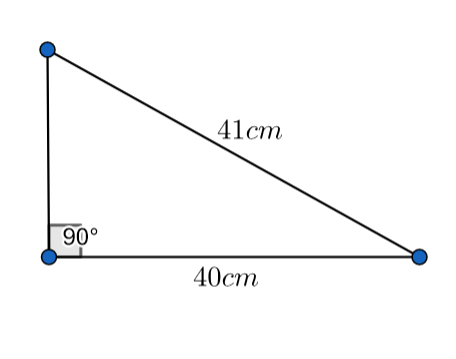
In a right angled triangle the length of the hypotenuse is 41 cm and one side is 40 cm. Find the length of the other side.
Answer
 Verified
533.1k+ views
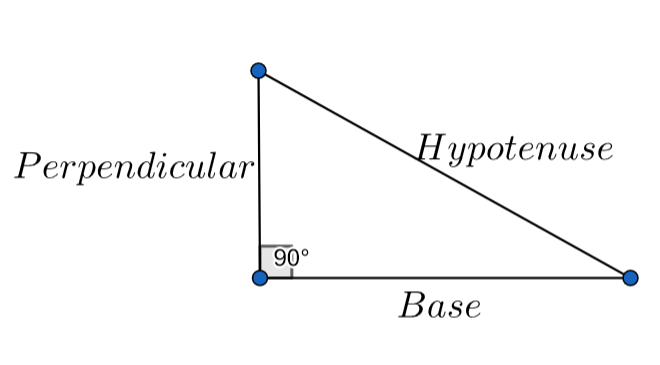
Hint: In this type of question we have to use the concept of Pythagoras theorem. We know that Pythagoras theorem explains the relation between the sides of a right angled triangle. By this theorem we can derive base, perpendicular and hypotenuse formulas. Pythagoras theorem states that, “In a right-angled triangle, the square of the hypotenuse side is equal to the sum of the squares of the two other sides”.
Complete step by step answer:
Now, we have to find the length of a side of a right angled triangle where the length of the hypotenuse is 41 cm and the length of one of the side is 40 cm.
We know that, the Pythagoras theorem states that, “In a right-angled triangle, the square of the hypotenuse side is equal to the sum of the squares of the two other sides”.
Mathematically we can express Pythagoras theorem as,
\[\Rightarrow \text{Hypotenus}{{\text{e}}^{2}}=\text{Bas}{{\text{e}}^{2}}+\text{ Perpendicula}{{\text{r}}^{2}}\]
Here, we have given that,
Hypotenuse = 41 cm
One side (Say Base) = 40 cm
Another Side (Say Perpendicular) = ?
By substituting the values in above equation, we can write,
\[\Rightarrow {{41}^{2}}={{40}^{2}}+\text{ Perpendicula}{{\text{r}}^{2}}\]
On Simplifying we get,
\[\begin{align}
& \Rightarrow 1681=1600+\text{ Perpendicula}{{\text{r}}^{2}} \\
& \Rightarrow 1681-1600=\text{Perpendicula}{{\text{r}}^{2}} \\
& \Rightarrow 81=\text{Perpendicula}{{\text{r}}^{2}} \\
\end{align}\]
By taking square root of both the sides we get,
\[\Rightarrow 9=\text{ Perpendicular}\]
Hence, the length of another side is 9 cm.
Note: In this type of question students have to remember the Pythagoras theorem for right angled triangles. Also students have to note that the side opposite to the angle \[{{90}^{\circ }}\] is called the hypotenuse, and the sides which formed the right angle are known as base and perpendicular.
Complete step by step answer:
Now, we have to find the length of a side of a right angled triangle where the length of the hypotenuse is 41 cm and the length of one of the side is 40 cm.
We know that, the Pythagoras theorem states that, “In a right-angled triangle, the square of the hypotenuse side is equal to the sum of the squares of the two other sides”.
Mathematically we can express Pythagoras theorem as,
\[\Rightarrow \text{Hypotenus}{{\text{e}}^{2}}=\text{Bas}{{\text{e}}^{2}}+\text{ Perpendicula}{{\text{r}}^{2}}\]
Here, we have given that,
Hypotenuse = 41 cm
One side (Say Base) = 40 cm
Another Side (Say Perpendicular) = ?
By substituting the values in above equation, we can write,
\[\Rightarrow {{41}^{2}}={{40}^{2}}+\text{ Perpendicula}{{\text{r}}^{2}}\]
On Simplifying we get,
\[\begin{align}
& \Rightarrow 1681=1600+\text{ Perpendicula}{{\text{r}}^{2}} \\
& \Rightarrow 1681-1600=\text{Perpendicula}{{\text{r}}^{2}} \\
& \Rightarrow 81=\text{Perpendicula}{{\text{r}}^{2}} \\
\end{align}\]
By taking square root of both the sides we get,
\[\Rightarrow 9=\text{ Perpendicular}\]
Hence, the length of another side is 9 cm.
Note: In this type of question students have to remember the Pythagoras theorem for right angled triangles. Also students have to note that the side opposite to the angle \[{{90}^{\circ }}\] is called the hypotenuse, and the sides which formed the right angle are known as base and perpendicular.
Recently Updated Pages
Master Class 10 Social Science: Engaging Questions & Answers for Success

Master Class 10 Science: Engaging Questions & Answers for Success
Master Class 10 Maths: Engaging Questions & Answers for Success
Master Class 10 General Knowledge: Engaging Questions & Answers for Success
Master Class 10 Computer Science: Engaging Questions & Answers for Success
Class 10 Question and Answer - Your Ultimate Solutions Guide
Trending doubts
What is the full form of PNG A Petrol Natural Gas B class 10 chemistry CBSE
Explain the Treaty of Vienna of 1815 class 10 social science CBSE
In cricket, how many legal balls are there in a standard over?
Why is there a time difference of about 5 hours between class 10 social science CBSE
Who Won 36 Oscar Awards? Record Holder Revealed
What is the median of the first 10 natural numbers class 10 maths CBSE