




In a rhombus \[ABCD\],\[\angle ABC = {56^ \circ }\] , then what will be the measure of\[\angle ACD\]
Answer
 Verified
603k+ views
Hint:In this question, we are provided with one of the angles of the rhombus\[\square
ABCD\]. By using the properties of opposite angles of the rhombus and some general mathematical operations we’ll find the measure of\[\angle ACD\].
Complete step by step solution:
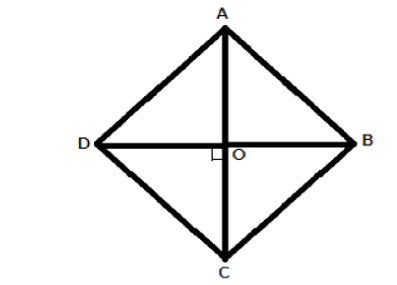
We are provided with measure of \[\angle ABC = {56^ \circ }\]
One of the properties of the rhombus states that the opposite angles of a rhombus are congruent.
Applying the above mentioned property,
\[
\angle ABC = \angle ADC \\
\therefore \angle ADC = {56^ \circ } \\
\]
One of the properties of rhombus states that the diagonals of a rhombus bisect each other.
As shown in the diagram, in \[\vartriangle OCD\]
The sum of measure of all angles of a triangle is \[{180^ \circ }\], which implies,
\[
\angle OCD + \angle ODC + \angle COD = {180^ \circ } \\
\Rightarrow \angle OCD + {28^ \circ } + {90^ \circ } = {180^ \circ } \\
\Rightarrow \angle OCD + {118^ \circ } = {180^ \circ } \\
\Rightarrow \angle OCD = {180^ \circ } - {118^ \circ } \\
\Rightarrow \angle OCD = {62^ \circ } \\
\]
The points A and O lie on the same line.
Therefore, \[\angle ACD = {62^ \circ }\]
Additional information:Rhombus is a special kind of quadrilateral. A quadrilateral is a polygon having four angles, four vertices and four sides. The opposite sides of the rhombus are parallel and the opposite angles of the rhombus are equal. The diagonals of the rhombus bisect each other and form a right angle.
The addition of two adjacent angles of a rhombus is 180 degrees. When the two diagonals of the rhombus bisect each other it forms 4 right angled triangles. These right angles triangles are congruent to each other. Rhombus can also act as a parallelogram as the opposite sides of the rhombus area parallel.
Note:It is to be noted that the sides of the rhombus are named in an orderly manner. If the sides of the rhombus are named randomly in a distorted manner then the two given angles may not become adjacent angles and the approach would be considered wrong. So care should be taken for naming the given rhombus and then identifying the angles given in the problem to solve it.
ABCD\]. By using the properties of opposite angles of the rhombus and some general mathematical operations we’ll find the measure of\[\angle ACD\].
Complete step by step solution:
We are provided with measure of \[\angle ABC = {56^ \circ }\]
One of the properties of the rhombus states that the opposite angles of a rhombus are congruent.
Applying the above mentioned property,
\[
\angle ABC = \angle ADC \\
\therefore \angle ADC = {56^ \circ } \\
\]
One of the properties of rhombus states that the diagonals of a rhombus bisect each other.
As shown in the diagram, in \[\vartriangle OCD\]
The sum of measure of all angles of a triangle is \[{180^ \circ }\], which implies,
\[
\angle OCD + \angle ODC + \angle COD = {180^ \circ } \\
\Rightarrow \angle OCD + {28^ \circ } + {90^ \circ } = {180^ \circ } \\
\Rightarrow \angle OCD + {118^ \circ } = {180^ \circ } \\
\Rightarrow \angle OCD = {180^ \circ } - {118^ \circ } \\
\Rightarrow \angle OCD = {62^ \circ } \\
\]
The points A and O lie on the same line.
Therefore, \[\angle ACD = {62^ \circ }\]
Additional information:Rhombus is a special kind of quadrilateral. A quadrilateral is a polygon having four angles, four vertices and four sides. The opposite sides of the rhombus are parallel and the opposite angles of the rhombus are equal. The diagonals of the rhombus bisect each other and form a right angle.
The addition of two adjacent angles of a rhombus is 180 degrees. When the two diagonals of the rhombus bisect each other it forms 4 right angled triangles. These right angles triangles are congruent to each other. Rhombus can also act as a parallelogram as the opposite sides of the rhombus area parallel.
Note:It is to be noted that the sides of the rhombus are named in an orderly manner. If the sides of the rhombus are named randomly in a distorted manner then the two given angles may not become adjacent angles and the approach would be considered wrong. So care should be taken for naming the given rhombus and then identifying the angles given in the problem to solve it.
Recently Updated Pages
Master Class 11 English: Engaging Questions & Answers for Success

Master Class 11 Social Science: Engaging Questions & Answers for Success
Master Class 11 Maths: Engaging Questions & Answers for Success
Master Class 11 Biology: Engaging Questions & Answers for Success
Master Class 11 Physics: Engaging Questions & Answers for Success
Master Class 11 Chemistry: Engaging Questions & Answers for Success
Trending doubts
Explain the Treaty of Vienna of 1815 class 10 social science CBSE
What is the full form of POSCO class 10 social science CBSE
Define Potential, Developed, Stock and Reserved resources
The diagonals of a rhombus are 10cm and 24cm Find the class 10 maths CBSE
Fill the blanks with proper collective nouns 1 A of class 10 english CBSE
What planets have no moons Which one has only one moon class 10 physics CBSE