



In a reaction of acidified hydrogen peroxide with potassium iodide, the concentration of iodine formed rises from 0 to ${10^{ - 5}}mol/d{m^3}$ in 10 seconds. What is the rate of reaction?
A. ${10^{ - 6}}mol/s/d{m^3}$
B. ${10^6}mol/s/d{m^3}$
C. ${10^{ - 5}}mol/s/d{m^3}$
D. ${10^4}mol/s/d{m^3}$
Answer
 Verified
573.9k+ views
Hint: The rate of a chemical reaction or reaction refers to the speed at which reactants are converted into products in a chemical reaction. Some chemical reactions are nearly instantaneous. For example, combustion of cellulose in the fire. While others usually take some time to reach the final equilibrium, for example, rusting of iron.
Complete step by step answer:
The rate of reaction, in general, is the change in concentration of reactants or products per unit time. Let us consider a chemical reaction:
$aA + bB \to cC + dD$
The rate of reaction $ = \dfrac{{ - 1}}{a}\dfrac{{d[A]}}{{dt}} = \dfrac{{ - 1}}{b}\dfrac{{d[B]}}{{dt}} = \dfrac{1}{c}\dfrac{{d[C]}}{{dt}} = \dfrac{1}{d}\dfrac{{d[D]}}{{dt}}$
A negative sign is not used because the concentration of the reactant decreases with the course of the chemical reaction.
The reaction of acidified hydrogen peroxide with potassium iodide is given as:
$2{I^ - } + {H_2}{O_2} + 2{H^ + } \to {I_2} + 2{H_2}O$
Rate of reaction $ = \dfrac{{d[{I_2}]}}{{dt}} = \dfrac{{{{10}^{ - 5}} - 0}}{{10}}mol/d{m^3}/s = {10^{ - 6}}mol/d{m^3}/s$
The graphical representation of the rate of reaction is as:
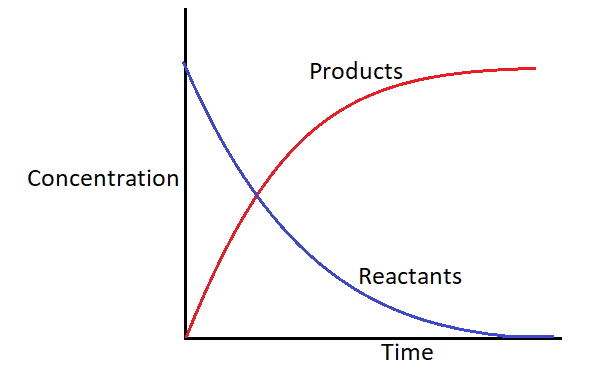
Therefore the rate of reaction is ${10^{ - 6}}mol/s/d{m^3}$ .
So, the correct answer is Option A .
Note:
There are some of the factors that affect the rate of chemical reaction, some of them are as follows:
Nature of the reaction: The rate of a chemical reaction depends on the nature and type of chemical reaction, the physical state of the reactants, the number of reactants, and complexity of the reaction. The rate of the chemical reaction is generally slower in liquids as compared to gases and even slower in solids. The size of reactants also matters in determining the rate of the reaction.
Concentration: According to the collision theory, the rate of reaction increases with the increase in the concentration of the reactants.
Temperature: According to the collision theory, a chemical reaction that takes place at a higher temperature generates more energy than a reaction at a lower temperature.
1.Presence of catalyst
2.Activation energy
Complete step by step answer:
The rate of reaction, in general, is the change in concentration of reactants or products per unit time. Let us consider a chemical reaction:
$aA + bB \to cC + dD$
The rate of reaction $ = \dfrac{{ - 1}}{a}\dfrac{{d[A]}}{{dt}} = \dfrac{{ - 1}}{b}\dfrac{{d[B]}}{{dt}} = \dfrac{1}{c}\dfrac{{d[C]}}{{dt}} = \dfrac{1}{d}\dfrac{{d[D]}}{{dt}}$
A negative sign is not used because the concentration of the reactant decreases with the course of the chemical reaction.
The reaction of acidified hydrogen peroxide with potassium iodide is given as:
$2{I^ - } + {H_2}{O_2} + 2{H^ + } \to {I_2} + 2{H_2}O$
Rate of reaction $ = \dfrac{{d[{I_2}]}}{{dt}} = \dfrac{{{{10}^{ - 5}} - 0}}{{10}}mol/d{m^3}/s = {10^{ - 6}}mol/d{m^3}/s$
The graphical representation of the rate of reaction is as:
Therefore the rate of reaction is ${10^{ - 6}}mol/s/d{m^3}$ .
So, the correct answer is Option A .
Note:
There are some of the factors that affect the rate of chemical reaction, some of them are as follows:
Nature of the reaction: The rate of a chemical reaction depends on the nature and type of chemical reaction, the physical state of the reactants, the number of reactants, and complexity of the reaction. The rate of the chemical reaction is generally slower in liquids as compared to gases and even slower in solids. The size of reactants also matters in determining the rate of the reaction.
Concentration: According to the collision theory, the rate of reaction increases with the increase in the concentration of the reactants.
Temperature: According to the collision theory, a chemical reaction that takes place at a higher temperature generates more energy than a reaction at a lower temperature.
1.Presence of catalyst
2.Activation energy
Recently Updated Pages
Basicity of sulphurous acid and sulphuric acid are

Master Class 12 English: Engaging Questions & Answers for Success
Master Class 12 Social Science: Engaging Questions & Answers for Success
Master Class 12 Maths: Engaging Questions & Answers for Success
Master Class 12 Economics: Engaging Questions & Answers for Success
Master Class 12 Physics: Engaging Questions & Answers for Success
Trending doubts
Which are the Top 10 Largest Countries of the World?
Draw a labelled sketch of the human eye class 12 physics CBSE
Draw ray diagrams each showing i myopic eye and ii class 12 physics CBSE
Give 10 examples of unisexual and bisexual flowers
Coming together federation is practiced in A India class 12 social science CBSE
How was the Civil Disobedience Movement different from class 12 social science CBSE