




In a quadrilateral ABCD, cosAcosB + sinCsinD =
$
(a){\text{ cosCcosD + sinAsinB}} \\
(b){\text{ cosCcosD - sinAsinB}} \\
(c){\text{ sinCsinD - cosAcosB}} \\
(d){\text{ sinA + sinB + sinC + sinD}} \\
$
Answer
 Verified
639k+ views
Hint: In this question use the concept that the sum of opposite angles of a quadrilateral is ${180^0}$. Thus A+C=180 and B+D=180. Thus use these two equations and apply cosine to get the answer.
Complete step-by-step answer:
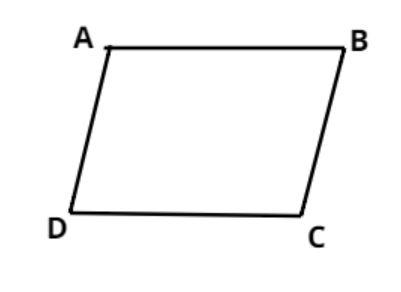
As we know that in a cyclic quadrilateral the sum of opposite angles is 180 degrees.
So let us assume a quadrilateral ABCD as shown in the figure whose vertices are taken in order.
Therefore the sum of angles A and C and B and D should be 180 degrees.
$ \Rightarrow A + C = {180^0}$....................... (1)
$ \Rightarrow B + D = {180^0}$ .................. (2)
Now from equation (1) and (2) we can say that
$ \Rightarrow A + C = B + D$
$ \Rightarrow A - B = D - C$
Now apply cosine on both sides we have,
$ \Rightarrow \cos \left( {A - B} \right) = \cos \left( {D - C} \right)$
Now expand the above equation according to cosine property which is $\left( {\cos \left( {A -
B} \right) = \cos A\cos B + \sin A\sin B} \right)$ we have,
$ \Rightarrow \cos A\cos B + \sin A\sin B = \cos D\cos C + \sin D\sin C$
$ \Rightarrow \cos A\cos B - \sin C\sin D = \cos C\cos D - \sin A\sin B$
So this is the required answer.
Hence option (B) is correct.
Note: A quadrilateral is a 4 sided plane figure having 4 vertices and 4 angles. The total sum of its interior angles is ${360^0}$. The tricky part here was the applying of cosine, as the equations were yielding us sides and we wished to have sides within cosine that’s why we took it. It is advised to remember direct trigonometric identities like $\left( {\cos \left( {A - B} \right) = \cos A\cos B + \sin A\sin B} \right)$.
Complete step-by-step answer:
As we know that in a cyclic quadrilateral the sum of opposite angles is 180 degrees.
So let us assume a quadrilateral ABCD as shown in the figure whose vertices are taken in order.
Therefore the sum of angles A and C and B and D should be 180 degrees.
$ \Rightarrow A + C = {180^0}$....................... (1)
$ \Rightarrow B + D = {180^0}$ .................. (2)
Now from equation (1) and (2) we can say that
$ \Rightarrow A + C = B + D$
$ \Rightarrow A - B = D - C$
Now apply cosine on both sides we have,
$ \Rightarrow \cos \left( {A - B} \right) = \cos \left( {D - C} \right)$
Now expand the above equation according to cosine property which is $\left( {\cos \left( {A -
B} \right) = \cos A\cos B + \sin A\sin B} \right)$ we have,
$ \Rightarrow \cos A\cos B + \sin A\sin B = \cos D\cos C + \sin D\sin C$
$ \Rightarrow \cos A\cos B - \sin C\sin D = \cos C\cos D - \sin A\sin B$
So this is the required answer.
Hence option (B) is correct.
Note: A quadrilateral is a 4 sided plane figure having 4 vertices and 4 angles. The total sum of its interior angles is ${360^0}$. The tricky part here was the applying of cosine, as the equations were yielding us sides and we wished to have sides within cosine that’s why we took it. It is advised to remember direct trigonometric identities like $\left( {\cos \left( {A - B} \right) = \cos A\cos B + \sin A\sin B} \right)$.
Recently Updated Pages
Master Class 10 Computer Science: Engaging Questions & Answers for Success

Master Class 10 General Knowledge: Engaging Questions & Answers for Success
Master Class 10 English: Engaging Questions & Answers for Success
Master Class 10 Social Science: Engaging Questions & Answers for Success
Master Class 10 Maths: Engaging Questions & Answers for Success
Master Class 10 Science: Engaging Questions & Answers for Success
Trending doubts
Explain the Treaty of Vienna of 1815 class 10 social science CBSE
Who Won 36 Oscar Awards? Record Holder Revealed
What is the median of the first 10 natural numbers class 10 maths CBSE
Why is it 530 pm in india when it is 1200 afternoon class 10 social science CBSE
Select the word that is correctly spelled a Twelveth class 10 english CBSE
Why is there a time difference of about 5 hours between class 10 social science CBSE