




In a parallelogram ABCD, determine the sum of angles C and D.
Answer
 Verified
628.8k+ views
Hint: There is a property of a parallelogram which says the sum of adjacent interior angles is supplementary (or 180°) and in a parallelogram ABCD angle C and angle D are the adjacent interior angles. So, the sum of angles C and D is 180°.
Complete step-by-step answer:
As we know from the properties of parallel lines that if a transversal is cutting two parallel lines then the sum of interior adjacent angles is 180°. In the below diagram, I have demonstrated the two parallel lines MN and OP and a transversal QR and the two adjacent interior angles.
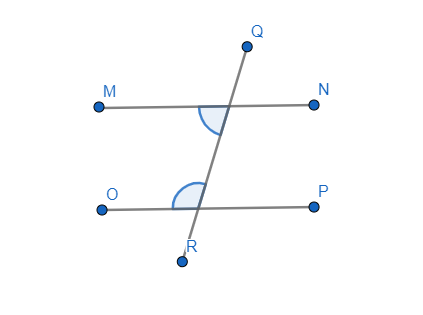
So, we are going to use the above property of parallel lines in the below parallelogram ABCD:
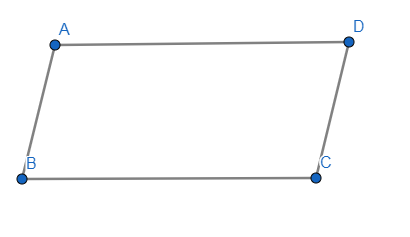
In a parallelogram, two pair of parallel lines (AD parallel to BC and AB parallel to DC) is present and one pair of parallel lines (AD parallel to BC) crosses with other pair of parallel lines (AB parallel to DC), so one pair of parallel lines (AB and DC) that crosses the other pair of parallel lines (AD and BC) behave as a transversal.
In the question, we are asked to find the sum of angles C and D so we are taking parallel lines AD and BC and DC as the transversal so using the above property of sum of adjacent interior angles we can say angle D and angle C are the adjacent interior angles so their sum should be 180°.
Hence, we have found that the sum of angle C and angle D is 180° (or are supplementary).
Note: We can prove that the sum of adjacent interior angles is 180°.
The following figure contains 2 parallel lines MN and OP and a transversal QR cutting them at T and S respectively.
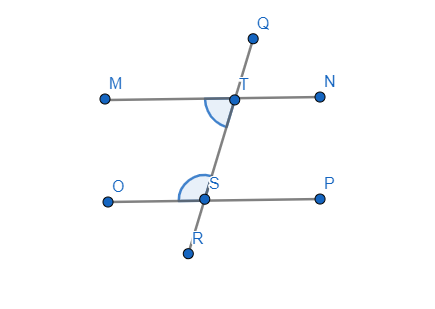
From the above figure, $\angle TSO=\angle MTS$(corresponding angles)…………… Eq. (1)
And $\angle MTS={{180}^{0}}-\angle QTM$……………… Eq. (2)
$\angle \text{MTS and }\angle \text{TSO}$ are adjacent interior angles that you can see from the figure.
Now, adding eq. (1) and eq. (2) we get:
$\angle TSO+\angle MTS={{180}^{0}}$
Hence, we have proved that the sum of adjacent interior angles is equal to 180°.
Complete step-by-step answer:
As we know from the properties of parallel lines that if a transversal is cutting two parallel lines then the sum of interior adjacent angles is 180°. In the below diagram, I have demonstrated the two parallel lines MN and OP and a transversal QR and the two adjacent interior angles.
So, we are going to use the above property of parallel lines in the below parallelogram ABCD:
In a parallelogram, two pair of parallel lines (AD parallel to BC and AB parallel to DC) is present and one pair of parallel lines (AD parallel to BC) crosses with other pair of parallel lines (AB parallel to DC), so one pair of parallel lines (AB and DC) that crosses the other pair of parallel lines (AD and BC) behave as a transversal.
In the question, we are asked to find the sum of angles C and D so we are taking parallel lines AD and BC and DC as the transversal so using the above property of sum of adjacent interior angles we can say angle D and angle C are the adjacent interior angles so their sum should be 180°.
Hence, we have found that the sum of angle C and angle D is 180° (or are supplementary).
Note: We can prove that the sum of adjacent interior angles is 180°.
The following figure contains 2 parallel lines MN and OP and a transversal QR cutting them at T and S respectively.
From the above figure, $\angle TSO=\angle MTS$(corresponding angles)…………… Eq. (1)
And $\angle MTS={{180}^{0}}-\angle QTM$……………… Eq. (2)
$\angle \text{MTS and }\angle \text{TSO}$ are adjacent interior angles that you can see from the figure.
Now, adding eq. (1) and eq. (2) we get:
$\angle TSO+\angle MTS={{180}^{0}}$
Hence, we have proved that the sum of adjacent interior angles is equal to 180°.
Recently Updated Pages
Master Class 10 Social Science: Engaging Questions & Answers for Success

Master Class 10 Science: Engaging Questions & Answers for Success
Master Class 10 Maths: Engaging Questions & Answers for Success
Master Class 10 General Knowledge: Engaging Questions & Answers for Success
Master Class 10 Computer Science: Engaging Questions & Answers for Success
Class 10 Question and Answer - Your Ultimate Solutions Guide
Trending doubts
What is the full form of PNG A Petrol Natural Gas B class 10 chemistry CBSE
Explain the Treaty of Vienna of 1815 class 10 social science CBSE
In cricket, how many legal balls are there in a standard over?
Why is there a time difference of about 5 hours between class 10 social science CBSE
Who Won 36 Oscar Awards? Record Holder Revealed
What is the median of the first 10 natural numbers class 10 maths CBSE