




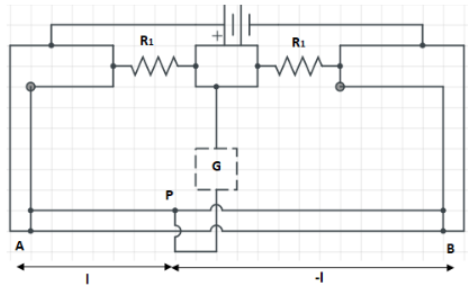
In a meter bridge, the wire of the length 1m has a non-uniform cross- section such that, the variation $\dfrac{dR}{dl}$ of its resistance R with length l is $\dfrac{dR}{dl}\propto \dfrac{1}{\sqrt{l}}$ . Two equal resistances are connected as shown in figure. The galvanometer has zero deflection when the jockey is at the point P. What the length AP is:
$\begin{align}
& A.0.2m \\
& B.0.3m \\
& C.0.25m \\
& D.0.35m \\
\end{align}$
Answer
 Verified
593.4k+ views
Hint: According to wheat stone’s bridge when the galvanometer shows zero deflection, we can use balanced condition. Therefore use balanced conditions. Then take resistances of point AD and DB as $R_1$ and $R_2$, since wire is not uniform. Apply expression, given in question. Replace R by $R_1$ and $R_2$, we get two equations. Integrate both the equation and equate it to get length of AD wire.
Complete answer:
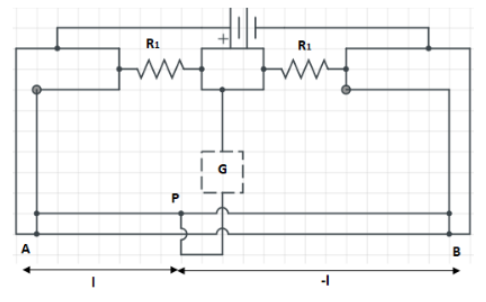
Question stated that $\dfrac{dR}{dl}$ is varying like,
$\dfrac{dR}{dl}\propto \dfrac{1}{\sqrt{l}}$
Total length of wire AB is 1m which has non- uniform cross-section. Thus, for the given wire:
$dR=C\dfrac{dl}{\sqrt{l}}........(1)$
Where, C = constant
It is mentioned that the resistance attached is the same. Let $R_1$ be the resistance of part AD and $R_2$ be the resistance of part DB. According to balanced condition of wheat stone’s network,
$\begin{align}
& \dfrac{{{R}^{'}}}{{{R}^{'}}}=\dfrac{{{R}_{1}}}{{{R}_{2}}} \\
& \therefore {{R}_{1}}={{R}_{2}}......(2) \\
\end{align}$
Now use equation (1)
Put $R =R_1$ in equation (1), we get
$d{{R}_{1}}=C\dfrac{dl}{\sqrt{l}}$
Integrate, we get
$\begin{align}
& \int{d{{R}_{1}}}=C\int\limits_{0}^{l}{\dfrac{dl}{\sqrt{l}}} \\
& \therefore {{R}_{1}}=C\int\limits_{0}^{l}{{{l}^{-\dfrac{1}{2}}}dl=C.2}\sqrt{l} \\
\end{align}$
Similarly for $R=R_2$
Therefore, $\int{d{{R}_{2}}}=C\int\limits_{1}^{l}{{{l}^{-\dfrac{1}{2}}}dl=C\left( 2-2\sqrt{l} \right)}$
According to condition given in equation (2), we get,
$\begin{align}
& C2\sqrt{l}=C\left( 2-2\sqrt{l} \right) \\
& 2\sqrt{l}=2-2\sqrt{l} \\
& 4\sqrt{l}=2 \\
& 16l=4 \\
& l=\dfrac{4}{16} \\
& l=\dfrac{1}{4} \\
& l=0.25m \\
\end{align}$
Hence the length of AD is 0.25m.
Therefore option (C) is the correct option.
Note:
Meter Bridge is the modification of the wheat stone’s network. Wheatstone’s network is used to determine the value of the unknown resistance. Since the length of the wire used is one meter therefore it is called a meter Bridge. The balancing condition for Wheatstone’s network can also be determined by using ohm’s law.
Complete answer:
Question stated that $\dfrac{dR}{dl}$ is varying like,
$\dfrac{dR}{dl}\propto \dfrac{1}{\sqrt{l}}$
Total length of wire AB is 1m which has non- uniform cross-section. Thus, for the given wire:
$dR=C\dfrac{dl}{\sqrt{l}}........(1)$
Where, C = constant
It is mentioned that the resistance attached is the same. Let $R_1$ be the resistance of part AD and $R_2$ be the resistance of part DB. According to balanced condition of wheat stone’s network,
$\begin{align}
& \dfrac{{{R}^{'}}}{{{R}^{'}}}=\dfrac{{{R}_{1}}}{{{R}_{2}}} \\
& \therefore {{R}_{1}}={{R}_{2}}......(2) \\
\end{align}$
Now use equation (1)
Put $R =R_1$ in equation (1), we get
$d{{R}_{1}}=C\dfrac{dl}{\sqrt{l}}$
Integrate, we get
$\begin{align}
& \int{d{{R}_{1}}}=C\int\limits_{0}^{l}{\dfrac{dl}{\sqrt{l}}} \\
& \therefore {{R}_{1}}=C\int\limits_{0}^{l}{{{l}^{-\dfrac{1}{2}}}dl=C.2}\sqrt{l} \\
\end{align}$
Similarly for $R=R_2$
Therefore, $\int{d{{R}_{2}}}=C\int\limits_{1}^{l}{{{l}^{-\dfrac{1}{2}}}dl=C\left( 2-2\sqrt{l} \right)}$
According to condition given in equation (2), we get,
$\begin{align}
& C2\sqrt{l}=C\left( 2-2\sqrt{l} \right) \\
& 2\sqrt{l}=2-2\sqrt{l} \\
& 4\sqrt{l}=2 \\
& 16l=4 \\
& l=\dfrac{4}{16} \\
& l=\dfrac{1}{4} \\
& l=0.25m \\
\end{align}$
Hence the length of AD is 0.25m.
Therefore option (C) is the correct option.
Note:
Meter Bridge is the modification of the wheat stone’s network. Wheatstone’s network is used to determine the value of the unknown resistance. Since the length of the wire used is one meter therefore it is called a meter Bridge. The balancing condition for Wheatstone’s network can also be determined by using ohm’s law.
Recently Updated Pages
Basicity of sulphurous acid and sulphuric acid are

Master Class 11 Business Studies: Engaging Questions & Answers for Success
Master Class 11 Computer Science: Engaging Questions & Answers for Success
Master Class 11 Economics: Engaging Questions & Answers for Success
Master Class 11 Social Science: Engaging Questions & Answers for Success
Master Class 11 English: Engaging Questions & Answers for Success
Trending doubts
One Metric ton is equal to kg A 10000 B 1000 C 100 class 11 physics CBSE
The largest wind power cluster is located in the state class 11 social science CBSE
Explain zero factorial class 11 maths CBSE
State and prove Bernoullis theorem class 11 physics CBSE
Which among the following are examples of coming together class 11 social science CBSE
Draw a diagram of a plant cell and label at least eight class 11 biology CBSE