




In a magic square, each row, each column, each diagonal have the same sum. Check if this is a magic square.
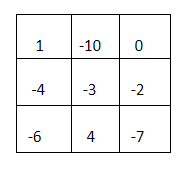
Answer
 Verified
662.1k+ views
Hint: Here we have a grid filled with integers. We check if the sum of elements of every row is equal to sum of elements of every column and equal to sum of elements of every diagonal. If all the sums are equal to the same constant, we say it is a magic square.
* A magic square of order \[n\] is an arrangement of \[{n^2}\] distinct numbers such that sum of \[n\] numbers in every row, sum of \[n\] numbers in every column and sum of \[n\] numbers in every diagonal sum to the same constant.
Complete step by step solution:
To solve the magic square we allot names to all rows, all columns and both diagonals to make calculations easier.
Say, the first row is denoted by \[{R_1}\] , second row by \[{R_2}\] and third row by \[{R_3}\].
Similarly, first column is denoted by \[{C_1}\] , second column by \[{C_2}\] and third column by \[{C_3}\]
Diagonal from top left to bottom right be denoted by \[{D_1}\] and diagonal from top right to left bottom by \[{D_2}\]
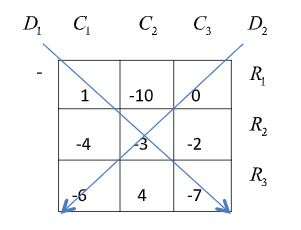
Elements of \[{R_1}\] are \[1, - 10,0\]
Therefore, sum of elements of \[{R_1}\] is \[(1) + ( - 10) + (0) = 1 - 10 = - 9\]
Elements of \[{R_2}\] are \[ - 4, - 3, - 2\]
Therefore, sum of elements of \[{R_2}\] is \[( - 4) + ( - 3) + ( - 2) = - (4 + 3 + 2) = - 9\]
Elements of \[{R_3}\] are \[ - 6,4, - 7\]
Therefore, sum of elements of \[{R_3}\] is \[( - 6) + (4) + ( - 7) = 4 - (6 + 7) = 4 - 13 = - 9\]
Elements of \[{C_1}\] are \[1, - 4, - 6\]
Therefore, sum of elements of \[{C_1}\] is \[(1) + ( - 4) + ( - 6) = 1 - (6 + 4) = 1 - 10 = - 9\]
Elements of \[{C_2}\] are \[ - 10, - 3,4\]
Therefore, sum of elements of \[{C_2}\] is \[( - 10) + ( - 3) + (4) = 4 - (10 + 3) = 4 - 13 = - 9\]
Elements of \[{C_3}\] are \[0, - 2, - 7\]
Therefore, sum of elements of \[{C_3}\] is \[(0) + ( - 2) + ( - 7) = - (2 + 7) = - 9\]
Elements of \[{D_1}\] are \[1, - 3, - 7\]
Therefore, sum of elements of \[{D_1}\] is \[(1) + ( - 3) + ( - 7) = 1 - (3 + 7) = 1 - 10 = - 9\]
Elements of \[{D_2}\] are \[0, - 3, - 6\]
Therefore, sum of elements of \[{D_2}\] is \[(0) + ( - 3) + ( - 6) = - (3 + 6) = - 9\]
Clearly sum or elements of each row is \[ - 9\].
Sum of elements of each column is \[ - 9\] .
And the sum of elements of each diagonal is \[ - 9\] .
Since, numbers in each row, numbers in each column and numbers in each diagonal sum up to the same constant i.e. \[ - 9\]
Therefore this arrangement of numbers in the form of a grid is a magic square.
Note:
Students should be aware of the meaning of terms ‘Rows’ and ‘Columns’ as it can create confusion sometimes. A Row is the horizontal data arrangement and a column is the vertical data arrangement.
* Generally, a magic square has all elements as positive distinct numbers, then constant sum is called ‘Magic constant’ or ‘Magic sum’ and is denoted by \[M\] and is calculated by the formula \[M = \dfrac{{n({n^2} + 1)}}{2}\], where \[n\] is the order of the square.
* A magic square of order \[n\] is an arrangement of \[{n^2}\] distinct numbers such that sum of \[n\] numbers in every row, sum of \[n\] numbers in every column and sum of \[n\] numbers in every diagonal sum to the same constant.
Complete step by step solution:
To solve the magic square we allot names to all rows, all columns and both diagonals to make calculations easier.
Say, the first row is denoted by \[{R_1}\] , second row by \[{R_2}\] and third row by \[{R_3}\].
Similarly, first column is denoted by \[{C_1}\] , second column by \[{C_2}\] and third column by \[{C_3}\]
Diagonal from top left to bottom right be denoted by \[{D_1}\] and diagonal from top right to left bottom by \[{D_2}\]
Elements of \[{R_1}\] are \[1, - 10,0\]
Therefore, sum of elements of \[{R_1}\] is \[(1) + ( - 10) + (0) = 1 - 10 = - 9\]
Elements of \[{R_2}\] are \[ - 4, - 3, - 2\]
Therefore, sum of elements of \[{R_2}\] is \[( - 4) + ( - 3) + ( - 2) = - (4 + 3 + 2) = - 9\]
Elements of \[{R_3}\] are \[ - 6,4, - 7\]
Therefore, sum of elements of \[{R_3}\] is \[( - 6) + (4) + ( - 7) = 4 - (6 + 7) = 4 - 13 = - 9\]
Elements of \[{C_1}\] are \[1, - 4, - 6\]
Therefore, sum of elements of \[{C_1}\] is \[(1) + ( - 4) + ( - 6) = 1 - (6 + 4) = 1 - 10 = - 9\]
Elements of \[{C_2}\] are \[ - 10, - 3,4\]
Therefore, sum of elements of \[{C_2}\] is \[( - 10) + ( - 3) + (4) = 4 - (10 + 3) = 4 - 13 = - 9\]
Elements of \[{C_3}\] are \[0, - 2, - 7\]
Therefore, sum of elements of \[{C_3}\] is \[(0) + ( - 2) + ( - 7) = - (2 + 7) = - 9\]
Elements of \[{D_1}\] are \[1, - 3, - 7\]
Therefore, sum of elements of \[{D_1}\] is \[(1) + ( - 3) + ( - 7) = 1 - (3 + 7) = 1 - 10 = - 9\]
Elements of \[{D_2}\] are \[0, - 3, - 6\]
Therefore, sum of elements of \[{D_2}\] is \[(0) + ( - 3) + ( - 6) = - (3 + 6) = - 9\]
Clearly sum or elements of each row is \[ - 9\].
Sum of elements of each column is \[ - 9\] .
And the sum of elements of each diagonal is \[ - 9\] .
Since, numbers in each row, numbers in each column and numbers in each diagonal sum up to the same constant i.e. \[ - 9\]
Therefore this arrangement of numbers in the form of a grid is a magic square.
Note:
Students should be aware of the meaning of terms ‘Rows’ and ‘Columns’ as it can create confusion sometimes. A Row is the horizontal data arrangement and a column is the vertical data arrangement.
* Generally, a magic square has all elements as positive distinct numbers, then constant sum is called ‘Magic constant’ or ‘Magic sum’ and is denoted by \[M\] and is calculated by the formula \[M = \dfrac{{n({n^2} + 1)}}{2}\], where \[n\] is the order of the square.

Recently Updated Pages
You are the head boyhead girl Write a notice informing class 7 english CBSE

The image formed by a plane mirror is always laterally class 7 physics CBSE
When phenolphthalein is added toNaOH the colour of class 7 chemistry CBSE
Find the least number which when divided by 15 leaves class 7 maths CBSE
Show that one and only one out of n n + 2n or n + -class-7-maths-CBSE
During heavy exercise we get cramps in the legs due class 7 biology CBSE
Trending doubts
Full Form of IASDMIPSIFSIRSPOLICE class 7 social science CBSE
List of coprime numbers from 1 to 100 class 7 maths CBSE
The plural of Chief is Chieves A True B False class 7 english CBSE
Collective noun a of sailors class 7 english CBSE
Write a short note on the great bath of MohenjoDar class 7 social science CBSE
What three things did Gopal do before going to buy class 7 english CBSE